
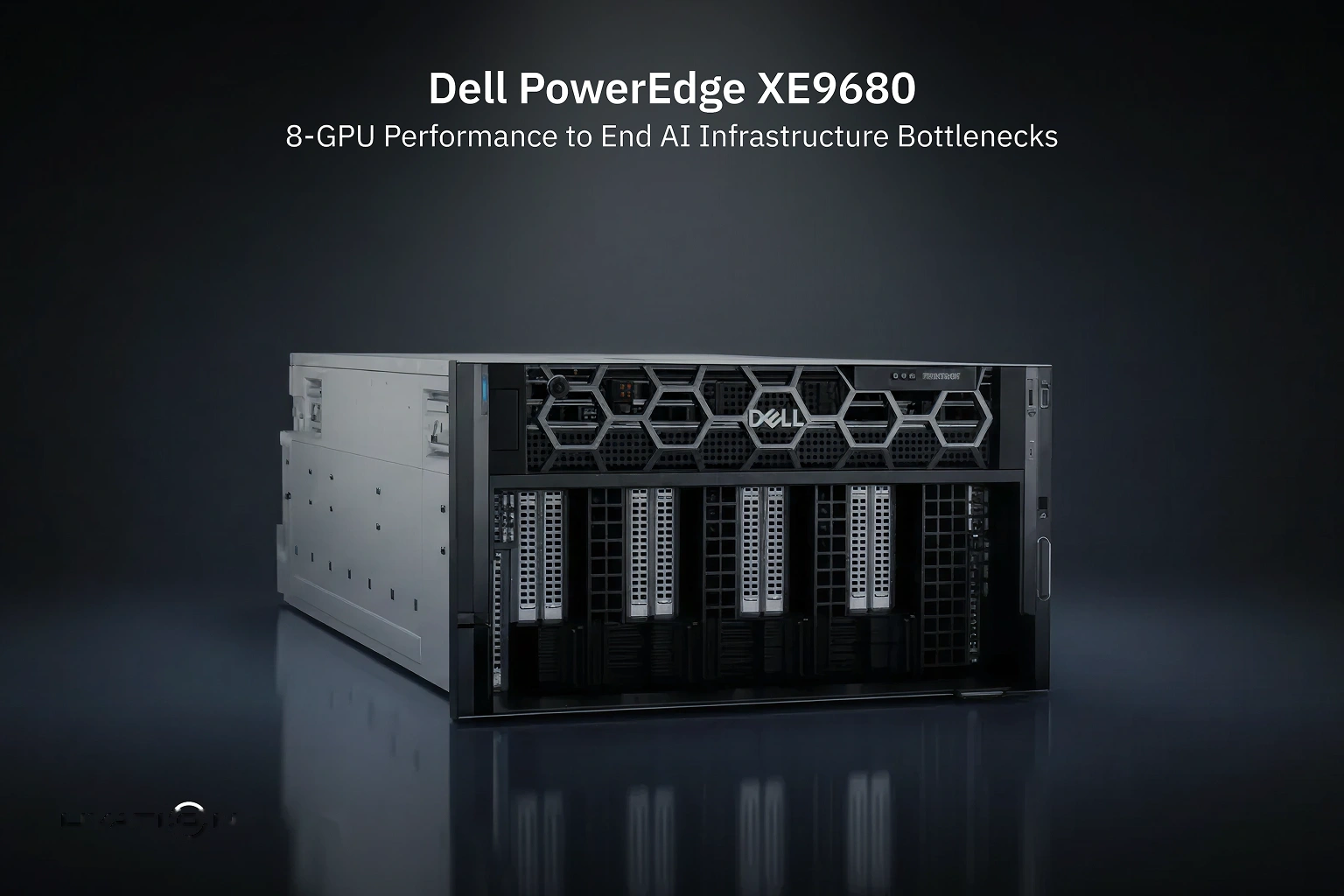
By the end of 2025, Gartner predicts that over 60% of AI projects will fail to move beyond pilot stages, not because of model limitations, but due to infrastructure bottlenecks. Training and deploying large models like Llama 3.1 or GPT-style multimodal systems requires servers capable of handling massive compute density, ultra-fast interconnects, and terabytes of shared GPU memory bandwidth. The Dell PowerEdge XE9680 is engineered to specifically meet that challenge: a flagship 8-GPU, 6U server that enables enterprises to move from experimental AI to full-scale production with minimal friction. Designed around next-generation CPUs, high-bandwidth memory, and flexible accelerator choices, the XE9680 brings together computational performance and operational efficiency to deliver what modern GenAI workflows demand:
- Faster model training across multi-node clusters
- Lower inference latency for production-grade responsiveness
- Freedom to choose between NVIDIA, AMD, or Intel accelerators without redesigning your infrastructure
As organizations scale from fine-tuning compact models to hosting trillion-parameter architectures, the XE9680 offers a unified foundation capable of handling the entire AI lifecycle, from data preprocessing to inference delivery.
In this blog, we’ll explore how Dell’s XE9680 performs under real-world conditions, breaking down its architectural design, benchmark results, power efficiency, and practical decision framework to help enterprises identify whether this server aligns with their AI roadmap.
01Architecture That Powers Modern AI Training
Every element of the Dell PowerEdge XE9680’s architecture is built to sustain high-performance AI operations, from model training to multi-GPU inference. This section breaks down the underlying compute, memory, and accelerator design that defines its benchmark performance.
02CPU, Memory, and I/O Core
At the compute layer, the XE9680 uses dual 4th or 5th Gen Intel Xeon Scalable processors, offering up to 64 cores per socket. These CPUs deliver a stable foundation for high parallel workloads, ensuring predictable scaling during intensive AI training cycles. Memory bandwidth is another key factor. The system supports up to 4TB of DDR5 RDIMM with speeds up to 5600 MT/s, significantly reducing latency when shuttling large datasets and intermediate tensors between CPU and GPU memory. For I/O and storage, the server features PCIe Gen 5.0 lanes and supports up to 16 E3.S NVMe direct drives, offering as much as 122.88 TB of storage capacity. This architecture ensures rapid access to model checkpoints, datasets, and temporary cache — all essential for sustained throughput and low-latency AI pipelines. Together, these capabilities translate to higher throughput, faster data movement, and consistent low-latency access. the attributes critical for AI training, HPC modeling, and real-time analytics.
03Flexible 8-Way GPU Ecosystem
Where the XE9680 truly distinguishes itself is in its accelerator flexibility. Unlike fixed GPU server designs, Dell enables enterprises to choose the right accelerator for their AI roadmap, whether that’s training LLMs, computer vision models, or running high-frequency inference workloads.
The XE9680’s agnostic GPU design supports up to 1.5TB of shared coherent GPU memory, enabling large-scale model parallelism without excessive inter-node communication overhead. This design allows organizations to future-proof their AI infrastructure, switching between accelerators as frameworks evolve, all without changing the base server architecture.
04Benchmark Insights from AI Training to Inference
Performance benchmarks are where the Dell PowerEdge XE9680 proves its value in actual AI and HPC workloads that reflect what enterprises run every day. Whether it’s large-scale AI training, HPC modeling, or inference-heavy analytics, Dell’s flagship server consistently lands near the top of industry benchmarks. Let’s break down how it performs across different dimensions.
05AI Training and Throughput Analysis
The XE9680’s 8-GPU configuration delivers exceptional results in MLPerf Training benchmarks, particularly in workloads such as image classification, BERT pre-training, and GPT-style transformer models. In Dell’s internal tests and MLPerf submissions, XE9680 systems populated with NVIDIA H100 SXM5 GPUs achieved:
- Up to 1.8× faster BERT pre-training compared to previous-generation XE8545 systems.
- Linear scaling when moving from 4 to 8 GPUs, demonstrating minimal communication bottlenecks thanks to NVSwitch + NVLink 4.0 integration.
- Sustained GPU utilization above 95% under full thermal load, a result of Dell’s balanced airflow and liquid-assisted cooling.
These metrics translate to shorter training cycles, reduced cost per model iteration, and improved energy efficiency, all crucial for teams running continuous model retraining.
06Inference and Real-Time Performance
Inference efficiency often gets less attention than training performance, but in production settings, it determines total cost and user experience. On the XE9680, inference workloads (such as BERT, DLRM, and ResNet-50) show:
- Up to 2× higher inference throughput using H100 GPUs with Transformer Engine optimizations.
- FP8 precision support, which cuts latency while preserving accuracy, ideal for real-time recommendation systems or conversational AI deployments.
- The ability to deploy multiple inference pipelines concurrently across GPUs, maintaining consistent sub-millisecond response times.
This performance edge makes the XE9680 particularly effective for enterprises deploying hybrid AI stacks, where training and inference need to coexist within the same data center.
07Multi-Node Scaling and Networking Efficiency
AI at scale is no longer about single-node performance. What matters is how efficiently a server scales across nodes in a cluster. The XE9680 supports InfiniBand NDR and 100/200/400 GbE fabrics, allowing it to interconnect seamlessly with high-bandwidth, low-latency environments. In distributed training tests:
- Scaling efficiency remains above 90% across 32+ nodes.
- Native integration with NVIDIA GPUDirect RDMA reduces CPU intervention, minimizing communication overhead.
- Optional Intel Gaudi 3 accelerators leverage built-in RoCE v2 Ethernet interfaces, simplifying multi-node scaling without needing additional NICs.
For teams managing large model training or reinforcement learning clusters, these efficiencies mean shorter synchronization windows and reduced idle GPU time, leading to measurable cost savings over extended runs.
08Operational Economics of Running AI at Scale
When you scale GenAI infrastructure, every watt and every dollar count. The Dell PowerEdge XE9680 stands out not just for raw GPU horsepower but for how efficiently it sustains that performance at scale. It’s built for organizations that want data center-grade acceleration without compromising energy discipline, manageability and total cost of ownership.
09Power Efficiency and Economics
Even with eight high-wattage GPUs, the XE9680 maintains impressive energy discipline. A full configuration with 8× NVIDIA H100 SXM GPUs draws about 5,586W, while AMD MI300X setups consume slightly more at ~750W per GPU. Across a six-server rack (~60kW), that translates into 816 concurrent users and a projected five-year TCO of ~$7.6 million. Where Dell shines is flexibility:
- NVIDIA configurations deliver the best performance-per-watt for inference-heavy workloads.
- AMD MI300X variants offer 10–20% acquisition savings, plus higher 192GB HBM3 memory per GPU, ideal for large-model training.
In short, XE9680 gives organizations control over the performance-cost tradeoff, a balance few dense GPU platforms achieve at this scale.
10Operational Management and Security
XE9680’s can be managed and secured in enterprise environments. With iDRAC9 and OpenManage Enterprise, administrators can monitor thermals, update firmware, and automate lifecycle management remotely, reducing manual maintenance cycles. Security is anchored in Dell’s Cyber Resilient Architecture, combining a Silicon-based Root of Trust, TPM 2.0, and cryptographically signed firmware to safeguard against tampering or unauthorized changes. For enterprises handling sensitive AI or defense workloads, that means compliance-ready protection without sacrificing uptime or manageability. Whether your focus is training frontier models or scaling real-time inference, the platform gives you performance you can actually afford to run continuously.
11Is the Dell PowerEdge XE9680 the Right Fit for Your AI Ambitions?
After examining its performance, architecture, and efficiency, the next logical question is which XE9680 configuration aligns best with your AI goals? Dell’s real strength lies in choice. With support for NVIDIA, AMD, and Intel accelerators on the same platform, the XE9680 allows enterprises to tailor configurations based on model size, latency needs, and cost constraints. Below is a decision framework to help evaluate which setup delivers the best outcome for your specific workload priorities.
If your organization runs LLM training pipelines, the AMD MI300X setup offers unmatched memory and floating-point performance. For production inference, NVIDIA Hopper GPUs remain the clear leaders due to their mature CUDA stack and precision efficiency. If your goal is to scale flexibly across multiple workloads, Intel Gaudi 3 presents a balanced price-to-performance proposition with simplified networking.
12Deploying Dell PowerEdge XE9680 with Semifly Marketplace
You don’t need to build your XE9680 environment from scratch. Semifly helps enterprises deploy, integrate, and optimize Dell PowerEdge XE9680 systems so you can focus on innovation, not configuration.
- Pre-validated Configurations: We deliver XE9680 setups tested for real AI and HPC workloads, ready to plug into your environment.
- Seamless Integration: From NVSM and Slurm to Prometheus or Grafana, we ensure your XE9680 fits smoothly into existing monitoring and orchestration stacks.
- Performance Validation: Multi-node stress tests and GPU interconnect checks confirm your system performs reliably under peak loads.
- Operational Enablement: We provide training, documentation, and 24/7 support to keep your infrastructure optimized long-term.
Get a Free Infrastructure Consultation: Schedule a quick call with Semifly’s AI infrastructure specialists to evaluate your XE9680 deployment and receive tailored guidance for your workloads.
13Final Word
The Dell PowerEdge XE9680 stands as one of the most capable AI and HPC servers available today, combining dense compute power, scalable GPU architecture, and precision-engineered thermal design. Whether you’re training billion-parameter models or running large-scale simulations, its flexibility and sustained performance make it a long-term investment in enterprise AI readiness. The XE9680 gives organizations the freedom to evolve, adapt, and stay hardware-agnostic while maximizing ROI. If you’re evaluating next-generation infrastructure or planning to upgrade your current setup, Semifly can help you translate these capabilities into measurable business outcomes.
← Back to Insights