• FEATURED STORY OF THE WEEK

      H200 GPU for AI Model Training: Memory Bandwidth & Capacity Benefits Explained

      Written by :  
      semifly
      Team Semifly
      4 minute read
      July 24, 2025
      Category : Cybersecurity
      H200 GPU for AI Model Training: Memory Bandwidth & Capacity Benefits Explained
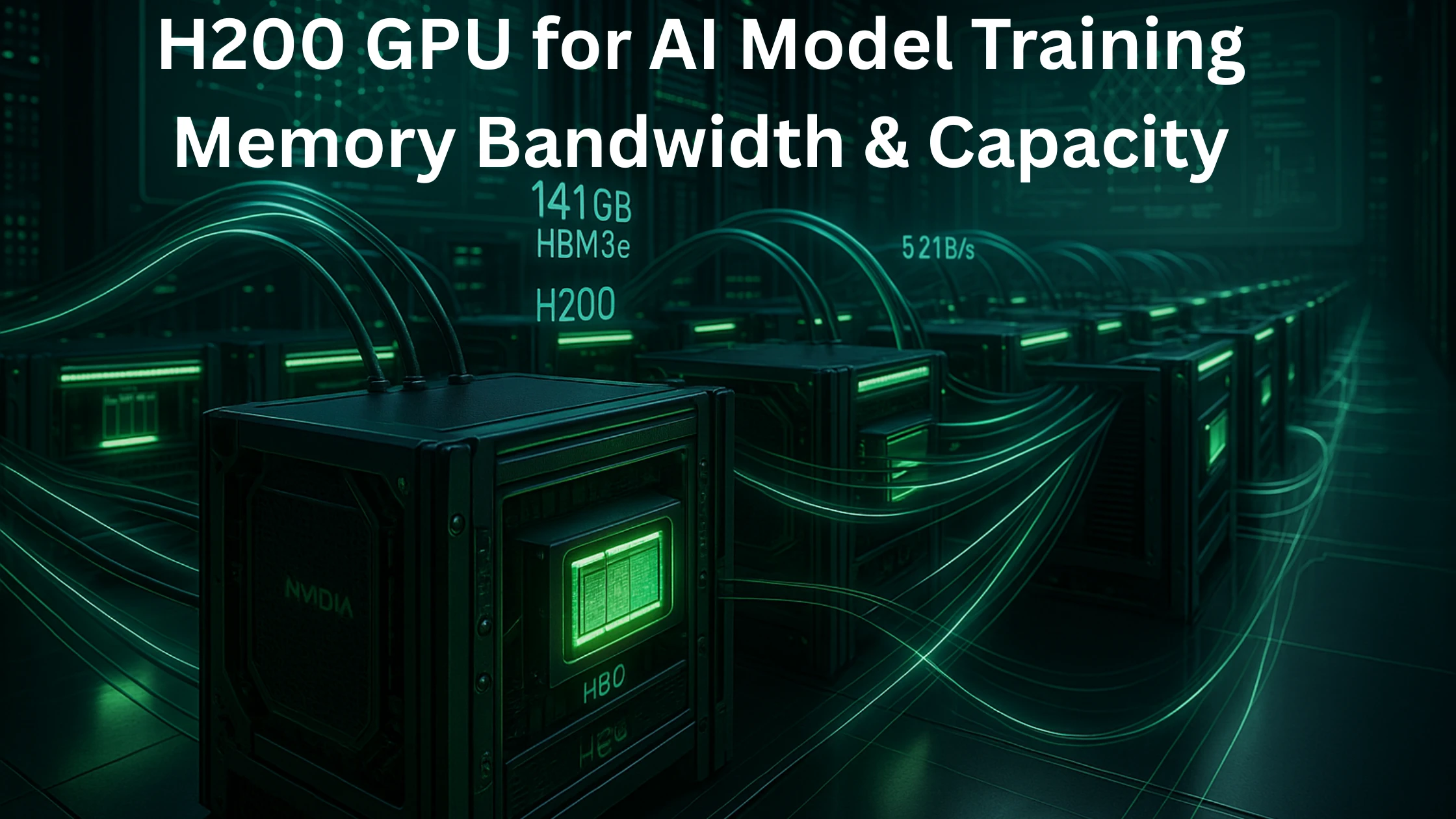
      What Makes the H200 GPU Ideal for High-Performance Model Training


      In modern AI pipelines, compute power alone is no longer the bottleneck. Teams training large models like LLaMA-65B or GPT-3 are discovering that memory bandwidth and capacity are now the new ceilings.


      Take this real example: A team fine-tuning a LLaMA-65B model on H100 GPUs experienced sluggish training cycles and frequent memory-related checkpoints. After upgrading to H200s, they saw uninterrupted execution and smoother epochs. What changed? 141 GB of HBM3e memory and 5.2 TB/s bandwidth.


      With increasing token windows and growing model sizes, the H200 delivers not just performance but memory headroom critical for modern training.
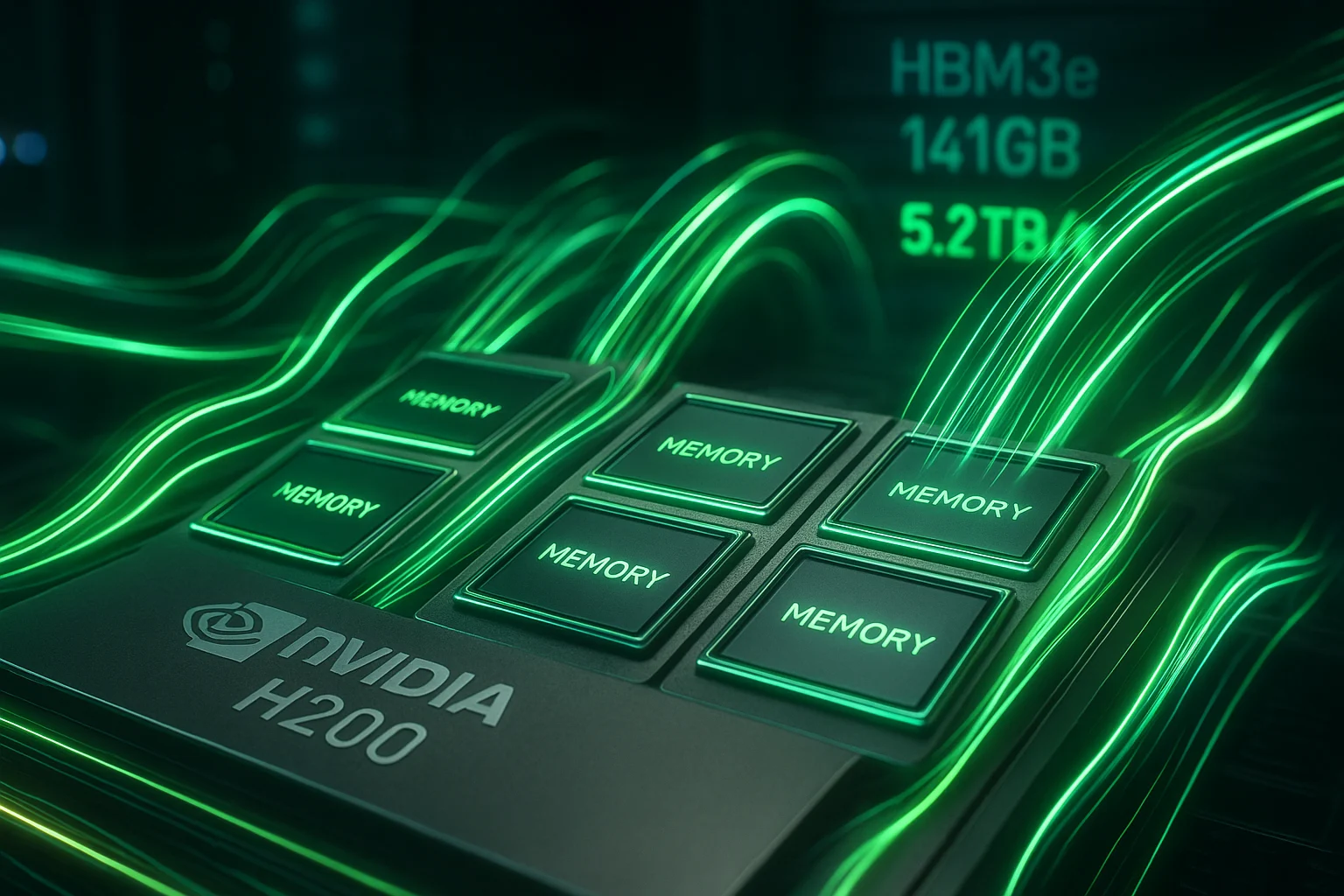
       

      NVIDIA H200 GPU memory modules with glowing data streams showing high bandwidth.


      What’s the Memory Difference Between H200 and H100 GPUs?


      Table 1 – GPU Memory Architecture Comparison

      GPU Memory Type Capacity Peak Bandwidth Transformer Engine Launch Year
      H100 HBM3 80 GB 3.35 TB/s Gen 1 2022
      H200 HBM3e 141 GB 5.2 TB/s Gen 2 2024


      Explore full specs: Semifly NVIDIA H200 Servers


      How Does HBM3e Bandwidth Improve Transformer Model Training Speed?


      Transformer models rely heavily on memory bandwidth. During backpropagation, matrices are accessed repeatedly. H200’s 5.2 TB/s bandwidth reduces memory fetch latency, allowing more consistent token throughput and fewer stalls.


      This is crucial when using FP8 precision and sparse matrix optimizations enabled by the Gen 2 Transformer Engine.
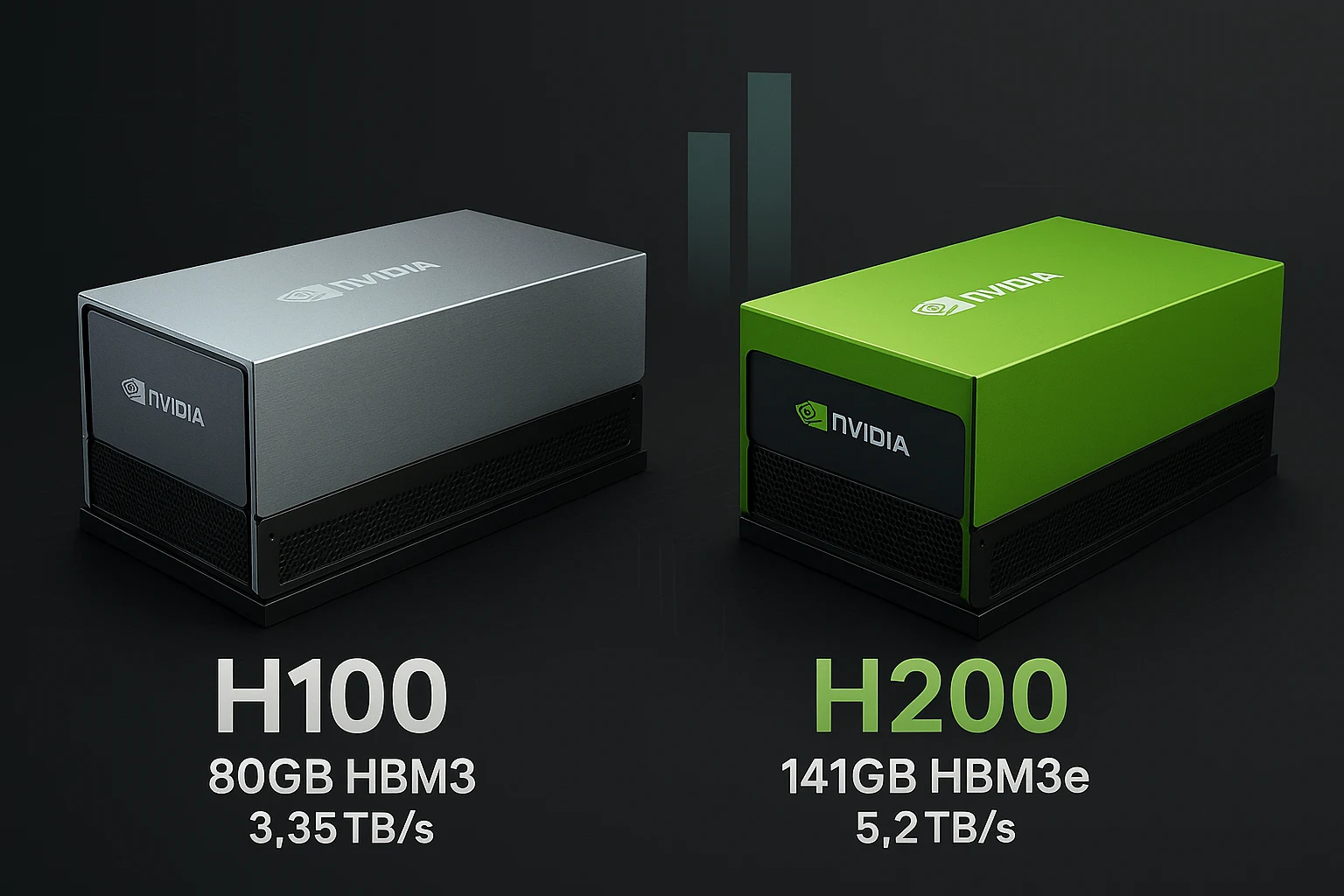
       

      Side-by-side H100 vs H200 GPU memory and bandwidth comparison graphic.


      How Much Memory Do Large Models Like LLaMA-65B Require?


      LLaMA-65B is becoming a go-to foundation model for enterprises due to its balance between performance and inference cost. But at 65 billion parameters, its training memory requirement (~130 GB in FP16) exceeds the 80 GB limit of H100.


      Table 2 – Model Size vs Memory Residency (Training Phase)


      Model Params FP16 Memory Req Fits in H100? Fits in H200?
      GPT-3 (175B) 175B 350 GB No No (multi-GPU)
      LLaMA 65B 65B ~130 GB No Yes
      Mistral 7B 7B ~14 GB Yes Yes


      H100 vs H200: What’s the Real Throughput Gain for Training?


      Switching from H100 to H200 doesn’t just mean bigger memory. It unlocks faster epochs and improved batching.


      Table 3 – Training Throughput Comparison


      Model GPU Tokens/sec Epoch Time (hrs) Memory Used
      LLaMA 65B H100 5,000 9.2 78 GB
      LLaMA 65B H200 9,300 4.8 129 GB


      Insight: Upgrading to H200 nearly halves epoch time with room to scale sequences up to 128K tokens.


      What Are the Memory Bottlenecks in Multi-GPU AI Training?


      In H100-based clusters, teams often rely on gradient checkpointing and weight sharding due to RAM constraints. This leads to:


      • Increased inter-GPU sync latency
      • Higher power and rack usage
      • Model truncation for large datasets


      One NLP team cut training time by 35% after switching to H200s and removing checkpointing logic entirely.


      How to Track Memory Saturation in PyTorch (Code Snippet)


      import torch
      print(“Max Memory Used (GB):”, torch.cuda.max_memory_allocated() / 1e9)

      This quick diagnostic helps track saturation during training.


      Explore Semifly’s AI Infrastructure Consulting


      How Semifly Helps Enterprises Optimize H200 Memory Efficiency


      We don’t just deliver hardware. Semifly offers:


      • Memory-aware model-to-cluster sizing
      • DGX-H200 clusters with NVLink fabric
      • Pre-built Triton and NeMo training stacks
      • Observability dashboards for GPU cost modeling


      Book a memory profiling session: Contact Us
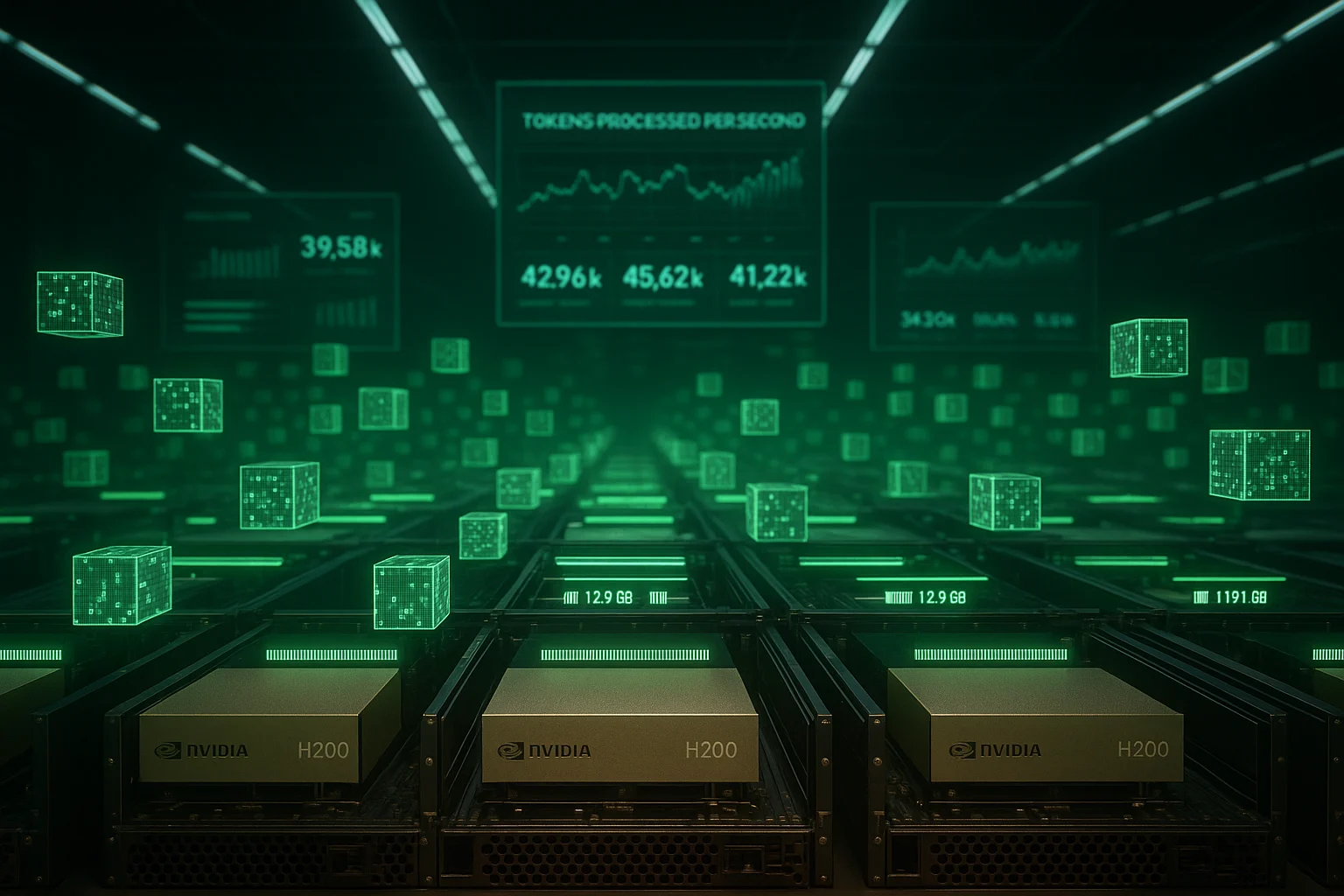
       

      Multiple NVIDIA H200 GPUs processing LLaMA-65B tokens inside AI training datacenter.


      Should You Upgrade to H200 or Stay with H100?


      Table 4 – GPU Selection Matrix by Use Case


      Workload Type Priority Best GPU Reason
      GenAI Inference Latency < 100 ms H200 Larger memory + fast tokens
      Foundation Model Training High throughput H100 (multi-GPU) Cheaper scale out
      65B+ Fine-tune Memory capacity H200 141 GB can host full model


      Get Started – Turnkey H200 Clusters by Semifly


      Semifly delivers:


      • Pre-validated DGX-H200 clusters
      • Training-ready environments with FP8 optimizations
      • Full observability stack with memory dashboards


      CTA: Ready to eliminate memory bottlenecks? Request an H200 simulation today.
       

      Bookmark me
      Share on
      Comments
      Add your Comment

      Writing About AI

      Semifly

      is an engineer and a technologist with a diverse background spanning software, hardware, aerospace, defense, and cybersecurity. As CTO at Semifly, he leverages his extensive experience to lead the company’s technological innovation and development.

      Explore Nvidia’s GPUs

      Find a perfect GPU for your company etc etc
      Go to Shop

      FAQs

      • The H200 GPU is ideal because it directly addresses the new bottlenecks in modern AI pipelines: memory bandwidth and capacity. While compute power was once the primary constraint, large models like LLaMA-65B and GPT-3 now frequently hit limitations related to memory. The H200 offers a significant upgrade with 141 GB of HBM3e memory and 5.2 TB/s bandwidth, providing the necessary headroom for uninterrupted and efficient training cycles, especially with increasing token windows and growing model sizes.

      • The main differences lie in memory type, capacity, and bandwidth. The H100 uses HBM3 memory, offering 80 GB capacity and 3.35 TB/s bandwidth. In contrast, the H200 features more advanced HBM3e memory, providing a significantly larger 141 GB capacity and a faster 5.2 TB/s bandwidth. The H200 also includes a Gen 2 Transformer Engine, an upgrade from the H100’s Gen 1, further enhancing its capabilities for demanding AI workloads.

      • Transformer models are highly reliant on memory bandwidth, particularly during backpropagation where matrices are repeatedly accessed. The H200’s 5.2 TB/s HBM3e bandwidth significantly reduces memory fetch latency. This allows for more consistent token throughput and fewer processing stalls, leading to faster training. This enhanced bandwidth is particularly crucial when utilising advanced features like FP8 precision and sparse matrix optimisations, which are enabled by the H200’s Gen 2 Transformer Engine.

      • Large models like LLaMA-65B require substantial memory for training. For instance, LLaMA-65B, with 65 billion parameters, needs approximately 130 GB of memory when using FP16 precision. This exceeds the 80 GB capacity of the H100, meaning it cannot fully reside in its memory. GPT-3 (175B parameters) requires even more, around 350 GB in FP16, necessitating a multi-GPU setup even with the H200. The H200’s 141 GB capacity allows LLaMA-65B to fit entirely in its memory, which is a significant advantage.

      • Upgrading from an H100 to an H200 yields substantial throughput gains, leading to faster epoch times and improved batching. For a LLaMA-65B model, an H100 can achieve approximately 5,000 tokens/sec with an epoch time of 9.2 hours, using 78 GB of memory. The H200, however, can nearly double the throughput to 9,300 tokens/sec, reducing the epoch time to 4.8 hours, while utilising 129 GB of its memory. This demonstrates a near 50% reduction in epoch time, with further room to scale sequences.

      • In H100-based clusters, memory constraints often force teams to implement techniques like gradient checkpointing and weight sharding. These workarounds introduce several bottlenecks: increased inter-GPU synchronisation latency, higher power consumption, greater rack usage, and the potential for model truncation when dealing with large datasets. By contrast, the H200’s larger memory capacity can eliminate the need for such complex logic, significantly reducing training times and improving efficiency, as seen by one NLP team cutting training time by 35% after switching.

      • Semifly provides comprehensive support to help enterprises optimise H200 memory efficiency beyond just hardware delivery. Their services include memory-aware model-to-cluster sizing, deployment of DGX-H200 clusters with NVLink fabric for high-speed interconnects, and pre-built training stacks like Triton and NeMo. They also offer observability dashboards for GPU cost modelling and memory profiling sessions, ensuring that organisations can effectively manage and monitor their GPU resources to maximise the H200’s capabilities.

      • The decision to upgrade depends on the specific workload. For GenAI inference requiring latency below 100 ms, the H200 is preferred due to its larger memory and faster token processing. For foundation model training focused on high throughput, multi-GPU H100 setups can be a more cost-effective scale-out solution. However, for fine-tuning 65B+ models where memory capacity is critical, the H200 is the superior choice because its 141 GB can host the full model, eliminating memory bottlenecks. Semifly offers advisors to simulate usage patterns and validate the best GPU choice for specific needs.

      Disclaimer: All performance figures, memory capacities, bandwidth rates, and model training statistics mentioned in this blog are based on publicly available specifications, internal benchmarks, and observed customer use cases at the time of publication. Actual performance may vary depending on workload type, system configuration, software stack, and deployment environment. NVIDIA®, H100, and H200 are trademarks of NVIDIA Corporation. Semifly does not guarantee exact replication of results, and recommends consulting our technical advisors for workload-specific planning.


      More Similar Insights and Thought leadership

      No Similar Insights Found

      semifly
      About Us