
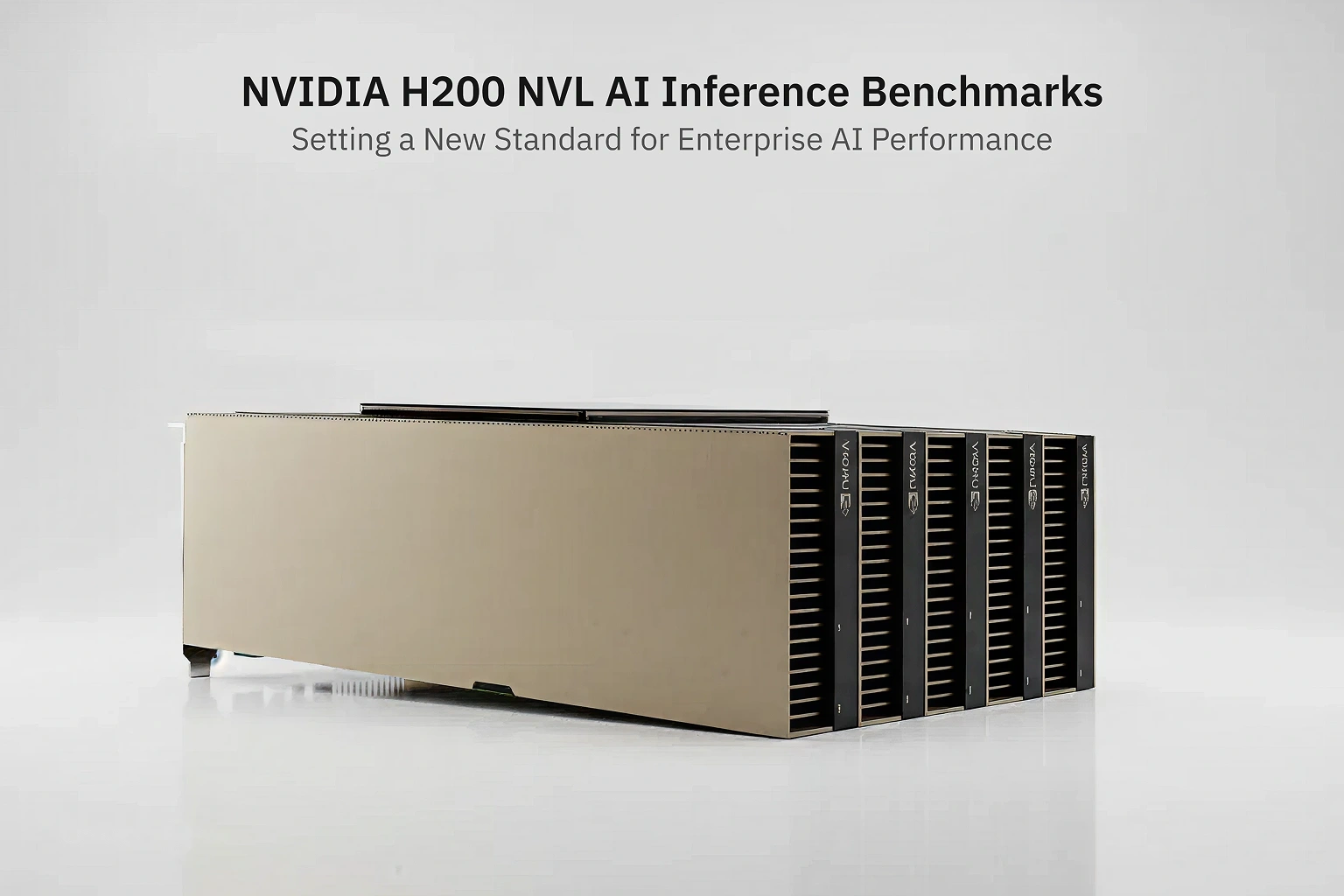
Enterprises are accelerating their adoption of large language models, computer vision systems, and analytics workloads that demand faster and more efficient inference. As AI workloads grow in complexity and scale, the need for higher throughput, lower latency, and energy-efficient processing has become a central concern for data center leaders. Many organizations face the challenge of balancing computational power with operating costs and infrastructure constraints.
How can enterprises achieve this balance while maintaining reliable performance across large AI workloads? The NVIDIA H200 NVL GPU addresses this challenge through advanced memory capacity, improved bandwidth, and high interconnect efficiency designed for sustained inference workloads in modern AI servers. This blog explores H200 NVL AI inference benchmarks in detail, examining what the data reveals about its performance, efficiency, and the implications for enterprise infrastructure planning.
011. Understanding the H200 NVL Architecture
The NVIDIA H200 NVL GPU represents a major step forward in AI inference performance and efficiency. Its design focuses on faster data movement, higher memory capacity, and improved interconnect performance, all essential for running large models in enterprise AI servers. To understand its impact, it is useful to look at two key aspects: how it achieves high-throughput inference and how it supports flexible deployment across different data center configurations.
02Built for High-Throughput Inference
At the core of the H200 NVL’s performance is NVLink, NVIDIA’s high-speed interconnect technology. NVLink allows direct communication between GPUs without routing data through the CPU, reducing latency and improving overall throughput. Each H200 NVL GPU pair connects through fourth-generation NVLink with data transfer speeds of up to 900 GB/s, creating an efficient communication pathway for complex AI workloads. This design allows GPUs to share data faster, which is crucial for large language model inference and real-time analytics.
The H200 NVL features 141 GB of HBM3e memory, a substantial increase from the H100’s 80 GB HBM3. This expansion enables larger AI models to fit entirely within GPU memory. This reduces the need for model partitioning or frequent memory swaps. With a memory bandwidth of 4.8 TB/s, the H200 NVL can handle heavy inference workloads with consistent speed and stability.
These architectural improvements allow enterprises to deploy AI servers that can sustain higher inference throughput across multiple workloads, whether running chat-based assistants, document summarization tools, or computer vision pipelines.
03AI Server Configurations and Deployment Flexibility
Enterprises can deploy the H200 NVL in several configurations based on workload needs. A common setup includes dual H200 NVL pairs, where two GPUs are linked via NVLink to function as a high-speed compute unit. Larger deployments can scale up to 8-GPU systems, forming powerful inference clusters that support concurrent model execution and low-latency responses.
These configurations allow data center teams to align performance with specific AI workloads. For example, smaller configurations are suitable for lightweight inference tasks, while multi-GPU clusters serve enterprise-scale LLM or generative AI workloads that require continuous processing. The H200 NVL’s design also supports mixed GPU environments, allowing organizations to extend their existing infrastructure without major architectural changes.
In enterprise AI servers, this flexibility translates to better workload distribution, consistent performance under heavy traffic, and higher overall utilization of compute resources. The result is an AI infrastructure that delivers faster inference results and improved efficiency without overhauling existing systems.
042. Benchmarking H200 NVL for AI Inference Performance
H200 NVL AI inference benchmarks are essential for assessing how well these GPUs handle real-world workloads such as large language models, image recognition, and recommendation systems. The NVIDIA H200 NVL has undergone extensive performance testing across these workloads to validate its efficiency, throughput, and reliability in enterprise AI servers.
05Benchmark Overview and Test Methodology
The MLPerf Inference benchmark is an industry-standard suite used to evaluate GPU performance across a variety of AI workloads. It measures how efficiently a GPU performs inference tasks — the process of running trained AI models to generate predictions or outputs. MLPerf provides a consistent framework to compare hardware platforms using standardized datasets and performance criteria.
In the H200 NVL AI inference benchmarks, tests covered different precision modes, including FP8 and FP16, which define the level of numerical accuracy used in computations. FP8 mode supports faster inference speeds by using lower precision, while FP16 provides higher numerical accuracy for sensitive workloads. The benchmarks included a range of model categories:
Large Language Models (LLMs) such as GPT and Llama variants.
Computer Vision Models used in image classification and detection.
Recommendation Models that support real-time personalization and search applications.
Performance metrics focused on latency (response time per query) and throughput (inferences per second). These indicators determine how effectively a GPU can manage concurrent requests and maintain response speed under production workloads.
06Benchmark Results Across Key Workloads
Benchmark data show the H200 NVL delivering a strong improvement in inference performance compared to the H100 PCIe and SXM configurations.
In LLM inference, the H200 NVL achieved up to 1.8x higher performance over the H100 PCIe, largely due to its larger memory and higher bandwidth. This allows entire models to stay in GPU memory during inference, minimizing communication overhead.
For vision and recommender workloads, the H200 NVL demonstrated substantial latency reductions when processing concurrent inference streams. This improvement ensures consistent response times even when models are handling thousands of simultaneous queries.
In addition, the H200 NVL recorded higher performance-per-watt, which measures how much computation is achieved per unit of energy consumed. This metric is critical for enterprises managing operational efficiency and sustainability goals.
Together, these benchmarks confirm the H200 NVL’s suitability for both large-scale inference deployments and mixed workload environments.
07Interpreting the Numbers: What They Mean for Enterprises
For enterprises, benchmark results translate directly into measurable operational advantages. Faster inference means lower wait times for AI-driven services, from chat-based applications to automated analytics. This efficiency also reduces the number of GPUs required for a given workload, leading to lower infrastructure and power costs.
The H200 NVL’s 141 GB of HBM3e memory allows enterprises to run larger models without partitioning them across multiple GPUs. This simplifies data management and improves model stability during inference. In addition, NVLink interconnect performance enables effective multi-GPU scaling, which is vital for high-volume generative AI workloads that depend on fast GPU communication.
083. Comparing H200 NVL to Previous Generations
The NVIDIA H200 NVL builds on the foundation set by the H100 series but introduces architectural refinements that make it better suited for sustained AI inference workloads. Understanding how it differs from its predecessor helps enterprises make informed decisions about upgrading their GPU infrastructure.
09H100 vs. H200 NVL: Performance and Power
The H200 NVL represents a major architectural improvement over the H100 series, primarily in memory, interconnect speed, and energy efficiency. While both GPUs are built on the Hopper architecture, the H200 NVL introduces HBM3e memory, which increases memory capacity to 141 GB per GPU and boosts memory bandwidth to 4.8 TB/s. In contrast, the H100 is limited to 80 GB of HBM3 memory with a maximum bandwidth of around 3.35 TB/s. This expanded capacity allows the H200 NVL to handle much larger AI models entirely within GPU memory, reducing data movement and improving inference consistency.
Another important difference lies in NVLink bandwidth. The H200 NVL features a fourth-generation NVLink with higher interconnect speeds, improving GPU-to-GPU communication efficiency. This directly benefits large-scale inference tasks where multiple GPUs must exchange data rapidly, such as in LLM and recommender system deployments.
From a power and cost perspective, the H200 NVL offers stronger performance-per-watt than the H100 PCIe variant, resulting in reduced energy costs for continuous AI inference operations. Enterprises evaluating total cost of ownership (TCO) will find the H200 NVL more efficient, as it delivers higher sustained throughput for the same or lower energy footprint.
These combined advantages—greater memory, faster interconnects, and higher efficiency—make the H200 NVL better equipped for workloads that demand consistent performance across long operational cycles.
10SXM vs. NVL Form Factors
The SXM and NVL form factors each offer distinct strengths for enterprise deployment. The SXM configuration is designed for high-density data centers where thermal management and compact compute clusters are key considerations. It connects GPUs through an integrated baseboard and typically supports higher power limits per GPU, offering peak performance in training and mixed workloads.
The NVL form factor, by comparison, is designed specifically for inference workloads. It consists of two GPUs connected through NVLink as a matched pair, supporting direct GPU-to-GPU communication without the need for a CPU intermediary. This design enhances throughput for inference tasks while simplifying deployment in traditional server chassis. NVL pairs can be scaled up to 8-GPU systems, delivering strong performance for inference-heavy applications.
When deciding between SXM and NVL, enterprises should consider workload type and data center design. SXM systems are well-suited for AI model training and hybrid workloads that require maximum compute density. NVL configurations, on the other hand, provide a more efficient balance of performance and power for inference-focused environments, especially when consistent, low-latency output is the priority.
114. Real-World Applications: Where H200 NVL Excels
The NVIDIA H200 NVL GPU delivers measurable performance improvements across real-world AI workloads that depend on fast and efficient inference. Its high memory capacity, NVLink bandwidth, and energy-efficient architecture make it especially well-suited for enterprise environments that demand both reliability and throughput.
12Generative AI and LLM Deployments
Generative AI and large language models require significant computational power during inference, particularly for interactive services such as chatbots, virtual assistants, and copilots. The H200 NVL’s 141 GB of HBM3e memory allows these large models to run entirely within GPU memory, reducing the latency often caused by data swapping between memory layers.
In recent MLPerf Inference benchmarks, the H200 NVL demonstrated up to 1.8x faster performance in LLM inference compared to the H100 PCIe configuration. This improvement allows enterprises to deliver AI-powered services with more consistent performance during high-demand periods. For customer-facing applications, this means smoother interactions and faster feedback loops without increasing infrastructure costs.
13Computer Vision
In manufacturing, healthcare, and security, computer vision applications rely on fast image recognition and classification. These workloads often involve processing large volumes of visual data in real time. The H200 NVL’s high memory bandwidth of 4.8 TB/s enables efficient handling of such workloads, allowing inference models to process images and video frames with minimal delay.
For medical imaging, for example, this performance allows AI systems to analyze complex scans quickly while maintaining diagnostic accuracy. In industrial environments, the same efficiency supports quality inspection systems that identify defects or anomalies instantly. By maintaining consistent inference performance under heavy data loads, the H200 NVL ensures that visual AI systems operate reliably and at scale.
14Recommendation Systems
Recommendation systems power personalization in retail, streaming, and digital platforms. These workloads depend on fast, parallel inference to analyze user behavior and make predictions in milliseconds. The H200 NVL’s NVLink interconnect supports high-speed data sharing between GPUs, which helps maintain low latency even as the number of concurrent recommendations grows.
Enterprises using AI servers equipped with the H200 NVL can process larger datasets with fewer delays, improving both user experience and operational efficiency. In high-traffic environments, this improvement directly supports faster recommendations, higher engagement, and more effective resource utilization within data centers.
15Balancing Cost Efficiency and Service-Level Performance
The architectural design of the H200 NVL allows organizations to balance computational efficiency with power consumption. Its superior performance-per-watt ratio helps reduce energy costs, while its large memory capacity minimizes the need for additional GPU resources. This balance is crucial for enterprises scaling AI workloads while managing total cost of ownership.
By improving throughput across diverse workloads—LLMs, computer vision, and recommendation engines—the H200 NVL provides enterprises with reliable inference performance at predictable cost levels. It is well-suited for organizations aiming to build AI infrastructures that deliver consistent service quality without overextending operational budgets.
165. Strategic Implications for AI Infrastructure Planning
The performance of the NVIDIA H200 NVL GPU extends beyond raw benchmark scores. It influences how enterprises plan, procure, and scale their AI infrastructure. As organizations deploy larger AI models and expand inference workloads, hardware efficiency, interoperability, and long-term scalability have become essential factors in infrastructure decisions.
17Influencing Server Procurement and Capacity Planning
The H200 NVL’s performance benchmarks directly affect how IT leaders approach server procurement. With its higher performance-per-watt and large memory capacity, the GPU allows enterprises to achieve greater inference throughput with fewer servers. This efficiency helps reduce capital expenditure while maintaining consistent processing capability across workloads.
From a capacity planning perspective, organizations can consolidate inference workloads that previously required multiple GPU nodes onto fewer H200 NVL servers. This consolidation lowers cooling requirements and simplifies infrastructure management. For data center planners, this translates into better resource utilization and predictable cost modeling for expanding AI services.
18The Role of NVLink and HBM3e Memory in Data Center Design
The combination of NVLink and HBM3e memory defines the H200 NVL’s impact on data center architecture. NVLink enables direct GPU-to-GPU communication, reducing data bottlenecks that occur when workloads span multiple GPUs. This architecture supports more efficient scaling for inference tasks involving large language models or deep learning applications.
HBM3e memory eliminates the overhead of model partitioning and frequent data transfers between memory and storage. For data center architects, this means improved performance consistency and reduced latency, even in distributed workloads. These capabilities allow enterprises to plan AI infrastructure that can adapt to increasing model complexity without frequent hardware replacements.
19Conclusion: H200 NVL and the Next Frontier of Enterprise AI Performance
The H200 NVL AI inference benchmarks establish a new standard for enterprise AI performance. H200’s combination of higher memory capacity, faster NVLink interconnect, and superior performance-per-watt positions it as a clear advancement over previous GPU generations. For enterprises, these improvements translate into faster results, reduced energy costs, and consistent service reliability.
The benchmark data confirms NVIDIA’s continued leadership in inference performance and efficiency. As enterprises expand their AI infrastructure, the H200 NVL provides a practical and future-aligned platform for sustained workload performance.
Semifly helps organizations design and deploy AI servers that harness the full potential of the H200 NVL. Through expert guidance and proven infrastructure solutions, our teams enable enterprises to build AI environments that support long-term operational efficiency and growth.
← Back to Insights