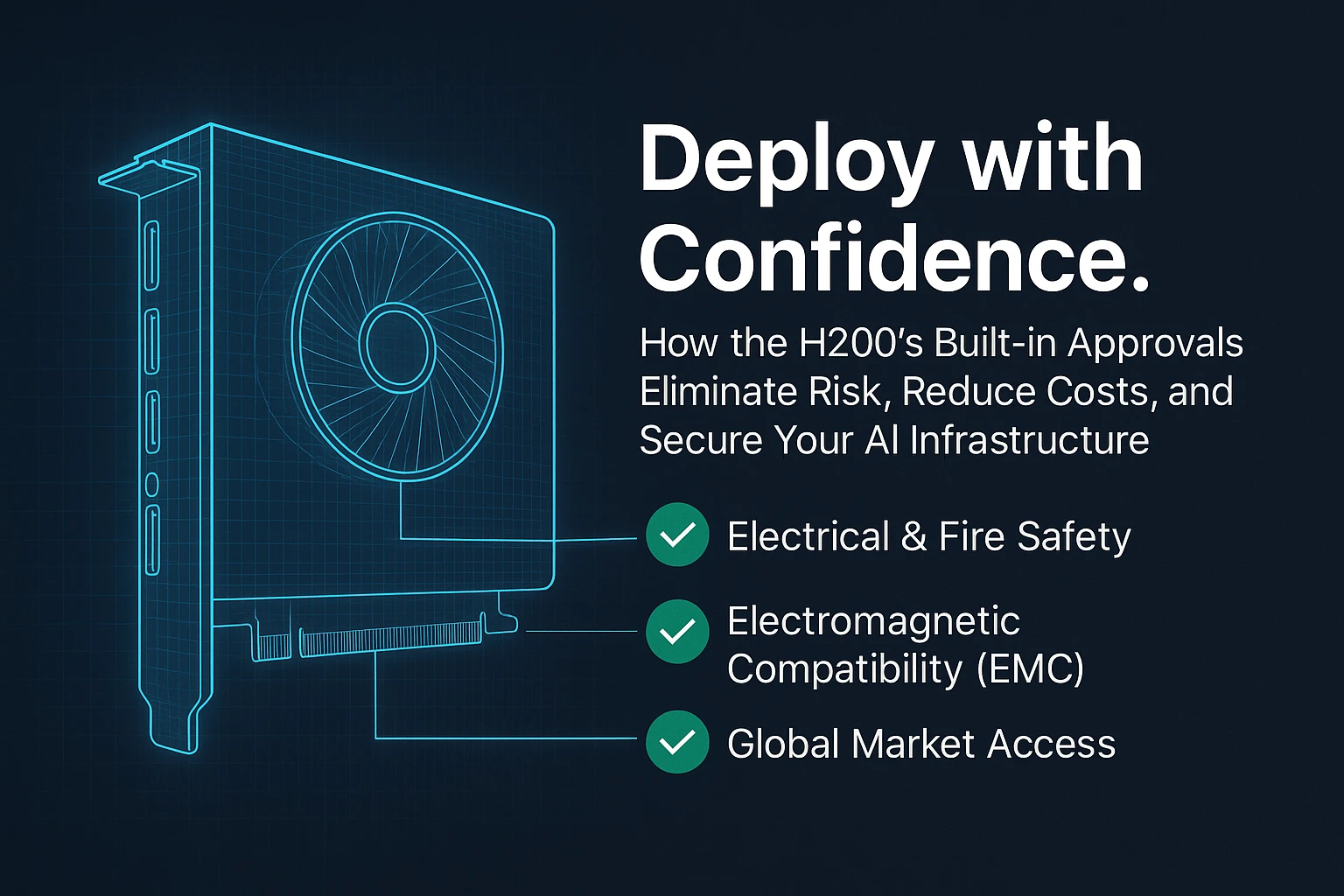
For enterprises deploying AI and high-performance computing (HPC) workloads, regulatory compliance is essential. Certifications confirm that hardware meets established safety, electromagnetic, and environmental standards, ensuring legal market access and operational reliability. Without these approvals, organizations risk deployment delays, financial penalties, or equipment that cannot be lawfully installed in data centers across regions. According to Gartner, hardware compliance frameworks are a critical consideration in global IT procurement strategies because they directly affect cost, risk, and time-to-deployment.
The NVIDIA H200 GPU is designed for advanced AI and HPC workloads, and it carries certifications that meet international regulatory standards. These approvals, which cover regions such as North America, Europe, and Asia-Pacific, validate its safe operation in enterprise environments. For IT leaders, this ensures that the NVIDIA H200 can be deployed across research institutions, corporate AI clusters, and data centers without the need for additional third-party compliance testing.
011. Understanding the Key NVIDIA H200 Regulatory Approvals
Every region has its own compliance framework for IT hardware. For data center administrators and procurement leaders, understanding these certifications is vital to ensure lawful deployment and operational safety. The NVIDIA H200 GPU carries approvals that cover electrical safety, electromagnetic compatibility (EMC), and environmental standards across major global markets.
02RCM (Regulatory Compliance Mark, Australia/New Zealand)
The RCM mark confirms that the NVIDIA H200 meets Australian and New Zealand standards for electrical safety and electromagnetic compatibility. It ensures devices do not emit harmful interference and are safe to connect to national power systems. For enterprises operating research or HPC centers in this region, RCM certification is a prerequisite for lawful import and operation.
03BSMI (Taiwan)
Taiwan’s Bureau of Standards, Metrology and Inspection (BSMI) certification ensures compliance with local electrical and EMC regulations. Without BSMI approval, IT hardware cannot be imported or sold in Taiwan. For universities and enterprises building GPU clusters in East Asia, BSMI compliance guarantees that NVIDIA H200 GPUs align with the country’s strict technical standards.
04CE (European Union)
CE marking is required for products distributed across the European Economic Area. It certifies that the NVIDIA H200 conforms to EU safety, health, and environmental directives. This includes low-voltage electrical safety and electromagnetic compatibility. For IT leaders in Europe, CE approval provides assurance that GPUs can be deployed in enterprise or academic data centers without additional certification steps.
05FCC (United States)
The Federal Communications Commission requires electronic equipment to comply with standards for electromagnetic interference. FCC approval ensures that the NVIDIA H200 does not emit interference that could disrupt communication systems or other electronic devices. For U.S.-based enterprises, FCC certification is mandatory for lawful deployment in commercial environments.
06ICES (Canada)
In Canada, the Innovation, Science and Economic Development (ISED) department enforces the Interference-Causing Equipment Standards (ICES). This certification confirms electromagnetic compatibility, ensuring that NVIDIA H200 GPUs can operate in Canadian data centers without causing interference. It also aligns with the country’s strict consumer and enterprise safety standards.
07KCC (South Korea)
The Korea Communications Commission regulates equipment that emits electromagnetic waves. KCC approval for the NVIDIA H200 confirms compliance with Korean safety and EMC rules. This certification is essential for enterprises deploying AI or HPC systems in South Korea, where data centers must meet strict regulatory oversight.
08cUL / UL (United States/Canada)
Underwriters Laboratories (UL) and its Canadian counterpart (cUL) provide independent testing for fire and electrical safety. For GPUs like the NVIDIA H200, this certification demonstrates that the hardware has been tested against potential electrical hazards and is safe for installation in high-density server racks. UL approval is widely recognized by insurers, making it a critical requirement for enterprise IT deployments in North America.
092. Why These Approvals Matter for Enterprise Deployments
Regulatory certifications are not just technical checkboxes. They are the foundation for legal operation, safe deployment, and cost-effective scaling of advanced computing hardware like the NVIDIA H200 GPU. For IT leaders, these approvals determine whether infrastructure investments can move forward without additional delays or expenses.
First, compliance ensures that NVIDIA H200 GPUs can be legally deployed across global markets. Without certifications such as CE for Europe or FCC for the U.S., enterprises would face import restrictions or delays in deployment. Regulatory approval removes uncertainty, giving decision-makers confidence that systems will pass regional inspections and audits.
Second, certified hardware safeguards data centers and personnel. Electrical safety and electromagnetic compatibility standards are designed to protect against hazards such as overheating, electrical shock, or electromagnetic interference. These risks are particularly significant in GPU clusters, which draw high power loads and operate continuously under demanding conditions.
Finally, certified components reduce operational costs. Without standardized approvals, enterprises would need to commission additional testing for each market or use case. By shipping with global certifications, the NVIDIA H200 avoids this expense, making it simpler for universities, government labs, or enterprises to deploy AI and HPC clusters on schedule.
103. Comparative Table of NVIDIA H200 Approvals
Enterprises and universities often need a clear view of how NVIDIA H200’s regulatory approvals align with regional requirements. Each certification has practical implications, from ensuring legal import to protecting staff and equipment.
The table below highlights the scope and relevance of these approvals for real-world deployments.
114. Best Practices for Enterprises Using NVIDIA H200
For enterprises deploying NVIDIA H200 GPUs, following best practices around regulatory compliance is essential to ensure operational reliability and minimize risk. Proper planning not only protects data centers and personnel but also helps organizations avoid costly delays or legal issues in global deployments.
Verify Regulatory Approvals Before Procurement
Before acquiring NVIDIA H200 GPUs, IT teams should confirm that all necessary certifications for their target markets are in place. This includes electrical safety, electromagnetic compatibility, and environmental compliance. Verifying approvals in advance helps prevent delays in installation and ensures the GPUs can be legally deployed in data centers across different regions.
Maintain Documentation for Audits and Insurance
Maintaining detailed records of all compliance certifications is critical. This includes keeping copies of regulatory approval certificates, test reports, and correspondence with vendors. Proper documentation supports internal audits, insurance claims, and regulatory inspections, reducing administrative risk and demonstrating due diligence to stakeholders.
Combine Compliance with Environmental and Energy Standards
NVIDIA H200’s regulatory approvals should be considered alongside environmental and energy efficiency requirements. Selecting hardware that meets both compliance and energy standards helps reduce operational costs, improves sustainability, and aligns with corporate responsibility policies. Enterprises can evaluate GPUs in terms of power consumption, thermal efficiency, and operational footprint to optimize long-term TCO while maintaining regulatory adherence.
By adhering to these best practices, organizations can deploy NVIDIA H200 GPUs confidently, ensuring both compliance and operational efficiency while supporting AI and high-performance computing workloads at scale.
12Conclusion
NVIDIA H200’s regulatory approvals play a critical role in ensuring the safety, legality, and operational reliability of the GPU across global markets. For enterprises deploying AI, high-performance computing, or research workloads, these certifications provide assurance that the hardware meets international standards for electrical safety, electromagnetic compatibility, and environmental compliance. By validating that GPUs comply with local and regional requirements, organizations can avoid deployment delays, reduce risk to personnel and equipment, and streamline integration into existing IT infrastructure.
Looking ahead, enterprises must maintain vigilance as regulatory requirements evolve. Continuous monitoring of international standards, firmware updates, and hardware revisions ensures that GPU deployments remain compliant and operational without interruptions. Coupled with proper documentation, verification processes, and adherence to best practices, these efforts enable IT leaders to deploy NVIDIA H200 GPUs confidently, supporting high-performance workloads while maintaining legal and operational integrity.
← Back to Insights