• FEATURED STORY OF THE WEEK

      NVIDIA H200 Tensor Core GPU Technical Specifications: What It Means for AI Performance

      Written by :  
      semifly
      Team Semifly
      4 minute read
      August 7, 2025
      Category : Edge Computing
      NVIDIA H200 Tensor Core GPU Technical Specifications: What It Means for AI Performance
      What Is the NVIDIA H200 Tensor Core GPU?


      The NVIDIA H200 is part of the Hopper GPU family, built to accelerate generative AI, high-performance computing (HPC), and enterprise LLM workloads. With 141GB of HBM3e memory and the world’s fastest memory bandwidth (up to 4.8 TB/s), the H200 redefines throughput for AI workloads.


      It’s more than just a GPU—it’s an accelerator built for precision-tuned AI systems.


      What Makes the NVIDIA Hopper Architecture Unique?


      The H200 is based on the NVIDIA Hopper architecture, designed to improve efficiency across floating-point and integer operations, reduce power consumption, and boost model execution speed through FP8/FP16 Tensor Cores.
       

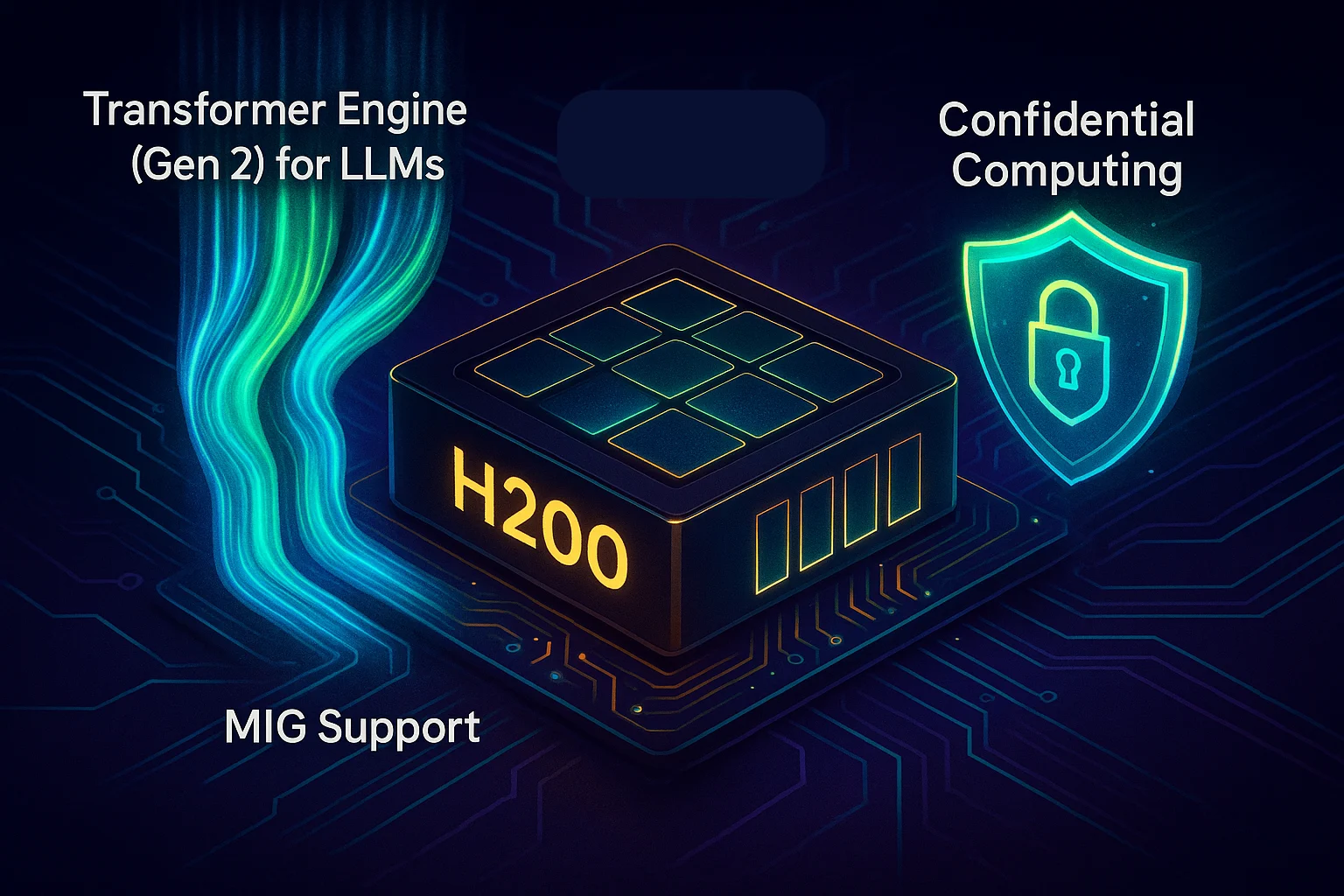
      Glowing NVIDIA H200 GPU with radiating light trails, symbolising immense power and speed for AI workloads


      Hopper introduces:


      • Transformer Engine (Gen 2): Tailored for LLMs with dynamic mixed-precision (FP8/FP16) execution
      • MIG (Multi-Instance GPU) support: Partition H200 into multiple logical GPUs for isolation
      • Confidential computing: Secure execution environments for regulated industries


      Learn more about how Semifly delivers secure, high-performance deployments using Hopper-based DGX-H200 clusters.


      What Are the H200’s Compute Capabilities by Precision Type?


      Each precision mode on the H200 is optimized for different workloads—FP64 for simulations, FP8 for LLMs, INT8 for inference. Here’s a quick comparison:


      Table 1: H200 Compute Performance by Precision Type

      Precision Type Performance (TFLOPS) Notes
      FP64 34 Double precision for scientific computing
      FP64 Tensor Core 67 Tensor acceleration for simulations
      FP32 67 Standard training and compute
      TF32 Tensor Core 989 (with sparsity) Enhanced FP32 with AI acceleration
      BFLOAT16 Tensor Core 1,979 (with sparsity) Used for mixed precision training
      FP16 Tensor Core 1,979 (with sparsity) Legacy precision, still widely used
      FP8 Tensor Core 3,958 (with sparsity) Ideal for LLM inference + training
      INT8 Tensor Core 3,958 (with sparsity) Optimized for deployment + edge inference

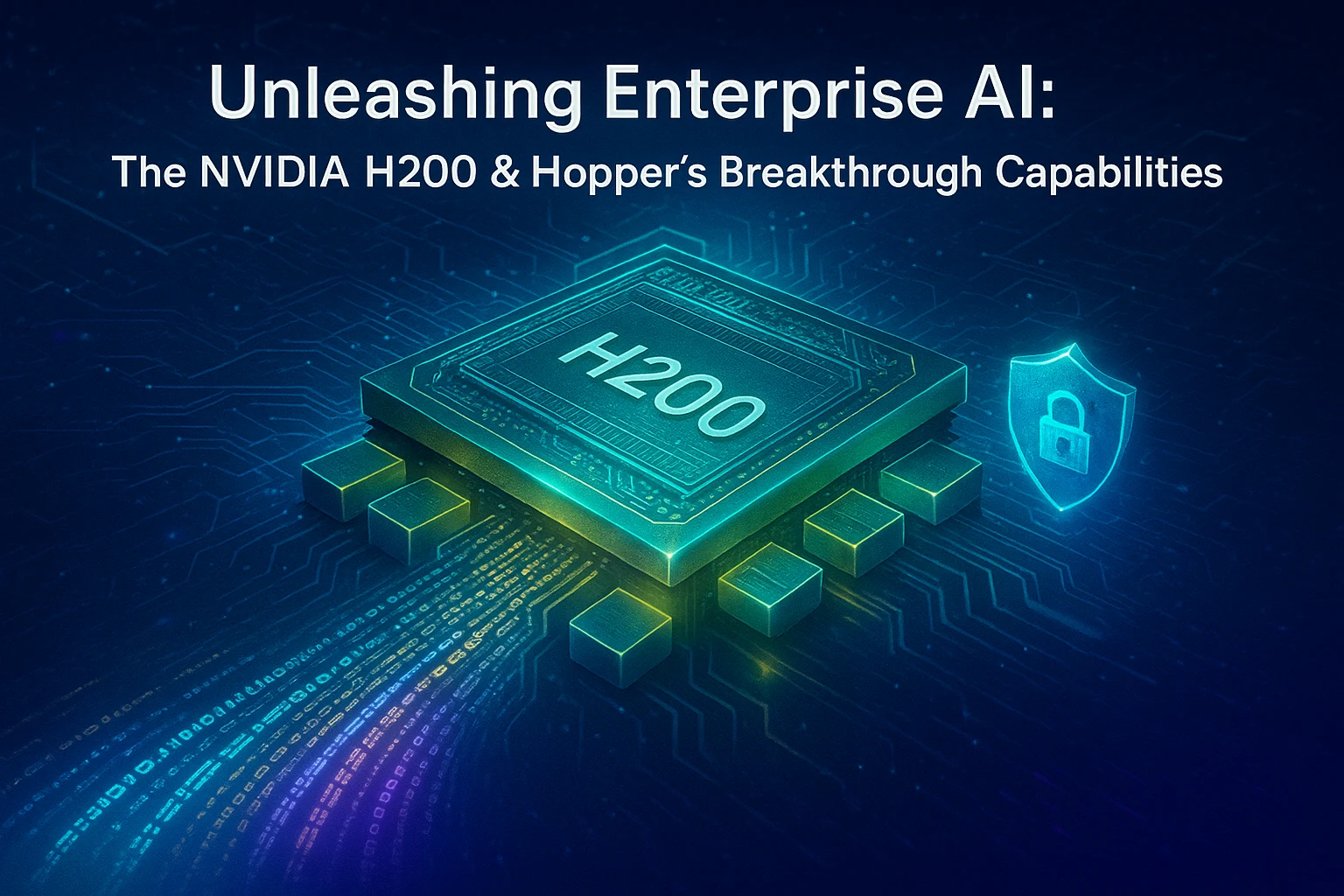
      Hopper architecture features: data streams, segmented GPUs, and security shields for enterprise AI innovation.

      How Much Memory and Bandwidth Does the H200 Provide?

      Memory is a critical bottleneck in training and inference. The H200 eliminates it.


      Table 2: Memory Capabilities of the H200 GPU

      Feature Specification
      GPU Memory 141 GB HBM3e
      Memory Bandwidth Up to 4.8 TB/s
      Max Bandwidth (with NVLink) 900 GB/s
      Decoders 7 NVDEC + 7 JPEG

      This memory bandwidth is nearly 50% higher than the previous generation H100, enabling faster token movement, larger context windows, and better multi-user handling.


      What Form Factors and Interconnects Are Available?


      The H200 is designed to scale across various enterprise workloads—from workstations to hyperscale clusters.


      Table 3: Form Factor & Interconnect Options

      Feature Option
      Form Factors SXM, PCIe (NVL)
      Interconnect NVIDIA NVLink (900 GB/s)
      PCIe Support Gen5 (128 GB/s)
      TDP 700W (SXM), 600W (NVL)

      NVLink enables high-bandwidth multi-GPU scaling for LLM training and real-time inferencing.


      How Does the H200 Support Confidential and Multi-Instance Computing?


      For industries like healthcare, finance, and government, GPU security is non-negotiable.


      • Confidential Computing: The H200 supports Trusted Execution Environments (TEEs) that isolate workloads at runtime.
      • MIG (Multi-Instance GPU): Split one H200 into 7 logical GPUs with 16.5 GB each.


      This enables secure multi-tenant use in shared GPU clusters and better GPU utilization across teams.


      What Enterprise Use Cases Benefit from the H200’s Specs?


      Use Case H200 Advantage
      LLM Training (e.g., LLaMA, Mistral) FP8 + 141 GB memory enables larger batch sizes
      Real-time Inference (Chatbots) Reduced latency with INT8/FP8 execution
      Confidential Cloud Inference TEEs and MIGs for isolation + efficiency
      HPC Simulation (Physics/Genomics) FP64 and FP64 Tensor Core compute

      Vast digital network with interconnected lines and glowing nodes, showing H200's enterprise AI scalability.

      How Semifly Helps Enterprises Deploy the H200 with Confidence

      At Semifly, we don’t just ship hardware—we deliver outcomes.


      Request a custom H200 deployment consultation.
       

      Bookmark me
      Share on
      Comments
      Add your Comment

      Writing About AI

      Semifly

      is an engineer and a technologist with a diverse background spanning software, hardware, aerospace, defense, and cybersecurity. As CTO at Semifly, he leverages his extensive experience to lead the company’s technological innovation and development.

      Explore Nvidia’s GPUs

      Find a perfect GPU for your company etc etc
      Go to Shop

      FAQs

      • The NVIDIA H200 is an advanced GPU belonging to the Hopper family, specifically engineered to accelerate demanding workloads in generative AI, high-performance computing (HPC), and enterprise-level Large Language Models (LLMs). Its core strength lies in its exceptional memory capabilities, featuring 141GB of HBM3e memory and the world’s fastest memory bandwidth, reaching up to 4.8 TB/s. This makes it a powerful accelerator designed for precision-tuned AI systems, particularly adept at handling large datasets and complex AI computations.

      • The NVIDIA H200 is built upon the Hopper architecture, which introduces several innovations to enhance efficiency and performance. Key features include the Transformer Engine (Gen 2), specifically designed for LLMs with dynamic mixed-precision (FP8/FP16) execution, allowing for optimal balance between speed and accuracy. Additionally, it offers Multi-Instance GPU (MIG) support, enabling the partitioning of a single H200 into multiple logical GPUs for isolated workloads, and confidential computing, which provides secure execution environments crucial for regulated industries by isolating workloads at runtime through Trusted Execution Environments (TEEs).

      • The H200 offers optimised performance across various precision types, making it versatile for diverse workloads. For scientific computing and simulations, it provides FP64 and FP64 Tensor Core capabilities. Standard training and general compute benefit from FP32. For AI acceleration, particularly with sparsity, it offers enhanced FP32 (TF32 Tensor Core), BFLOAT16 Tensor Core, and FP16 Tensor Core. Crucially, for Large Language Model (LLM) inference and training, the H200 excels with FP8 Tensor Core, and for deployment and edge inference, it’s highly optimised with INT8 Tensor Core, both delivering exceptional performance.

      • The H200 GPU significantly addresses memory bottlenecks crucial for training and inference. It boasts an impressive 141 GB of HBM3e GPU memory, which is essential for handling large models and datasets. Furthermore, it delivers a memory bandwidth of up to 4.8 TB/s, nearly 50% higher than its predecessor, the H100. When utilising NVLink, the maximum bandwidth can reach 900 GB/s. These capabilities enable faster data movement, support for larger context windows in LLMs, and improved handling of multiple users, making it highly efficient for memory-intensive AI tasks.

      • The H200 is designed for scalability across various enterprise environments, from workstations to hyperscale clusters. It is available in SXM and PCIe (NVL) form factors. For high-bandwidth multi-GPU scaling, particularly important for LLM training and real-time inferencing, it leverages NVIDIA NVLink, offering a bandwidth of 900 GB/s. Additionally, it provides PCIe Gen5 support with 128 GB/s bandwidth. The Thermal Design Power (TDP) varies by form factor, being 700W for SXM and 600W for NVL. These options allow for flexible deployment and robust interconnectivity for complex AI infrastructures.

      • For industries with stringent security requirements, such as healthcare, finance, and government, the H200 incorporates crucial features. It supports Confidential Computing through Trusted Execution Environments (TEEs), which isolate workloads during runtime, providing a secure environment. Alongside this, the Multi-Instance GPU (MIG) feature allows a single H200 to be divided into up to 7 logical GPUs, each with 16.5 GB of memory. This dual capability ensures secure multi-tenant use in shared GPU clusters and significantly improves GPU utilisation across different teams and workloads.

      • The NVIDIA H200’s specifications make it highly advantageous for several demanding enterprise use cases. For Large Language Model (LLM) training (e.g., LLaMA, Mistral), its FP8 precision and 141 GB memory enable the use of larger batch sizes, accelerating the training process. Real-time inference for applications like chatbots benefits from reduced latency due to efficient INT8/FP8 execution. Confidential cloud inference is made secure and efficient by the H200’s TEEs and MIG capabilities. Furthermore, High-Performance Computing (HPC) simulations in fields like physics and genomics greatly benefit from its robust FP64 and FP64 Tensor Core compute capabilities.

      • Enterprises typically deploy the H200 through pre-configured solutions like DGX-H200 clusters, which come equipped with necessary software frameworks such as NeMo and Triton for seamless integration. Support is often provided for optimising workloads, including FP8/FP16 optimisation for popular AI frameworks like Hugging Face and RAG workloads. To ensure efficient operation and cost management, custom observability dashboards are also offered, allowing tracking of GPU, memory, and cost-per-inference metrics. For regulated industries, specific confidential computing environments can be established, ensuring secure AI workload deployment. Enterprises can request consultations for tailored H200 deployment solutions.

      More Similar Insights and Thought leadership

      No Similar Insights Found

      semifly