FEATURED STORY OF THE WEEK
NVIDIA Pre-Trained Models: Accelerating AI Adoption with H200

Artificial intelligence is no longer confined to research labs or experimental projects. Today, pre-trained models are the foundation for practical AI deployments across industries. From medical imaging to fraud detection and natural language interfaces, organizations are building on pre-trained models rather than starting from scratch. This approach allows them to deploy accurate, production-ready AI systems in a fraction of the time and cost.
NVIDIA has become a leader in this space with its expanding catalog of pre-trained models available through the NVIDIA NGC Catalog. These models cover computer vision, natural language processing, recommender systems, and generative AI. They are engineered to run efficiently on NVIDIA GPUs, including the H200.
The NVIDIA H200 GPU is designed for large-scale AI workloads, offering the high memory bandwidth and performance required to handle advanced pre-trained and foundation models. This combination—ready-to-use models and powerful compute—creates a practical pathway for enterprises to scale AI adoption.
This blog will examine what NVIDIA pre-trained models are, why they matter to enterprises, and how the NVIDIA H200 GPU enhances their performance. It will also highlight practical examples of how industries are using these models today.
1. Understanding NVIDIA Pre-Trained Models
Pre-trained models are reshaping how organizations adopt artificial intelligence. Instead of starting with raw data and untrained algorithms, enterprises can begin with models that have already learned patterns from massive, curated datasets. NVIDIA has invested heavily in this space, offering a wide range of pre-trained AI models through its NGC Catalog. These models address fields such as computer vision, natural language processing, and recommender systems.
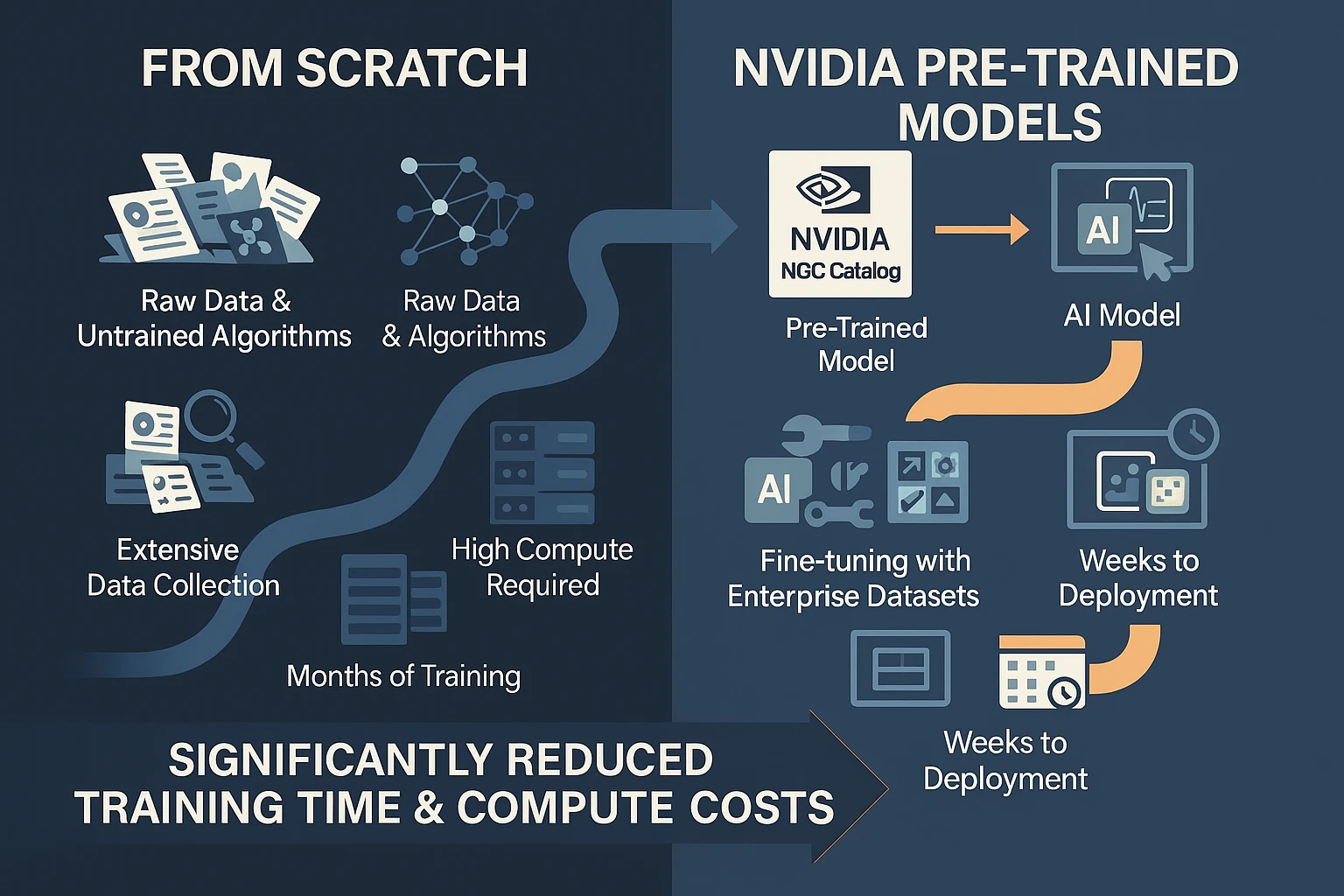
A pre-trained model is an AI model that has already been trained on large, representative datasets before being released for public use. Rather than building a neural network from scratch, organizations can adapt an existing model to their own needs. This process, known as fine-tuning, requires significantly fewer resources because the model already understands general features.
For example, a pre-trained image classification model can detect edges, shapes, and colors without requiring retraining from zero. NVIDIA explains that this shortcut reduces both time and computing requirements compared with traditional approaches.
Benefits for Enterprises
The practical benefits of NVIDIA pre-trained models are substantial:
- Reduced Training Time: Teams can move directly to fine-tuning, shortening project timelines from months to weeks.
- Lower Compute Costs: By starting with models already trained on massive data, enterprises use fewer GPU hours to achieve production-ready outcomes.
- Access to Advanced Architectures: NVIDIA makes available models based on proven neural network designs such as BERT, ResNet, and Megatron-LM. These architectures represent years of research and testing, giving enterprises a reliable foundation for deployment.
These advantages mean organizations can redirect resources toward solving domain-specific problems rather than allocating budgets to raw model development.
Industry Adoption Drivers
Several factors explain why the adoption of pre-trained models is accelerating:
- Faster AI Deployment: Businesses want AI applications that deliver results quickly. Pre-trained models reduce the time required to move from concept to deployment.
- Lower Barriers to Entry: Training advanced models from scratch requires both data and compute at a scale that many enterprises do not have. Pre-trained models make advanced AI accessible to more organizations, including mid-sized companies.
- Cross-Industry Applicability: Industries ranging from healthcare and finance to retail and manufacturing are applying pre-trained models. For instance, medical imaging teams can adapt NVIDIA’s vision models for tumor detection, while financial institutions can refine natural language models for fraud detection and compliance.
2. Significance of NVIDIA Pre-Trained Models in Supporting AI Strategy
Enterprises are under pressure to adopt AI at scale while keeping costs under control. Pre-trained models offer a way to achieve both goals by providing ready-to-use building blocks that can be adapted to business needs. NVIDIA pre-trained models are designed with industry use cases in mind, making them relevant across sectors where speed, accuracy, and efficiency are critical.
Enterprise Use Cases Across Industries
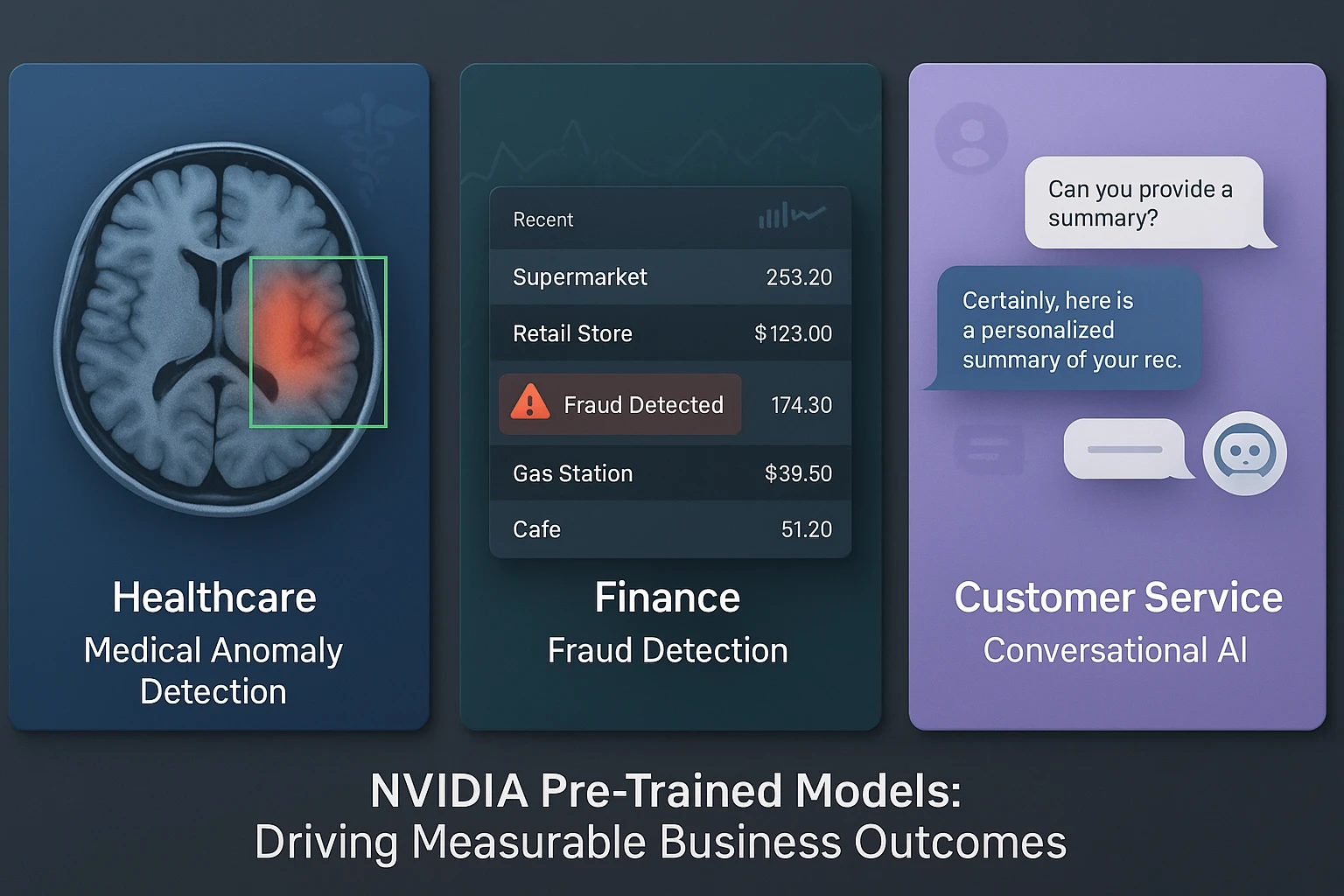
- In healthcare, pre-trained computer vision models are applied to tasks such as analyzing medical scans and supporting diagnostic workflows. This reduces the time radiologists spend on manual review and increases diagnostic precision.
- Financial services use natural language models to monitor transactions and detect anomalies, helping institutions prevent fraud and meet compliance requirements.
- In customer-facing industries, enterprises are fine-tuning language and generative models for applications like chatbots, summarization, and personalized content creation.
These applications show how NVIDIA pre-trained models are not just technical assets but enablers of measurable business outcomes.
Democratizing AI for Smaller Teams
Historically, only organizations with vast data science resources could train models from scratch. Pre-trained models lower this barrier. Teams without massive datasets or dedicated research groups can still deploy capable AI systems by adapting NVIDIA models to their domain-specific needs. This shift is significant because it enables mid-sized organizations and departments within large enterprises to adopt AI without needing research-level expertise. In this way, NVIDIA pre-trained models extend AI beyond elite technology groups to a wider base of practitioners.
Alignment with Enterprise Priorities
Enterprise leaders often measure AI initiatives against three key factors: time, scale, and cost. Pre-trained models directly support these priorities.
- Speed-to-Market: With pre-trained models, enterprises can reduce deployment cycles and introduce AI-driven services faster.
- Scalability of Adoption: Once proven in pilot projects, pre-trained models can be fine-tuned and extended across multiple functions or business units.
- Cost Efficiency: By reducing the need for extensive compute resources and large-scale data collection, enterprises can limit infrastructure expenses while still meeting accuracy benchmarks.
3. Role of NVIDIA H200 in Scaling Pre-Trained Models
Pre-trained models grow increasingly large and complex, especially in fields like natural language processing and multimodal AI. Running these models efficiently requires advanced hardware with significant compute capacity and memory bandwidth. The NVIDIA H200 GPU is designed to meet this demand, making it a strong choice for enterprises that rely on pre-trained and foundation models.
Overview of NVIDIA H200 GPU Architecture and Memory Bandwidth
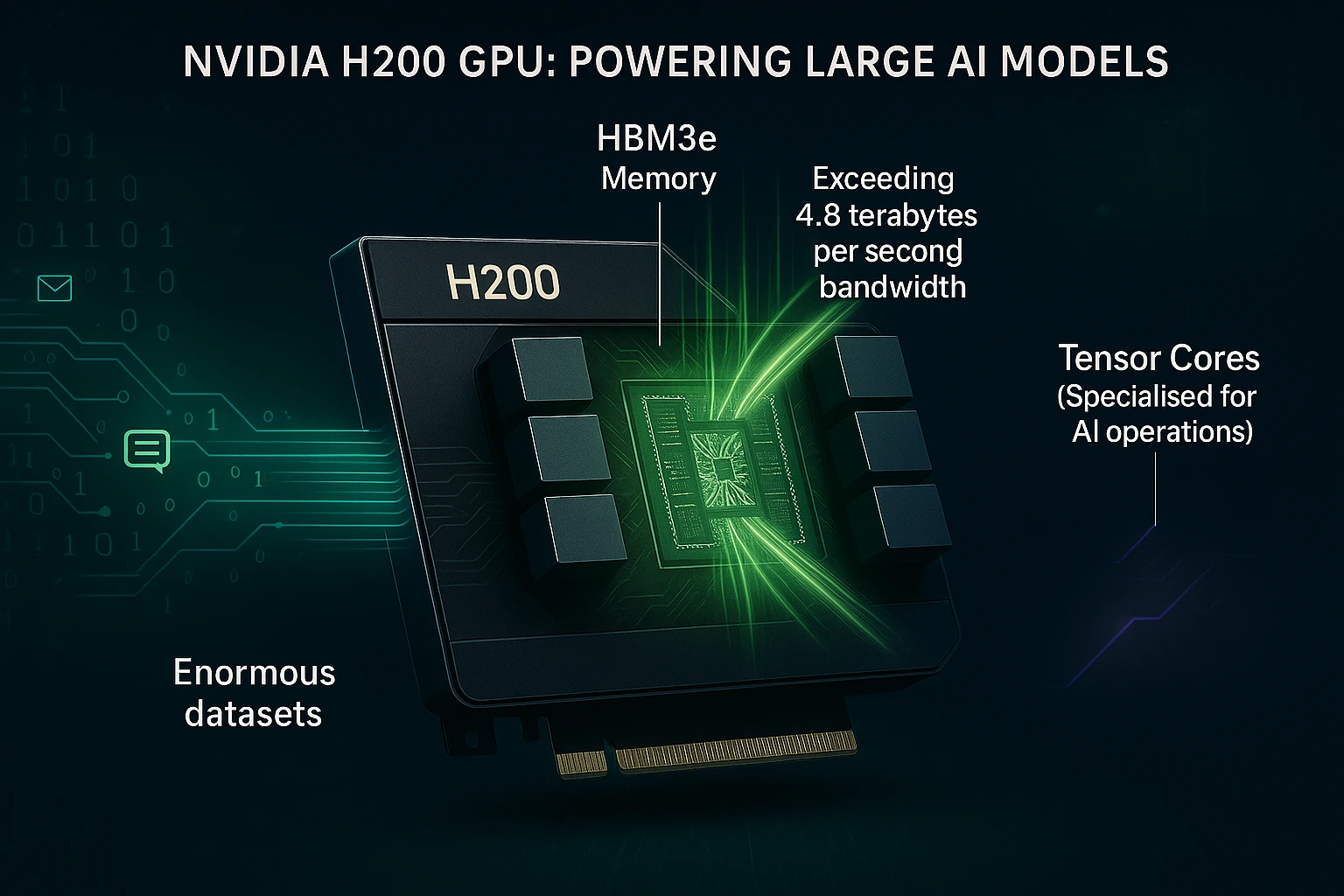
The H200 is based on NVIDIA’s Hopper architecture, designed to handle large-scale AI workloads. It is the first GPU to use HBM3e, which delivers memory bandwidth exceeding 4.8 terabytes per second, nearly double that of its predecessor, the H100.
This high bandwidth allows the GPU to process the enormous datasets required by pre-trained models without bottlenecks. The architecture also features Tensor Cores specialized for AI operations, improving both training and inference efficiency.
Why H200 Is Ideal for Large Pre-Trained and Foundation Models
Foundation models, such as large language models (LLMs), contain billions of parameters. They require both high memory capacity and fast throughput to run effectively. The H200’s expanded memory and bandwidth make it possible to host these models in memory rather than splitting them across multiple GPUs, which reduces latency and simplifies deployment. The H200 is well-suited for workloads like generative AI, recommender systems, and multimodal applications that combine text, images, and speech.
Performance Gains in Inference and Training
When paired with NVIDIA pre-trained models, the H200 delivers measurable performance improvements. Enterprises can expect faster fine-tuning cycles, allowing teams to adapt models to business-specific datasets more quickly. Inference—running predictions using the trained model—also benefits from lower latency and higher throughput.
These gains translate into more responsive applications, whether in real-time fraud detection, medical imaging analysis, or conversational AI. Workloads that previously required distributed GPU clusters can now run on fewer H200 units while maintaining performance levels.
4. NVIDIA Pre-Trained Models Most Relevant for Enterprises
Enterprises adopting AI often begin by identifying models that directly support their industry needs. NVIDIA pre-trained models cover a wide range of domains, from visual recognition to natural language understanding and generative AI. Many of these models are available through the NVIDIA NGC Catalog, where they can be downloaded, fine-tuned, and deployed on NVIDIA GPUs.
Computer Vision Models
Computer vision remains a leading driver of enterprise AI adoption. Pre-trained models such as ResNet-50 are available in the NGC Catalog and widely used for tasks like image classification and object detection. These models can be adapted for applications ranging from medical image analysis to retail video analytics.
For example, a hospital can fine-tune ResNet-based models to detect anomalies in MRI scans, while a logistics company can use object detection models to track goods in warehouses. By starting with proven architectures, enterprises save time and reduce the need for vast proprietary image datasets.
Natural Language Processing Models
Natural language processing (NLP) has advanced rapidly with large pre-trained models such as BERT and Megatron-LM. These models are designed to understand and generate human language with high accuracy. Enterprises can fine-tune them for domain-specific tasks like financial compliance reporting, legal document review, or customer support automation.
NVIDIA’s Retrieval-Augmented Generation (RAG) models extend this capability by combining generative AI with enterprise knowledge bases, making responses both contextually accurate and business-specific. This is especially valuable for industries handling sensitive or regulated data.
Generative AI Models
Generative AI is redefining how enterprises approach content creation and automation. NVIDIA offers pre-trained models such as StyleGAN for image synthesis and Riva for text-to-speech and speech-to-text. StyleGAN can be adapted for industries like retail and media, enabling rapid design prototyping or creative content generation.
NVIDIA Riva provides conversational AI capabilities, supporting applications like voice assistants, transcription services, and multilingual call center solutions. These models reduce the complexity of building generative systems while ensuring reliable performance when deployed on NVIDIA GPUs.
5. Implementing and Optimizing NVIDIA Pre-Trained Models
Deploying NVIDIA pre-trained models is not a single step but a structured process. Each stage—from selection to monitoring—ensures that the models remain reliable and business-relevant. With the NVIDIA NGC Catalog and H200-powered infrastructure, enterprises can accelerate adoption while maintaining control over performance and cost.
Step 1: Identify the Right Model from the NVIDIA NGC Catalog
The first step is selecting a model that aligns with your use case. The NVIDIA NGC Catalog provides a library of pre-trained models for vision, language, and generative AI tasks. Each model is benchmarked and validated for accuracy, which reduces the effort required to start experimentation. For example, enterprises can deploy a pre-trained BERT model for customer support automation or ResNet-50 for image classification in healthcare imaging.
Step 2: Deploy on H200-Powered Infrastructure
Once a model is chosen, it must run on a reliable hardware foundation. NVIDIA H200 GPUs deliver high memory bandwidth and performance, making them suitable for both inference and fine-tuning workloads. Running pre-trained models on H200-powered servers allows enterprises to handle large datasets efficiently and reduce latency in production environments.
Step 3: Fine-Tune with Enterprise Datasets
Pre-trained models provide a solid baseline, but fine-tuning them with enterprise-specific data ensures relevance. This process involves retraining the model on proprietary datasets—such as financial documents, medical records, or retail transaction logs—so the outputs are tailored to the organization’s domain. Fine-tuning also helps in meeting compliance requirements by aligning AI behavior with industry standards.
Step 4: Continuously Monitor and Update
AI models are not static. Over time, data patterns evolve, and model accuracy can decline. Continuous monitoring of performance metrics—such as precision, recall, and latency—is necessary. When performance drops, models should be retrained or updated with newer datasets. This approach helps enterprises maintain reliability while avoiding unnecessary drift in predictions.
Importance of Containerization and APIs
Deployment is simplified through containerization. NVIDIA provides NGC containers that package models, dependencies, and runtime environments in a consistent format. This ensures portability across development, testing, and production environments.
APIs, on the other hand, allow enterprises to connect these models with applications such as chatbots, dashboards, or analytics platforms without extensive re-engineering. Containers and APIs together streamline deployment and reduce operational overhead.
6. The Future of NVIDIA Pre-Trained Models
Pre-trained models are becoming central to enterprise AI strategies. They provide a foundation that organizations can adapt to specific industries and workflows, reducing time-to-deployment and lowering overall development cost. As AI adoption grows, NVIDIA’s pre-trained models will continue to expand in scope and influence.
Trend 1: Multimodal AI
AI systems are moving beyond single data types such as text or images. Multimodal AI models can process and generate across text, images, audio, and video simultaneously. This shift allows enterprises to build richer applications—such as customer service agents that understand both spoken queries and visual inputs. NVIDIA’s recent research in multimodal training demonstrates how combining different modalities improves accuracy and context-awareness in AI systems.
Trend 2: Agentic AI
Another development is the rise of agentic AI. These models do more than generate output; they can take actions, interact with other systems, and adapt to ongoing tasks. For businesses, this means AI models that can manage workflows such as document processing, IT support, or supply chain monitoring without constant human oversight. By grounding these capabilities in pre-trained foundation models, NVIDIA creates a reliable base that enterprises can adapt to their unique processes.
Trend 3: Domain-Specialized Foundation Models
General-purpose models are powerful but often require refinement for industry-specific tasks. NVIDIA is expanding its portfolio of domain-specialized foundation models, designed for sectors such as healthcare, finance, and manufacturing. These models come with built-in awareness of terminology and compliance needs, reducing the time required to fine-tune them for production use. Such models help enterprises achieve accuracy and trustworthiness in sensitive environments.
Trend 4: Edge Deployment and Federated Learning
The future of pre-trained models also extends to the edge. Many enterprises need AI models to run on devices closer to where data is generated, whether in factories, hospitals, or retail stores. Running pre-trained models on edge devices reduces latency and improves responsiveness. At the same time, federated learning offers a method for training models across decentralized datasets without moving sensitive information off-site. This approach supports privacy requirements while allowing global model improvements.
Expert Insight: Models as Building Blocks
NVIDIA leadership has often emphasized that pre-trained models are becoming the fundamental building blocks of AI, much like compilers were for software development. This analogy highlights the shift toward reusable AI components that can be adapted and extended for diverse enterprise needs. For decision-makers, it underscores the importance of adopting a model-centric strategy where pre-trained models form the base of ongoing AI development.
Conclusion
NVIDIA pre-trained models are reshaping enterprise AI adoption by reducing development time, lowering resource demands, and minimizing risks through validated, ready-to-use architectures. Instead of spending months building models from scratch, organizations can adapt models from the NVIDIA NGC Catalog to their own data and achieve results in weeks. Supported by the NVIDIA H200 GPU, enterprises gain the performance needed to handle large-scale workloads, from language models to multimodal AI, without hitting performance limits.
For business leaders, the question is no longer whether to adopt pre-trained models, but which ones best fit their industry needs. Healthcare providers may turn to imaging models, while financial firms may adopt fraud detection or compliance-focused AI. With analysts projecting pre-trained models to become the foundation of enterprise AI, organizations that move early with NVIDIA’s catalog and H200 infrastructure will be positioned to scale their AI strategies more effectively.
More Similar Insights and Thought leadership
No Similar Insights Found
Subscribe today to receive more valuable knowledge directly into your inbox
We are writing frequenly. Don’t miss that.
Subscribe to get updates

Unregistered User
It seems you are not registered on this platform. Sign up in order to submit a comment.
Sign up now