• FEATURED STORY OF THE WEEK

      Sovereign AI: Why Infrastructure, Not Just Policy, Will Decide Who Wins

      Written by :  
      semifly
      Team Semifly
      5 minute read
      September 17, 2025
      Category : Cloud
      Sovereign AI: Why Infrastructure, Not Just Policy, Will Decide Who Wins
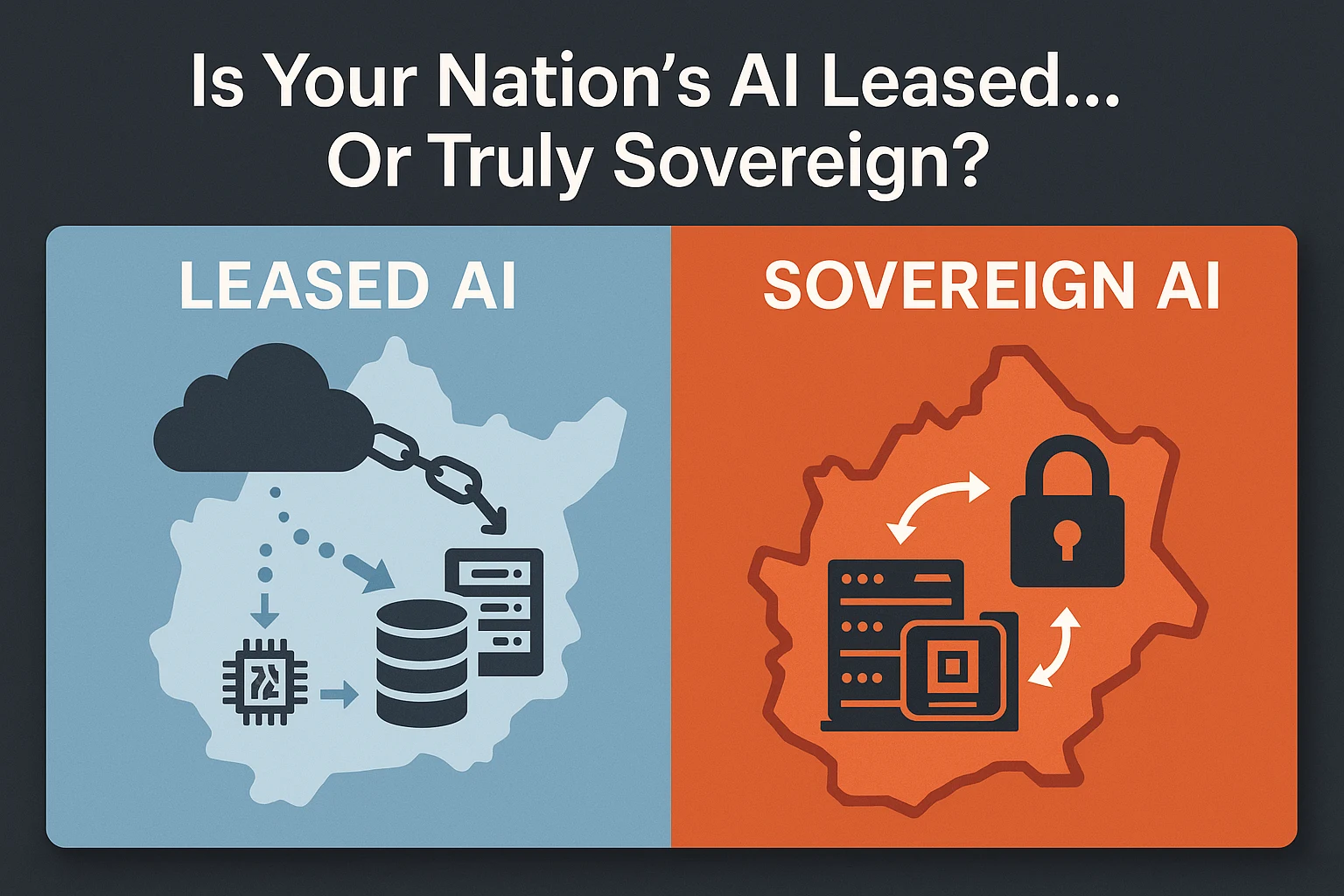
      1. Why Sovereign AI Is More Than Just Policy


      Sovereign AI is no longer a fringe concept. From Europe’s AI Act to India’s Digital Public Infrastructure initiatives, nations are racing to retain control over how AI is built, governed, and deployed.


      But most conversations stop at ethics, regulation, and data localization.


      The real question isn’t “Who writes the AI law?”
      It’s “Who runs the AI stack?


      If your country relies on third-party cloud platforms for inference, model hosting, or fine-tuning, your AI isn’t sovereign—it’s leased.


      2 . Global National Compute Infrastructure Strategies and Investments


      Building robust domestic AI compute capacity is fundamental to achieving sovereign AI, moving beyond mere policy to tangible infrastructure control. This involves substantial governmental and private sector investments in dedicated AI factories, supercomputing initiatives, and on-premise solutions.
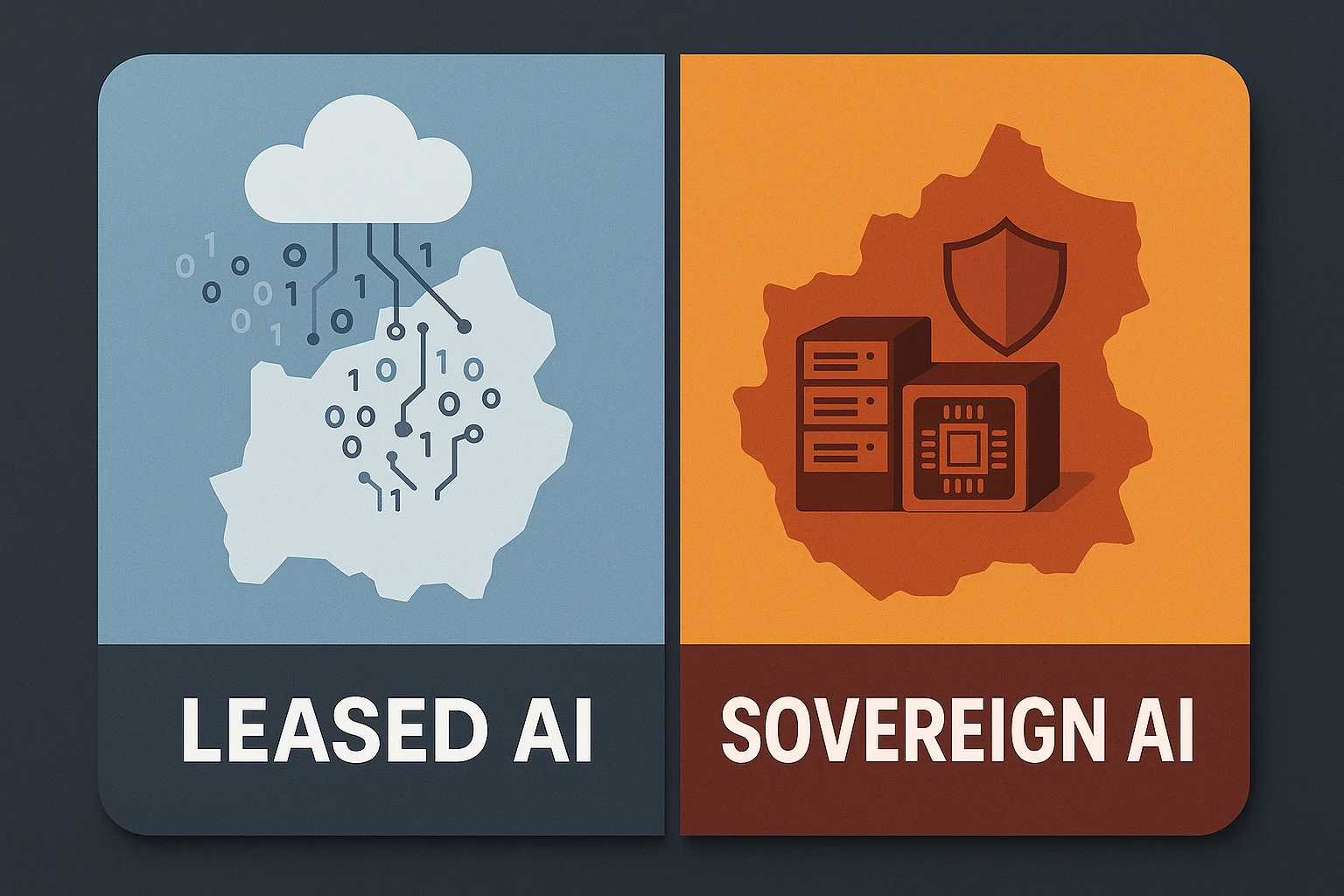
       

      Visual contrasting leased AI (external cloud dependency) with sovereign AI (internal national infrastructure control)


      • AI Factories and Supercomputing Initiatives: Nations are actively procuring and operating sovereign AI clouds and supercomputers to serve as the “bedrock of modern economies”. These “AI factories” are next-generation data centres hosting advanced, full-stack accelerated computing platforms for computationally intensive tasks.
      • Canada’s Strategy: Canada has committed $2 billion over five years (starting 2024–25) to new initiatives, including the Canadian Sovereign AI Compute Strategy. This strategy includes:
      • Mobilising Private Sector Investment: Up to $700 million for the AI Compute Challenge to build or expand commercial AI-specific data centres in Canada, aiming to foster Canadian AI champions and sustainable compute solutions.
      • Building Public Supercomputing Infrastructure: A transformational investment of up to $1 billion, including up to $705 million for a new state-of-the-art AI supercomputing system through the AI Sovereign Compute Infrastructure Program (SCIP). A smaller secure facility will also be established for government and industry R&D, including national security. An additional $200 million will augment existing public compute infrastructure for immediate needs.
      • AI Compute Access Fund: Up to $300 million to help Canadian innovators and businesses purchase AI compute resources, addressing high costs and limited domestic capacity, particularly in high-potential sectors like life sciences and advanced manufacturing.
      • EU’s Ambition: The EU’s “AI Continent Action Plan” includes a €200 billion “InvestAI” initiative to position Europe as a global AI leader. Key to this is the goal to triple the EU’s AI compute capacity by 2027 through “AI Factories” and forthcoming “Gigafactories”. Thirteen AI Factories are already selected across 17 Member States, with nine new AI-optimised supercomputers to be procured in 2025-2026. The “AI Gigafactories” initiative aims to create large-scale facilities, equivalent to CERN, capable of training frontier AI models with over 100,000 advanced AI processors per installation, mobilising €20 billion specifically for this.
      • Global Examples: Countries like France, Germany, Japan, India, and Singapore are investing significantly. France’s Scaleway is building Europe’s most powerful cloud-native AI supercomputer with NVIDIA DGX SuperPOD (1,016 H100 GPUs). Swisscom Group’s Italian subsidiary, Fastweb, is building Italy’s first NVIDIA DGX-powered supercomputer to develop an Italian-language LLM. India’s Tata Group is building large-scale AI infrastructure with NVIDIA GH200 Grace Hopper Superchips, and Reliance Industries is developing a foundation LLM for diverse languages. Singapore is upgrading its National Super Computer Center (NSCC) with NVIDIA H100 GPUs. Governments worldwide have collectively ordered at least 40,000 Graphics Processing Units (GPUs) in the past year.

      3. How to Build a Real Sovereign AI Stack


      To make Sovereign AI operational, you need more than policy. You need control at every layer:
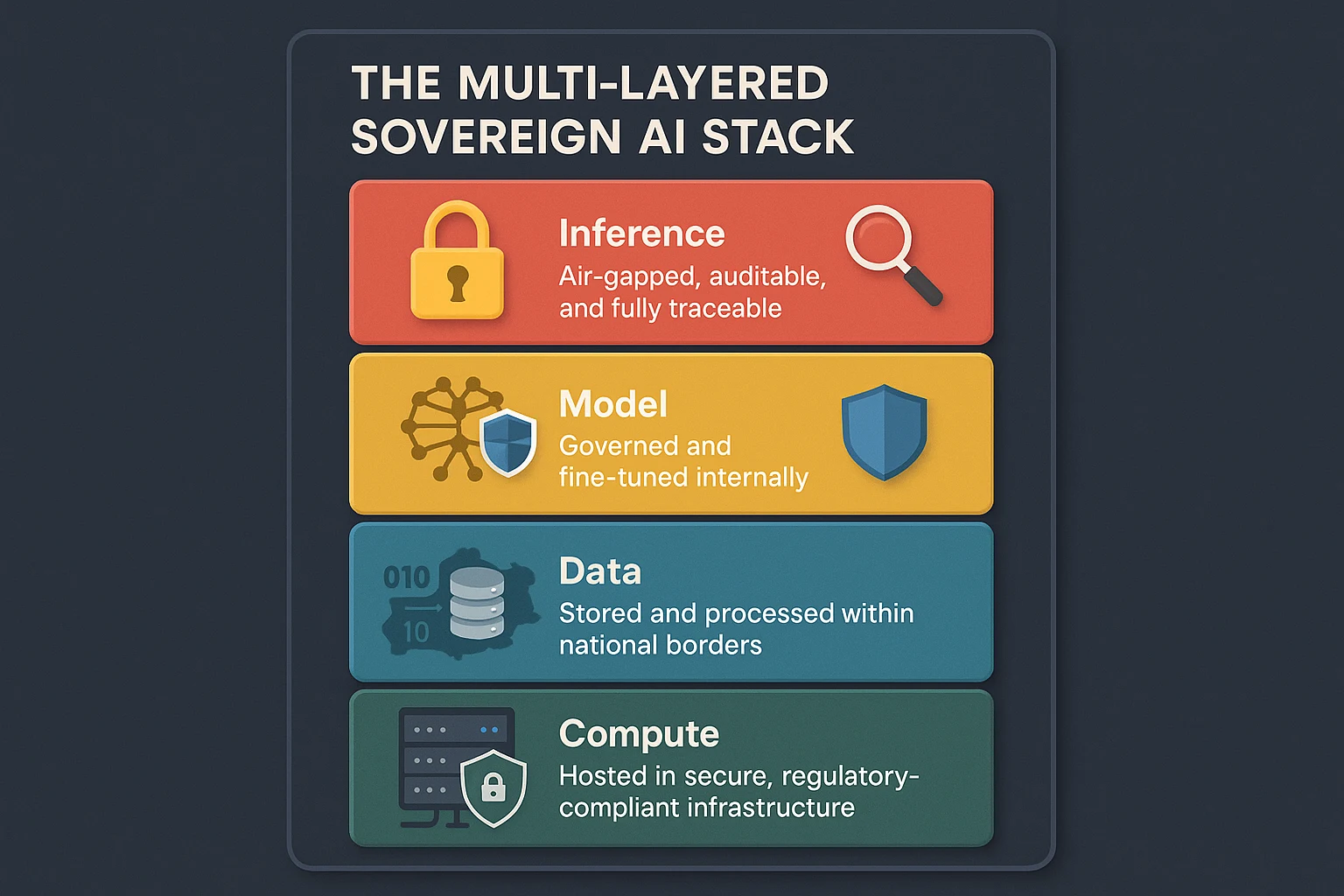
       

      Layered infographic illustrating a Sovereign AI stack, showing national control over compute, data, model, and inference.


      Sovereign AI begins with infrastructure. Without local compute, even the best policy frameworks are powerless.


      4. Why Any On-Prem AI Infrastructure Is Better Than Cloud


      The first step in reclaiming control? Move AI workloads off public cloud.


      Even with a standard on-prem GPU server:


      • You gain full data residency
      • You remove third-party telemetry leakage
      • You retain control over model versions and behavior


      Whether it’s a small-scale A100 deployment or a hybrid edge stack, on-premise AI infrastructure provides the sovereignty baseline.


      If Sovereign AI is your destination, on-prem compute is your vehicle.


      5. Real-World Use Cases: Sovereign AI in Action


      Semifly is already helping nations implement Sovereign AI using on-prem H200 deployments. Key examples include:


      Public Sector LLM Inference


      • MIG slicing assigns private GPU instances per agency
      • Air-gapped environments prevent API leakage
      • All responses are auditable, local, and compliant


      Defense & Intelligence


      • FP8/TF32 fine-tuning of open models in secure TEE zones
      • Distributed inference in low-bandwidth or disconnected environments
      • No external cloud dependency or data spillage


      Language & Cultural Models


      • Deploy LLMs in native dialects for education, governance, or cultural preservation
      • Ensure all training data and inference results remain within national archives


      6. How Semifly Helps You Build Sovereign AI


      Semifly offers turnkey infrastructure, orchestration, and compliance stacks purpose-built for Sovereign AI
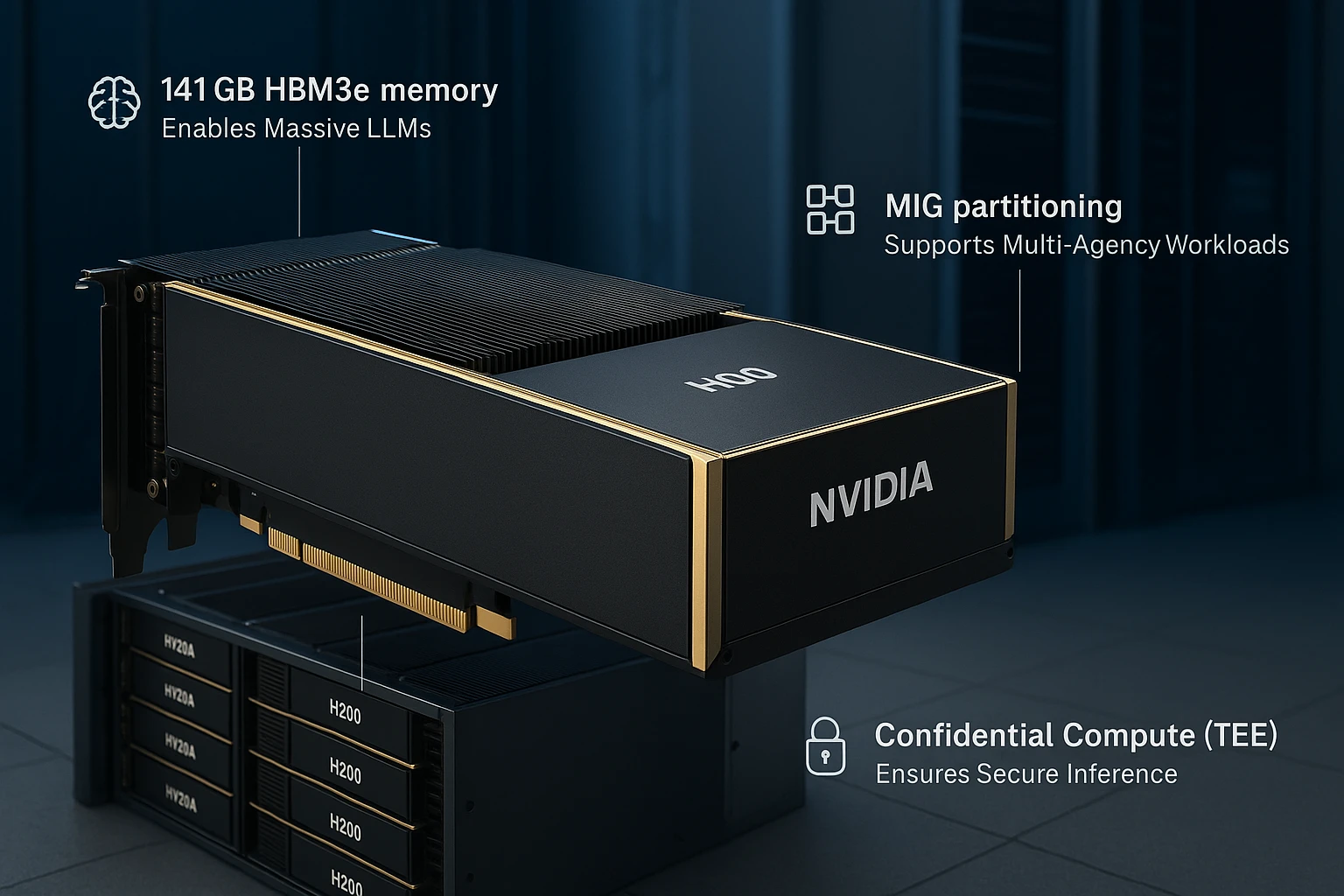
       

      NVIDIA H200 GPU in a secure data centre, showcasing its sovereign AI capabilities for large models and secure inference


      Component Semifly’s Offering
      AI Hardware NVIDIA H200 (PCIe or SXM), DGX/HGX systems
      Isolation MIG slicing, confidential compute (TEE)
      Custom Orchestration Terraform, Kubernetes, Slurm for secure AI deployment
      Compliance Templates Aligned with GDPR, HIPAA, EU AI Act, IndiaDP, and others
      Model Compatibility Hugging Face, Mistral, LLaMa2, BLOOM, regional LLMs


      Request a demo of Semifly’s Sovereign AI infrastructure blueprint


      7. Final Thought: Sovereignty Needs Infrastructure


      Sovereign AI isn’t about avoiding global AI—it’s about choosing how and where your AI runs.


      Any on-prem stack gets you started.
      The H200 gets you future-ready.


      And with Semifly, you don’t just get a GPU, you get a fully managed, policy-compliant, operational AI stack built for national scale.


      Let’s build sovereignty into your AI, block by block, byte by byte.
       

      Bookmark me
      Share on
      Comments
      Add your Comment

      Writing About AI

      Semifly

      is an engineer and a technologist with a diverse background spanning software, hardware, aerospace, defense, and cybersecurity. As CTO at Semifly, he leverages his extensive experience to lead the company’s technological innovation and development.

      Explore Nvidia’s GPUs

      Find a perfect GPU for your company etc etc
      Go to Shop

      FAQs

      • Sovereign AI goes beyond simply enacting laws and policies about artificial intelligence. It’s about a nation retaining tangible control over how AI is developed, governed, and deployed within its borders. This means owning and operating the entire AI stack—from data storage and processing to model training and inference—rather than relying on third-party cloud platforms or foreign infrastructure. Nations are increasingly recognising that without domestic compute capacity, their AI isn’t truly sovereign; it’s merely leased. This shift is driven by a desire to ensure data residency, prevent external influence, protect national security, and foster domestic innovation, as highlighted by initiatives like Europe’s AI Act and India’s Digital Public Infrastructure.

      • While policies, ethics, and data localisation are important components, they are insufficient on their own to achieve true Sovereign AI. The core issue is “who runs the AI stack?” If a country relies on external cloud providers for AI functions like inference, model hosting, or fine-tuning, it fundamentally lacks control. Real sovereignty requires domestic control over compute resources. This involves building dedicated “AI factories,” supercomputing initiatives, and on-premise solutions. Without local compute infrastructure, even the most robust policy frameworks are ineffective, as the actual processing and control of AI remain outside national purview.

      • Countries worldwide are making substantial investments to develop their national AI compute capacity. This includes:


        • AI Factories and Supercomputing Initiatives: Nations are procuring and operating sovereign AI clouds and supercomputers to serve as the “bedrock of modern economies.” These are next-generation data centres designed for intensive AI tasks.
        • Public and Private Sector Mobilisation: Governments are investing directly in public supercomputing infrastructure and also incentivising private sector investment to build commercial AI-specific data centres.
        • Compute Access Funds: Some nations are establishing funds to help domestic innovators and businesses purchase much-needed AI compute resources, addressing high costs and limited domestic capacity.


        Examples include Canada’s £1.2 billion (approx.) Canadian Sovereign AI Compute Strategy, the EU’s “InvestAI” initiative with a goal to triple AI compute capacity by 2027, and significant investments from countries like France, Germany, Japan, India, and Singapore in advanced GPU systems and large-scale AI infrastructure.

      • To make Sovereign AI operational and truly independent, control is needed at every layer of the AI stack:


        • Data: All data must be stored and processed within national borders to ensure residency and compliance.
        • Model: AI models must be governed and fine-tuned internally, allowing for national oversight and customisation without external influence.
        • Compute: AI workloads must be hosted in secure, regulatory-compliant infrastructure located domestically, typically on-premise.
        • Inference: The process of using trained models to make predictions or decisions must be air-gapped, auditable, and fully traceable within national control, preventing any external dependencies or data leakage.


        This layered control ensures comprehensive sovereignty over the entire AI lifecycle.

      • Moving AI workloads off public clouds is considered the crucial first step in reclaiming control for Sovereign AI. Even a standard on-premise GPU server offers significant advantages over public cloud platforms:


        • Full Data Residency: Ensures all data remains within national borders, complying with local regulations.
        • Removal of Third-Party Telemetry Leakage: Prevents external entities from collecting data on AI usage or model performance.
        • Control over Model Versions and Behaviour: Allows nations to dictate exactly how their AI models are updated, behave, and are accessed.
        • Enhanced Security: Provides a more secure and auditable environment, especially for sensitive data and national security applications, by eliminating external cloud dependencies and potential data spillage.


        On-premise infrastructure provides the essential baseline for sovereignty, acting as the “vehicle” to the “destination” of Sovereign AI.

      • Sovereign AI is being implemented across various critical sectors:


        • Public Sector LLM Inference: Governments are deploying large language models (LLMs) for internal use, with private GPU instances per agency, air-gapped environments to prevent API leakage, and fully auditable, local, and compliant responses.
        • Defense & Intelligence: Secure fine-tuning of open models within Trusted Execution Environments (TEEs), distributed inference in low-bandwidth or disconnected environments, and complete elimination of external cloud dependency or data spillage for sensitive operations.
        • Language & Cultural Models: Developing and deploying LLMs in native dialects for purposes like education, governance, and cultural preservation, ensuring that all training data and inference results remain securely within national archives.


        These applications demonstrate the practical benefits of controlling the AI stack end-to-end for national interests.

      • Semifly offers end-to-end solutions designed to help nations implement Sovereign AI. Their offerings include:


        • Turnkey Infrastructure: Providing advanced AI hardware like NVIDIA H200 (PCIe or SXM) and DGX/HGX systems.
        • Isolation Capabilities: Implementing features like MIG slicing and confidential compute (TEE) to ensure secure, isolated environments for AI workloads.
        • Custom Orchestration: Utilising tools like Terraform, Kubernetes, and Slurm for secure and efficient deployment of AI systems.
        • Compliance Templates: Offering pre-built frameworks aligned with major data protection and AI regulations such as GDPR, HIPAA, EU AI Act, and IndiaDP.
        • Model Compatibility: Ensuring compatibility with popular and regional LLMs, including Hugging Face, Mistral, LLaMa2, and others.


        Semifly positions itself as a provider of fully managed, policy-compliant, operational AI stacks built for national scale, moving beyond just hardware to provide complete sovereignty solutions.

      • The core message is that Sovereign AI is fundamentally about choosing how and where a nation’s AI runs, rather than merely avoiding global AI. It emphasises that true sovereignty is built block by block and byte by byte, with infrastructure as its foundation. Any on-premise AI stack is a crucial starting point, providing a baseline of control. For future-readiness and advanced capabilities, deploying powerful hardware like the NVIDIA H200 is key. Ultimately, achieving Sovereign AI means having a fully managed, policy-compliant, and operational AI stack controlled domestically, ensuring national interests are prioritised in the age of artificial intelligence.

      More Similar Insights and Thought leadership

      No Similar Insights Found

      semifly
      About Us