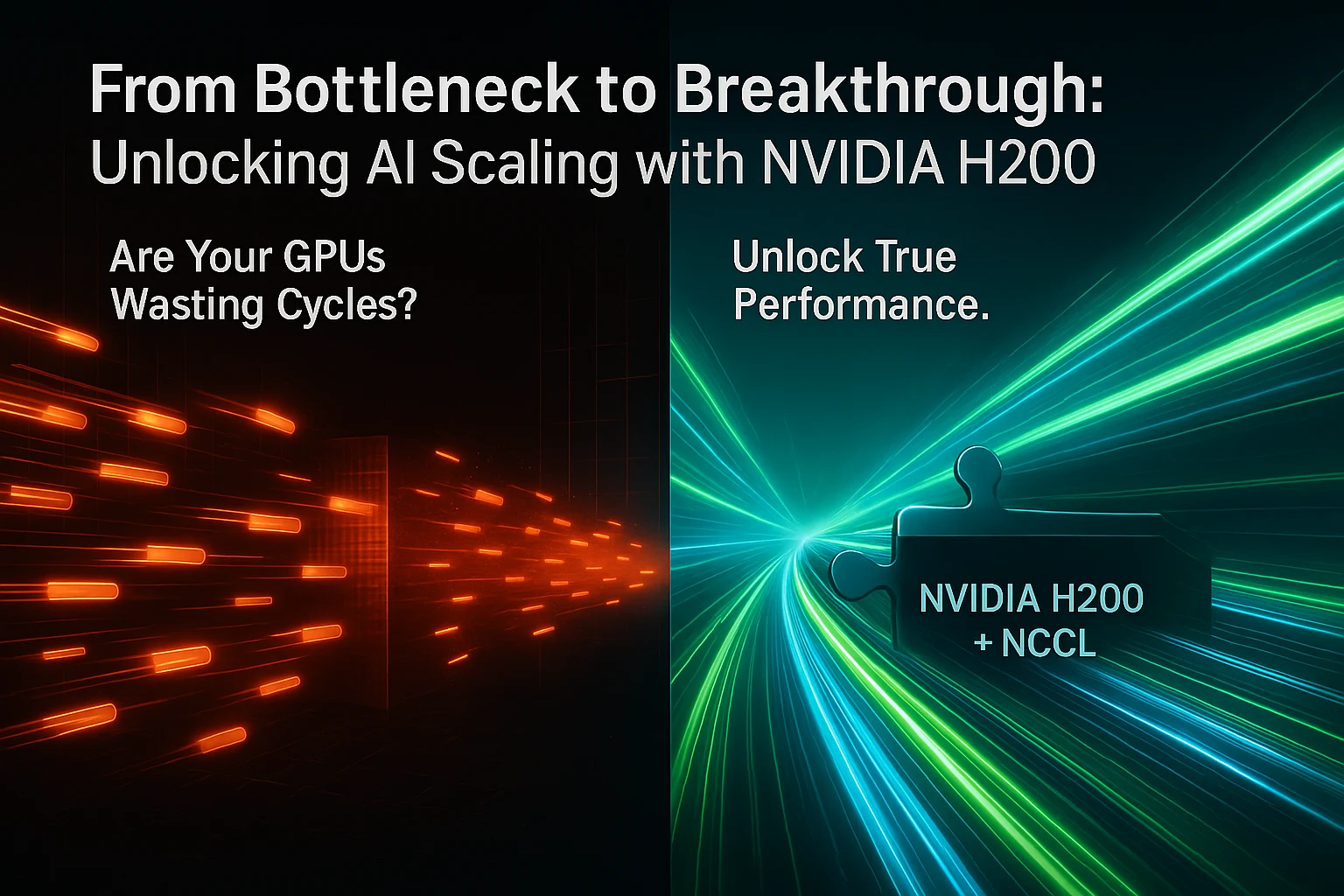
• FEATURED STORY OF THE WEEK

      Why NVIDIA H200 and NCCL Are Reshaping AI Training Efficiency at Scale

      Written by :  
      semifly
      Team Semifly
      3 minute read
      September 19, 2025
      Category : Information Technology
      Why NVIDIA H200 and NCCL Are Reshaping AI Training Efficiency at Scale

      The race to train larger, more sophisticated AI models is no longer just about raw compute—it’s about the speed, efficiency, and reliability of data movement across multi-GPU systems. And in this equation, the combination of NVIDIA H200 and NCCL (NVIDIA Collective Communications Library) is emerging as a critical performance enabler.

      The H200 delivers compute. NCCL ensures that compute isn’t wasted waiting for data.


      The Growing Complexity of AI Workloads


      AI workloads today are not confined to a single GPU or server. They span across entire clusters—sometimes across multiple racks and even data centers. Large Language Models (LLMs), generative AI, and real-time inferencing pipelines all require:


      • Low-latency inter-GPU communication
      • High-throughput data transfer
      • Efficient synchronization across distributed systems


      Even a small bottleneck in communication can create massive delays. That’s why the shift from “compute-centric” to “communication-aware” system design is in full motion.


      Infographic showing a communication bottleneck throttling data flow between idle GPUs in a multi-GPU system


      What Makes the NVIDIA H200 So Critical for NCCL Workloads?


      The NVIDIA H200 Tensor Core GPU, built on the Hopper architecture, is engineered not only for processing power but also for memory bandwidth and communication optimization. It introduces:


      • 141GB of HBM3e memory — nearly 2x the bandwidth of H100
      • NVLink 4.0 interconnects — enabling 900 GB/s GPU-to-GPU communication within nodes
      • Fourth-gen NVSwitch fabric — powering multi-GPU topologies at scale
      • FP8 precision support — ideal for LLM training and fine-tuning


      Architectural diagram of H200 GPUs in nodes, managed by an overarching NCCL software layer for efficient communication


      When paired with NCCL, these hardware capabilities unlock collective communication primitives (like AllReduce, AllGather, Broadcast, etc.) at much lower latency and higher throughput.


      Understanding NCCL: The Glue That Holds Multi-GPU Training Together


      NCCL is NVIDIA’s optimized library for multi-GPU and multi-node communication, handling all the heavy lifting of synchronizing weights and gradients during training. It supports:


      • Ring-based and tree-based topologies
      • Intra-node and inter-node communication
      • Native integration with PyTorch, TensorFlow, and JAX
      • Scalable performance with GPU Direct RDMA and NVLink


      While NCCL can run on older GPUs, its true potential is realized with modern architectures like the NVIDIA H200, where hardware interconnects are designed to support collective ops with minimal overhead.


      Table: H100 vs H200 for NCCL Collective Operations

      Feature NVIDIA H100 NVIDIA H200
      HBM Memory Size 80 GB HBM3 141 GB HBM3e
      Memory Bandwidth ~3.35 TB/s ~4.8 TB/s (est. with HBM3e)
      NVLink Bandwidth 600 GB/s 900 GB/s
      NVSwitch Support 3rd Gen NVSwitch 4th Gen NVSwitch
      NCCL Performance (AllReduce)* ~950 GB/s (multi-node) >1.4 TB/s (multi-node est.)

      *Estimates based on vendor benchmarks and internal model scaling results.


      Why This Matters: LLM Training, Scaling Laws, and Beyond

      Training a model like GPT-4 or Mixtral requires thousands of GPUs communicating tens of terabytes of gradients per second. If your communication layer (NCCL) lags behind, adding more GPUs does not give linear speedup—it just adds cost.


      With NVIDIA H200, NCCL can perform operations like AllReduce with less overhead, enabling:


      • Better parallelism efficiency
      • Fewer idle cycles
      • Improved GPU utilization
      • Faster convergence during training


      Real-World Impact: Faster Training, Lower TCO


      For enterprises building internal LLMs or hyperscalers fine-tuning models at scale, this combo directly reduces:


      • Training time (days → hours)
      • Power consumption per epoch
      • Rack space and cooling requirements
      • TCO over time due to better hardware utilization


      Conclusion: The Future Is Communication-Centric


      AI is scaling faster than Moore’s Law. As model sizes explode and deployment timelines shrink, the hardware-software pairing of NVIDIA H200 and NCCL is emerging as a foundational layer in future AI infrastructure.


      This isn’t just about speed—it’s about building infrastructure that scales smarter.


      Bookmark me
      Share on
      Comments
      Add your Comment

      Writing About AI

      Semifly

      is an engineer and a technologist with a diverse background spanning software, hardware, aerospace, defense, and cybersecurity. As CTO at Semifly, he leverages his extensive experience to lead the company’s technological innovation and development.

      Explore Nvidia’s GPUs

      Find a perfect GPU for your company etc etc
      Go to Shop

      FAQs

      • The fundamental shift in AI workload design is from a “compute-centric” approach to a “communication-aware” system design. Previously, the focus was primarily on raw processing power. However, with the increasing complexity and scale of AI models, particularly Large Language Models (LLMs), the efficiency and speed of data movement across multi-GPU and multi-node systems have become equally, if not more, critical. NVIDIA H200 and NCCL tackle the “bottleneck no one talks about”—the delays caused by inefficient communication, ensuring that compute resources are not wasted waiting for data.

      • NVIDIA H200 and NCCL work in tandem by combining cutting-edge hardware with optimised software. The H200 Tensor Core GPU provides high-bandwidth memory (141GB HBM3e) and high-speed interconnects (NVLink 4.0 at 900 GB/s, 4th-gen NVSwitch fabric), specifically engineered to facilitate rapid data transfer. NCCL (NVIDIA Collective Communications Library) is the software layer that leverages these hardware capabilities to efficiently manage and synchronise data movement, such as weights and gradients, across multiple GPUs and nodes. This synergy allows collective communication primitives (e.g., AllReduce, AllGather) to operate with significantly lower latency and higher throughput, making distributed AI training much more efficient.

      • The NVIDIA H200 introduces several key hardware enhancements vital for communication-intensive AI workloads:

        141GB of HBM3e memory: This nearly doubles the memory bandwidth compared to the H100, crucial for feeding data to the compute units quickly.

        NVLink 4.0 interconnects: These enable 900 GB/s GPU-to-GPU communication within nodes, significantly accelerating data exchange between GPUs.

        Fourth-gen NVSwitch fabric: This powers scalable multi-GPU topologies, facilitating efficient communication across a larger number of GPUs.

        FP8 precision support: This is particularly beneficial for LLM training and fine-tuning, allowing for more efficient processing.

        These features collectively optimise the H200 for handling the immense data movement demands of modern AI.

      • NCCL (NVIDIA Collective Communications Library) serves as the “glue” that synchronises and orchestrates data movement in multi-GPU and multi-node AI training. It is an optimised library responsible for handling all the heavy lifting of collective communication operations, such as synchronising weights and gradients. NCCL supports various communication topologies (e.g., ring-based, tree-based) and works across both intra-node (within a server) and inter-node (across multiple servers) communication. It integrates natively with popular AI frameworks like PyTorch, TensorFlow, and JAX, ensuring scalable performance, especially when paired with modern hardware like the H200 and technologies such as GPU Direct RDMA and NVLink.

      • The NVIDIA H200 significantly improves performance in NCCL collective operations compared to the H100 due to its advanced hardware. The H200 boasts:

        Greater HBM Memory Size: 141 GB HBM3e compared to H100’s 80 GB HBM3.

        Higher Memory Bandwidth: Approximately 4.8 TB/s (estimated) with HBM3e, versus H100’s ~3.35 TB/s.

        Increased NVLink Bandwidth: 900 GB/s, compared to H100’s 600 GB/s.

        Newer NVSwitch Support: 4th Gen NVSwitch, a generation ahead of H100’s 3rd Gen.

        These enhancements translate to a substantial boost in NCCL performance, for instance, an estimated AllReduce performance of over 1.4 TB/s (multi-node) for the H200, compared to ~950 GB/s for the H100. This means better parallelism efficiency, fewer idle cycles, and improved GPU utilisation.

      • For enterprises building internal LLMs or hyperscalers fine-tuning models at scale, the combination of H200 and NCCL yields significant real-world benefits:

        Faster Training Time: Reduces training time from days to hours, accelerating model development and deployment.

        Lower Total Cost of Ownership (TCO): Achieved through better hardware utilisation, which translates to reduced power consumption per epoch and potentially less rack space and cooling requirements.

        Improved Scaling: Enables more efficient scaling of AI models, preventing situations where adding more GPUs only adds cost without linear speedup due to communication bottlenecks.

        Faster Convergence: Leading to quicker model training and validation cycles.

        Essentially, it allows for building AI infrastructure that scales smarter, not just bigger.

      • Communication efficiency is critically important for training large models like GPT-4 or Mixtral because these models require thousands of GPUs to work in concert, exchanging tens of terabytes of gradients per second. If the communication layer (NCCL) is inefficient or lags, adding more GPUs does not result in a proportional speedup; instead, it merely increases costs without enhancing performance. Bottlenecks in inter-GPU communication, data transfer throughput, or system synchronisation can lead to massive delays, idle GPU cycles, and suboptimal resource utilisation. The ability of H200 and NCCL to perform collective operations with minimal overhead directly impacts the parallelism efficiency and overall training speed of these immense models.

      • The statement “The future is communication-centric” implies a fundamental reorientation in how AI infrastructure is designed and optimised. It signifies that as AI models continue to grow exponentially in size and complexity, raw computational power alone is insufficient. The bottleneck has shifted from processing speed to the speed, efficiency, and reliability of data movement and synchronisation across distributed systems. Future AI infrastructure must prioritise high-bandwidth memory, ultra-fast interconnects, and highly optimised communication libraries (like NCCL) to ensure that the compute resources are fully utilised and not starved for data. This focus will be crucial for achieving scalable performance, reducing training times, and ultimately lowering the total cost of ownership for advanced AI workloads.

      semifly
      About Us