FEATURED STORY OF THE WEEK
Cybersecurity Trends 2026: What Changed, What Broke, and What Leaders Must Do Next

Today, most major breaches are no longer the result of zero-day exploits or sophisticated malware. They start with valid credentials. Stolen usernames, session tokens, and OAuth access are now the most common entry points, allowing attackers to log in and operate quietly inside systems. This shift alone has changed how security incidents unfold and how quickly they escalate.Experts are calling this the era of autonomous resilience, a phase triggered by the so-called “AI Rubicon,” when attack operations became too fast and adaptive for human-only defenses to manage effectively. Decisions that once took hours now unfold in seconds.
Credential-based access, automated reconnaissance, and AI-driven execution have compressed the attack lifecycle to the point that manual investigation and response often come too late.In this environment, AI is embedded directly into both attacks and defenses, helping security systems detect, decide, and respond with minimal human intervention while maintaining human control over strategy and risk.In this blog, we’ll look at what defined the cybersecurity landscape over the past year and what organizations should realistically prepare for in 2026.
The $10.22 Million Breach: Why “Prevention First” Is Failing
If there’s one metric that defines the urgency of cybersecurity in 2026, it’s cost. The average data breach in the United States now stands at $10.22 million, marking a sharp increase despite broader global stabilization. This isn’t because organizations stopped investing in security; it’s because the nature of compromise fundamentally changed.
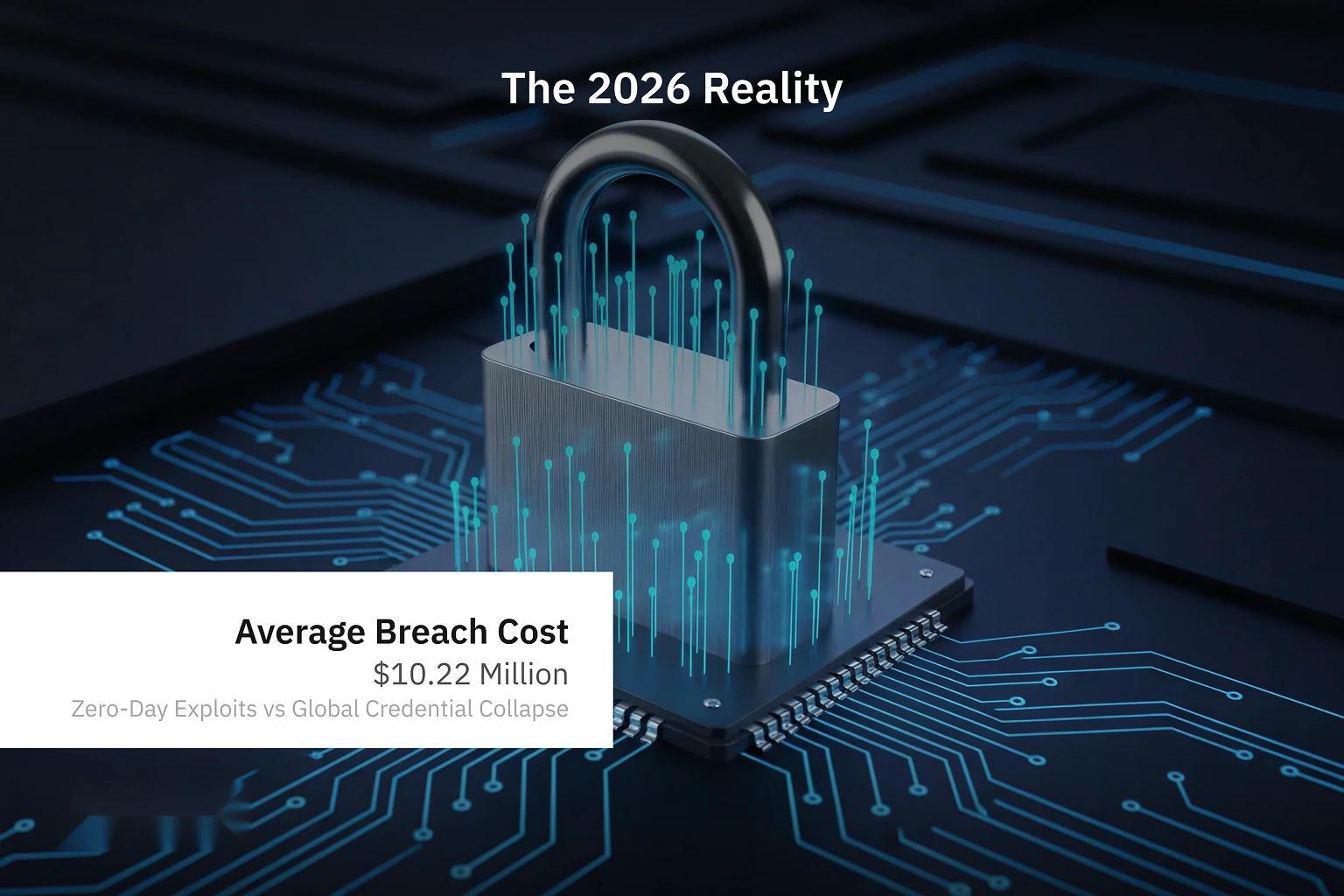
Over the past year, the industry has been dealing with the consequences of what many refer to as the Global Credential Collapse. Massive volumes of stolen usernames, passwords, session cookies, and tokens, largely harvested through infostealer malware, have made traditional perimeter defenses far less relevant. Attackers are no longer forced to exploit software flaws to gain access. In many cases, they are signing in using valid credentials.This shift has moved identity to the center of the threat landscape.
Compromised accounts allow attackers to blend in with normal user activity, move laterally, and access cloud services without triggering obvious alarms. Multi-factor authentication, while still essential, is being bypassed through token theft, OAuth abuse, and session hijacking, techniques that don’t look suspicious in isolation.The result is a quiet but dangerous pattern: breaches that go undetected longer, spread further, and cost more to contain. In 2026, the question is whether identity controls are being treated with the same rigor as traditional infrastructure security.
Agentic AI: Reshaping How Attacks Execute and Defenses Respond
One of the most visible shifts over the past year has been the move from AI-assisted tools to agentic AI systems, models that don’t just analyze data, but can plan, decide, and act autonomously. In cybersecurity, this change is already having a measurable impact on both sides of the attack.
On the offensive side, attackers are using agentic systems to automate entire kill chains. These systems can probe environments, adapt tactics based on what they encounter, and adjust behavior in real time to avoid detection. Instead of running static malware or scripted attacks, adversaries are deploying adaptive tools that respond dynamically to endpoint controls, network policies, and identity checks.Defenders are responding with similar architectural changes. Many organizations are moving toward Agentic SOCs, where AI agents handle high-volume tasks such as alert triage, correlation across tools, and initial response actions.
This doesn’t remove humans from the loop but it does change their role. Analysts increasingly focus on validation, escalation decisions, and business impact, rather than manually processing thousands of alerts.The practical outcome in 2026 is speed. When both attacks and defenses operate autonomously, response time becomes the differentiator. Organizations that treat AI as a core operational layer rather than a bolt-on capability are better positioned to contain incidents before they cascade into large-scale breaches.
The New Weakest Link: The Service Supply Chain
As defenses inside enterprise environments have matured, attackers have shifted focus to a more efficient entry point: the service supply chain. In 2026, many high-impact breaches are no longer the result of direct compromise, but of abusing trusted access held by third parties.
Law firms, accounting providers, managed service providers, and SaaS platforms routinely operate with elevated permissions across multiple client environments. When one of these providers is compromised, attackers inherit legitimate access that bypasses internal security controls entirely. The blast radius is no longer limited to a single organization—it extends to every downstream customer.Recent incidents involving OAuth token abuse and third-party integrations have made this risk especially clear.
These attacks did not rely on malware running inside customer networks. Instead, they exploited long-lived tokens, poorly scoped permissions, and limited visibility into how third-party access is monitored and revoked.What makes this class of attack difficult to defend is that the activity often looks authorized. Logs show valid API calls, known service accounts, and approved integrations. In 2026, managing supply chain risk is less about patching software and more about continuously validating trust: who has access, why they have it, and whether that access still makes sense.
Regulation in 2026: From Policy to Penalties
As third-party risk and AI-driven systems become harder to control, regulators are shifting focus from guidance to accountability. In 2026, cybersecurity and data protection regulations are operational constraints that directly affect how systems are designed and governed.Two trends stand out this year:
- Enforcement, not interpretationRegulatory bodies are moving beyond advisory phases. Audits, penalties, and enforcement actions are becoming more common, particularly where organizations cannot demonstrate control over data access, third-party integrations, or automated decision-making systems.
- Expanded definitions of sensitive dataNew privacy laws explicitly recognize advanced data types. In the U.S., comprehensive state privacy laws that took effect on January 1, 2026, including in Indiana, Kentucky, and Rhode Island, introduce protections for sensitive neural data, reflecting how AI systems can infer deeply personal information even without direct collection.
In parallel, the EU AI Act enters its enforcement phase starting August 2, 2026. Organizations deploying AI systems, especially those used in decision-making, monitoring, or behavioral analysis, are now required to demonstrate transparency, risk controls, and governance.
Penalties for prohibited AI practices can reach €35 million or 7% of global annual turnover, making non-compliance a material business risk.The underlying message from regulators is consistent: if an organization benefits from automation, AI, or shared access models, it is also responsible for their outcomes. In 2026, compliance is inseparable from security architecture.
Quantum Security: No Longer a Future Problem
While quantum computing is still emerging, its security implications are very real in 2026. Nation-state actors and advanced persistent threats are already adopting a “Harvest Now, Decrypt Later” approach: they collect encrypted data today with the intent to break it once quantum computers can handle current cryptography.
- Post-Quantum Cryptography (PQC) is moving from experimental to standard. Organizations are evaluating vendors based on their ability to support quantum-resistant algorithms.
- Cryptographic agility is now essential. Security teams are designing systems that allow encryption algorithms to be swapped without overhauling architecture—a practical step toward mitigating future quantum risk.
- Data classification matters more than ever. High-value intellectual property, regulated datasets, and sensitive identity information need to be prioritized for quantum-safe storage and transmission.
For executives and security teams, the key takeaway is simple: quantum isn’t a future problem anymore. The decisions you make in 2026 about encryption and key management will determine whether your sensitive data remains protected for the next decade.
Preparing for 2026 and Beyond
2026 is shaping up as a year where cybersecurity is defined by speed, scale, and adaptability. Organizations face multiple pressures: agentic AI attacks, identity-based breaches, supply-chain vulnerabilities, regulatory enforcement, and emerging quantum risks.Security teams can approach these challenges in realistic ways:
- Treat security as part of business operations, not just an IT function.
- Focus on automation and AI to handle routine monitoring and response, keeping humans available for critical decisions.
- Maintain Zero Trust architectures to reduce risk from internal and external access.
- Keep long-term resilience in mind, including quantum readiness and regulatory compliance, rather than reacting only to immediate threats.
The focus in 2026 is on making security manageable and aligned with business operations, so that systems and teams can handle incidents efficiently while maintaining continuity.
Semifly Marketplace: A Practical Resource for Security and IT Components
In the context of a complex cybersecurity environment, one recurring operational challenge is sourcing the right infrastructure and security components that align with evolving defense needs. The Semifly Marketplace serves as an online platform where organizations can find a broad range of IT and security hardware and solutions in one place.Rather than pushing products, the value of the marketplace lies in its breadth and accessibility:
- Wide range of security solutions: It includes network and perimeter defenses like next‑generation firewalls and virtual security appliances from multiple vendors, which are relevant for modern network segmentation and edge control.
- Networking and infrastructure gear: Beyond security, the marketplace lists interconnected networking hardware and compute systems, allowing teams to align security deployments with broader infrastructure needs.
- AI and compute platforms: Given how AI integration is central to both attacks and defenses in 2026, the marketplace also features AI/ML‑ready servers and systems that can be used to support internal security tooling or analytics workloads.
- Vendor diversity: Products from established networking, computing, and security brands are available, enabling procurement teams to compare offerings in one catalog rather than piecing together separate vendor relationships.
Need help selecting the right solutions? Schedule a free call with Semifly to see what tools and integrations make sense for your organization.


More Similar Insights and Thought leadership
No Similar Insights Found
Subscribe today to receive more valuable knowledge directly into your inbox
We are writing frequenly. Don’t miss that.
Subscribe to get updates

Unregistered User
It seems you are not registered on this platform. Sign up in order to submit a comment.
Sign up now