
• Reducing the Carbon Footprint: Energy-Saving Strategies for Data Centers
      Reducing the Carbon Footprint: Energy-Saving Strategies for Data Centers
      FEATURED INSIGHT OF THE WEEK

      Reducing the Carbon Footprint: Energy-Saving Strategies for Data Centers

      Data centers, the backbone of our digital world, are massive energy consumers. As their demand surges, utilizing renewable energy sources becomes imperative. This article explores energy consumption in data centers, projected future usage, energy-saving strategies, and the critical role of renewables in ensuring a sustainable future.

      4 minute read

      Search Insights & Thought Leadership

          Cybersecurity Trends 2026: What Changed, What Broke, and What Leaders Must Do Next

          Cybersecurity Trends 2026: What Changed, What Broke, and What Leaders Must Do Next

          Cybersecurity in 2026 is defined by "autonomous resilience" because the "AI Rubicon" has made attacks too fast for human-only defences to manage. Most breaches now stem from the "Global Credential Collapse," where attackers use stolen credentials and session tokens to bypass traditional perimeters. This fundamental change has pushed average breach costs to $10.22 million. To counter agentic AI attacks, organisations are implementing Agentic SOCs to automate triage and response. Additionally, the service supply chain is a critical vulnerability as third-party access creates a massive "blast radius" for compromises. Regulators have moved to strict enforcement, with the EU AI Act carrying penalties of up to €35 million. Organisations must also adopt quantum-resistant cryptography to combat "Harvest Now, Decrypt Later" tactics. AI-ready infrastructure to support these resilient architectures is available through the Semifly Marketplace.

          8 minute read

          Unleashing Computational Fluid Dynamics (CFD) with NVIDIA DGX H200

          Unleashing Computational Fluid Dynamics (CFD) with NVIDIA DGX H200

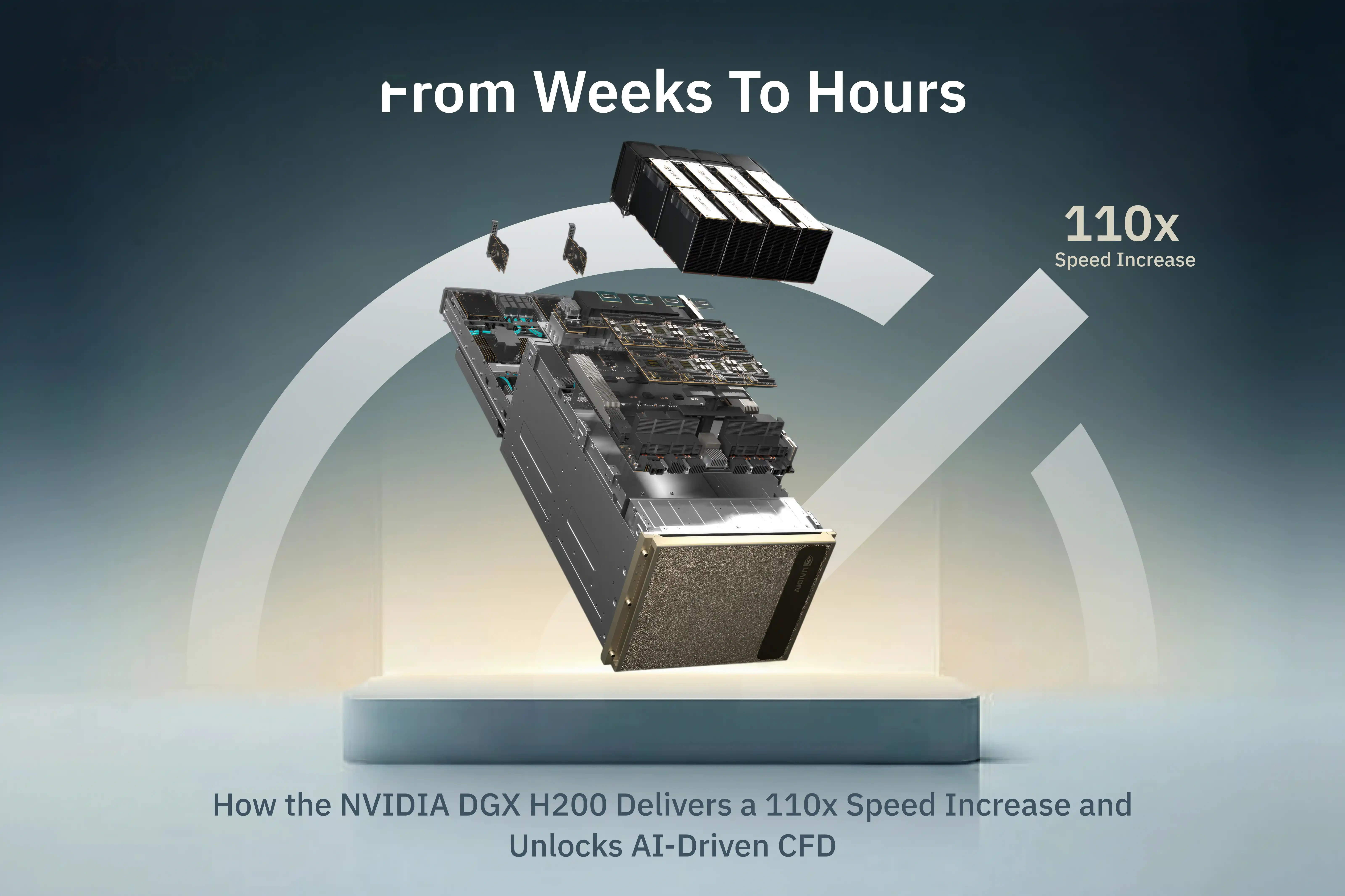
          Computational Fluid Dynamics (CFD) has moved from being a specialist’s tool to becoming a hallmark of modern engineering and research. From fine-tuning the aerodynamics of a Formula 1 car to simulating complex blood flow patterns in healthcare, engineers now rely on CFD for insights that are both fast and precise. But delivering this level of fidelity comes at a steep computational cost, one that traditional CPU clusters and earlier GPUs often struggle to handle. The NVIDIA DGX H200 meets this demand head-on, bringing together next-generation GPU performance and AI integration to accelerate large-scale CFD workloads, improve accuracy, and make scaling more seamless than ever before.

          8 minute read

          The NVIDIA H200 GPU and the Dawn of Hardware-Aware AI Infrastructure

          The NVIDIA H200 GPU and the Dawn of Hardware-Aware AI Infrastructure

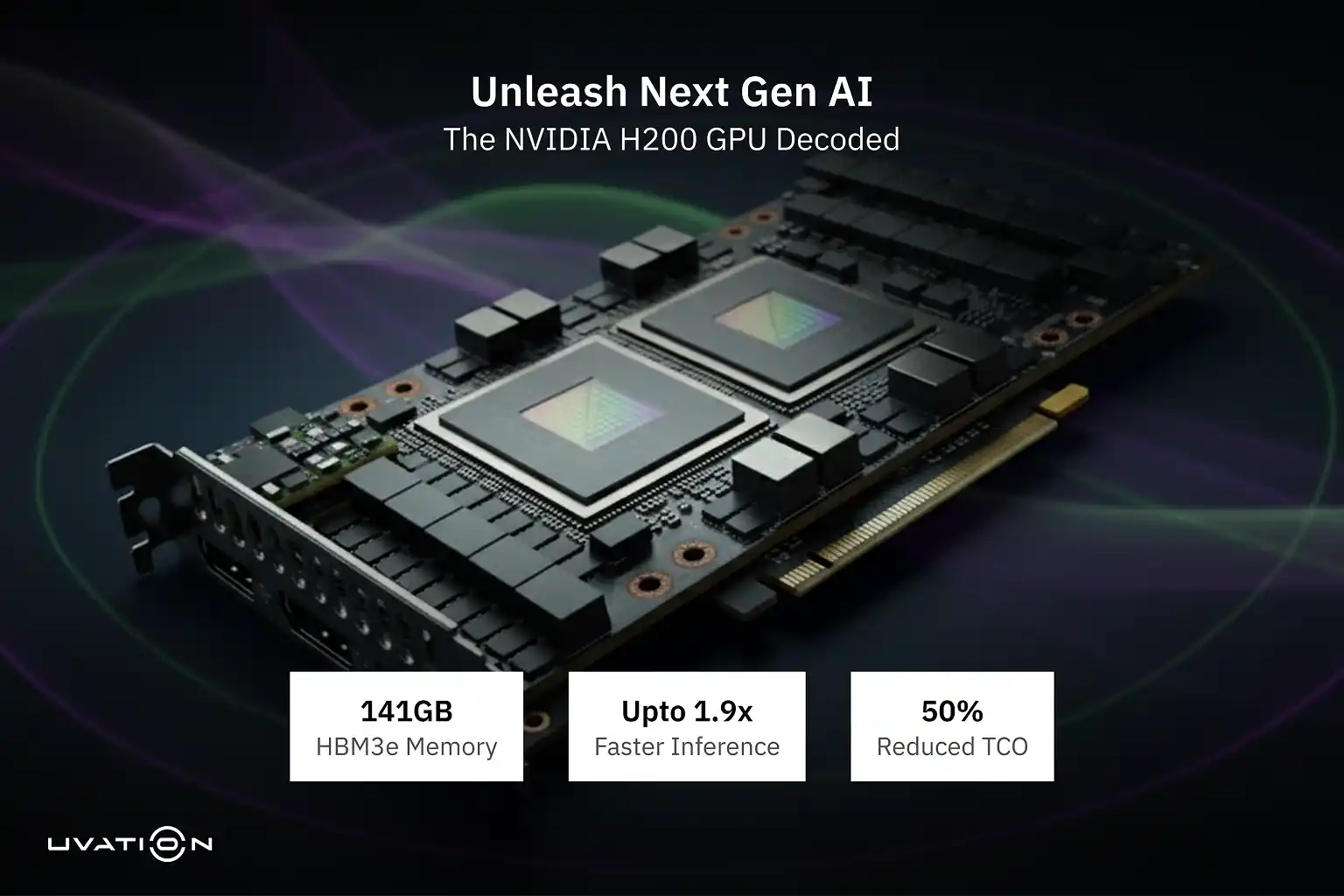
          The NVIDIA H200 Tensor Core GPU is designed to address memory capacity and bandwidth bottlenecks crucial for Large Language Models (LLMs). Utilizing HBM3e memory, it provides 141 GB of GPU memory and a 4.8 TB/s bandwidth, representing a 1.4x increase over the H100. This capacity facilitates the serving of models with over 100 billion parameters and delivers up to 1.9x faster LLM inference. For distributed AI, the H200 leverages high-speed NVLink and NVSwitch interconnects. However, scalability requires addressing collective communication challenges and dynamic workload skew, particularly in MoE models, often through sophisticated, communication-aware schedulers. The high computational density demands up to 10.2 kW for a DGX system, necessitating liquid cooling to prevent thermal imbalance and subsequent clock throttling. Despite the complexity, the H200 promises up to 50% reduced TCO for LLM inference due to its superior power efficiency. The H200 era emphasizes the need for full-stack optimization and intelligent hardware-software co-design.

          7 minute read

          NVIDIA H200 and NVLink: Powering the Next Leap in Enterprise AI Infrastructure

          NVIDIA H200 and NVLink: Powering the Next Leap in Enterprise AI Infrastructure

          The NVIDIA H200 GPU and NVLink interconnect establish a new standard for enterprise AI infrastructure by addressing performance limitations caused by data movement, which often causes GPUs to idle. The H200 features a breakthrough 141 GB of HBM3e memory, delivering 4.8 TB/s of memory bandwidth, approximately a 1.4x increase relative to the H100. NVLink complements this by providing a high-speed, direct interconnect between GPUs, offering up to 900GB/s of bidirectional bandwidth to bypass PCIe limitations. When deployed together, they create a unified compute fabric that allows multi-GPU systems to operate as a single logical accelerator, supporting memory pooling and rapid data exchange crucial for large language models (LLMs) and HPC. This combination translates into shorter training times, improved energy efficiency, lower compute costs per workload, and critical architectural headroom for future scaling and risk mitigation

          11 minute read

          Technology

          H200 GPU Memory Bandwidth: Unlocking the 4.8 TB/s Advantage for AI at Scale

          H200 GPU Memory Bandwidth: Unlocking the 4.8 TB/s Advantage for AI at Scale

          The NVIDIA H200 GPU significantly advances AI performance with its 4.8 terabytes per second (TB/s) memory bandwidth, enabled by 141 GB of next-generation HBM3e. This represents a 76% increase in capacity over H100’s HBM3 and ensures continuous data flow to the Hopper architecture’s Tensor Cores, preventing computational stalls. This substantial bandwidth is critical for today's demanding AI workloads, including Large Language Models (LLMs) with extended context windows, Multi-Modal AI, Retrieval-Augmented Generation (RAG) pipelines, and fine-tuning with large batches. Leveraging the H200’s full potential requires careful architecture and optimisation, such as aligning model parallelism and utilising NVLink/NVSwitch topologies. Proper optimisation dramatically improves sustained GPU utilisation, increases tokens per second, reduces epoch times, and lowers power costs. Companies like Semifly assist enterprises in exploiting this bandwidth ceiling, ensuring peak real-world throughput. Ultimately, memory bandwidth is now a decisive factor in AI compute performance.

          4 minute read

          Automotive

          NVIDIA SuperNIC: The Hidden Powerhouse of AI Cloud Data Centers

          NVIDIA SuperNIC: The Hidden Powerhouse of AI Cloud Data Centers

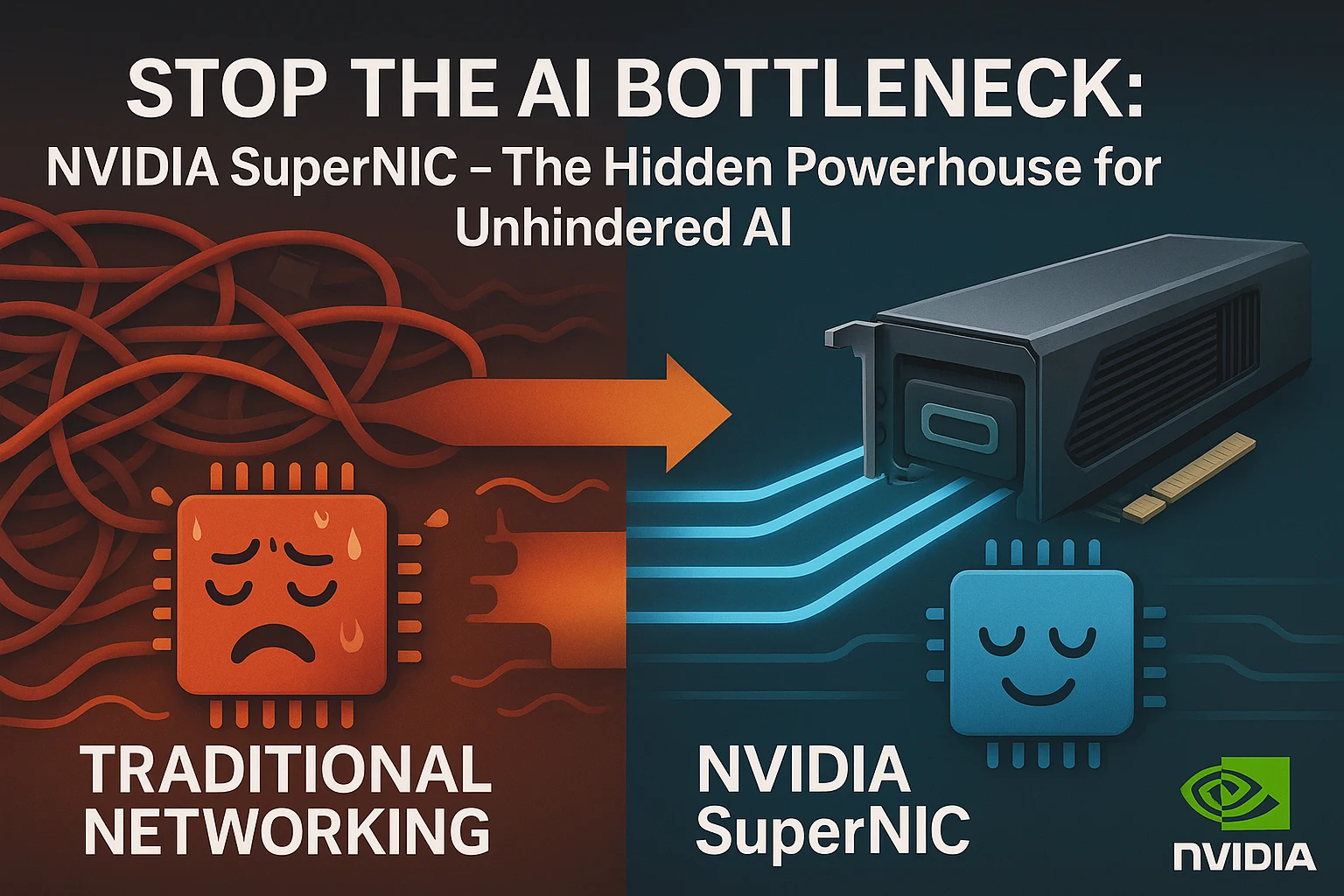
          NVIDIA SuperNICs are the hidden powerhouse of AI cloud data centres, providing the high-throughput, low-latency networking essential for ultra-scale AI workloads. Traditional networking struggles with AI's demands, causing bottlenecks due to variable latency, scaling complexity, and CPU consumption. SuperNICs, including BlueField-3 (400 Gb/s) and ConnectX-8 (up to 800 Gb/s), are Ethernet accelerators engineered for massive AI environments. They utilise RDMA over Converged Ethernet (RoCE) to bypass the CPU, delivering deterministic low-latency and secure multi-tenant isolation, crucial for large language model (LLM) training and inference. When combined with Spectrum-X Networking Fabric, they boost generative AI network performance by 1.6×. Semifly integrates these SuperNICs to build scalable, secure, and predictable AI infrastructure.

          4 minute read

          Training & Fine-Tuning on NVIDIA H200: From Blank Slate to Business Value

          Training & Fine-Tuning on NVIDIA H200: From Blank Slate to Business Value

          This guide, "NVIDIA H200 Training & Fine-Tuning: From Blank Slate to Business Value," serves as an advanced technical guide for AI engineers, ML teams, CTOs, and solution architects. Its core aim is to demonstrate how to transform raw NVIDIA H200 compute into reliable, production-grade AI outcomes, focusing on maximum performance. The NVIDIA H200 offers advantages like 141 GB HBM3e memory, a Transformer Engine with FP8, and NVLink/NVSwitch, leading to shorter time-to-convergence for pretraining and faster fine-tuning. The guide details how to architect training pipelines covering data, precision, parallelism, optimisers, and I/O, as well as fine-tuning strategies like LoRA/QLoRA and methods to control risks like catastrophic forgetting. Crucially, it emphasises pre-flight readiness to prevent costly failures. Semifly assists in designing this end-to-end recipe, providing architectural solutions, customised playbooks, and benchmark reporting to ensure efficient scaling and delivery of business value.

          6 minute read

          Nvidia CUDA Cores: The Engine Behind H200 Performance

          Nvidia CUDA Cores: The Engine Behind H200 Performance

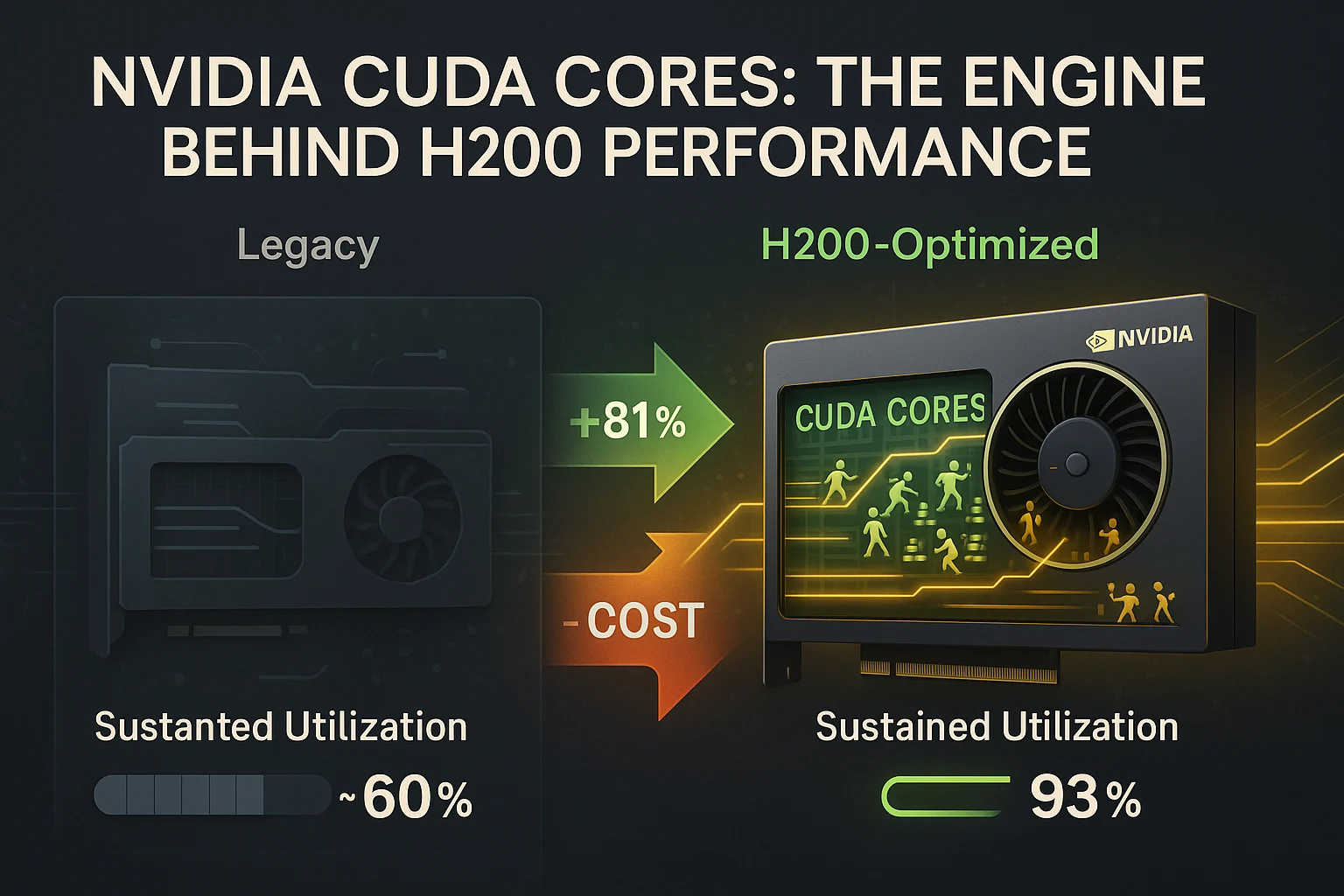
          NVIDIA CUDA Cores are the parallel compute units driving AI and HPC workloads, with the H200 GPU representing their fullest expression. The H200 significantly boosts performance by providing 4.8 TB/s memory bandwidth, 141 GB HBM3e, and FP8 precision, ensuring CUDA Cores are continuously fed and highly utilised. Throughput, not theoretical FLOPs, is the true measure of CUDA Core effectiveness, with H200 enabling up to 380K tokens/sec for 70B FP8 LLMs. Proper architecture and orchestration are critical to keep these cores saturated, avoiding pitfalls like memory fragmentation and outdated builds. When optimised, H200 clusters deliver unmatched performance-to-cost ratios, showing gains of +81% in throughput and -38% in power cost, leading to significant ROI and business outcomes.

          5 minute read

          Education

          H200 Performance Gains: How Modern Accelerators Deliver 110X in HPC

          H200 Performance Gains: How Modern Accelerators Deliver 110X in HPC

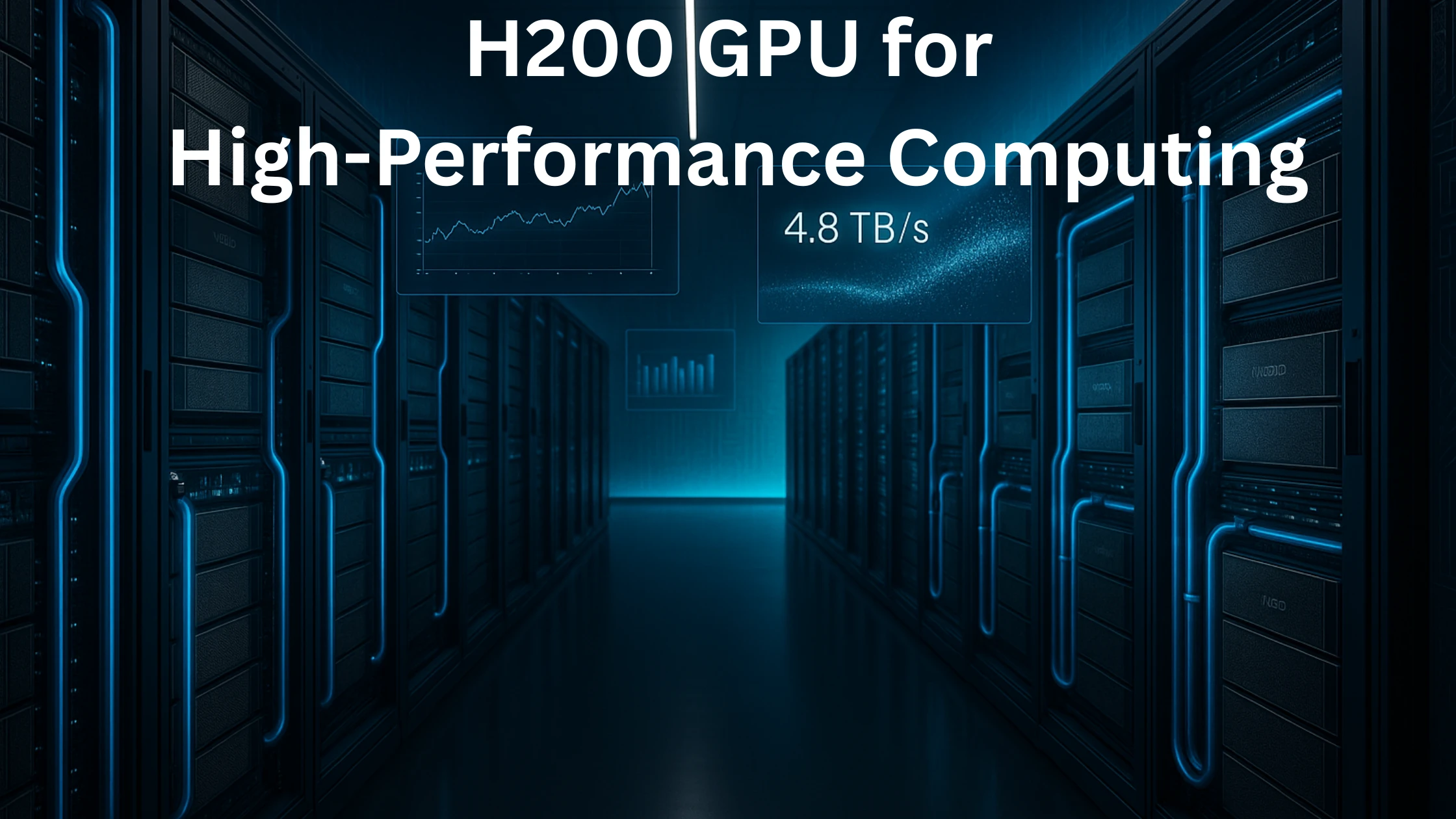
          The NVIDIA H200 GPU marks a significant leap in high-performance computing (HPC) and AI inference. Featuring 141GB of HBM3e memory and 4.8 TB/s bandwidth, it surpasses the H100 and A100, solving memory bottlenecks common in large language models and scientific simulations. Equipped with NVLink fabric and Gen 2 Transformer Engines, the H200 enables 110X faster performance in real-world applications like genomics, climate modeling, and computational fluid dynamics. Compared to legacy A100 clusters, H200 clusters deliver significantly reduced latency and higher token throughput, lowering cost per user and improving total cost of ownership (TCO). Semifly benchmarks show the H200 achieving up to 11,819 tokens per second in LLaMA 13B inference workloads. For enterprises seeking efficient HPC acceleration, the H200 offers a scalable, memory-optimized solution with turnkey deployment options, helping organizations reduce infrastructure costs while maximizing AI and scientific computing performance.

          4 minute read

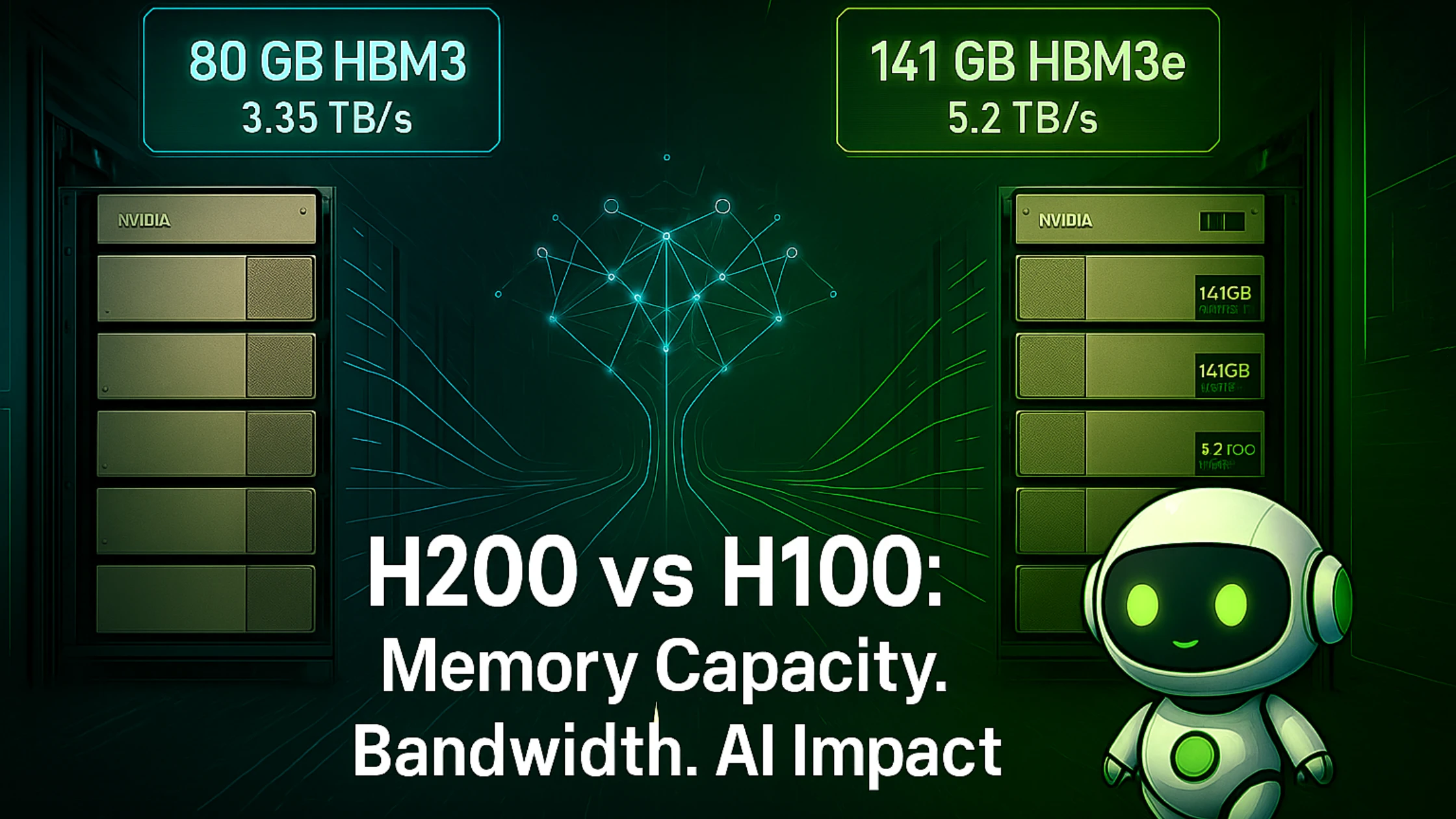
          H200 vs H100 GPU Memory: Which One Is Better for AI Workloads?

          H200 vs H100 GPU Memory: Which One Is Better for AI Workloads?

          GPU memory is now the biggest bottleneck in AI workloads, surpassing raw FLOPS, as modern AI depends more on memory bandwidth and size. The NVIDIA H200 significantly advances performance by offering 141 GB HBM3e memory and 5.2 TB/s bandwidth, compared to the H100's 80 GB HBM3 and 3.35 TB/s. This provides LLMs with 76% more memory and 1.5x bandwidth, giving them "breathing room". The H200 enables smoother attention head traversal and reduces token-level latency, for instance, being 44% faster for 128K token windows. It excels in enterprise GenAI inference due to consistent latency, higher session concurrency, and memory-persistent batching. Furthermore, the H200 benefits HPC and FP8 training workloads, increasing throughput for tasks like GPT-3 13B fine-tuning by 1.5x. The H200 is therefore the preferred GPU for memory-heavy AI workloads such as public GenAI and RAG + Vision GenAI, with memory being the new AI performance ceiling.

          3 minute read

          1–10 of 76 items
          of 8 pages
          semifly
          About Us