• FEATURED STORY OF THE WEEK

      NVIDIA SuperNIC: The Hidden Powerhouse of AI Cloud Data Centers

      Written by :  
      semifly
      Team Semifly
      4 minute read
      September 4, 2025
      Category : Artificial Intelligence
      NVIDIA SuperNIC: The Hidden Powerhouse of AI Cloud Data Centers
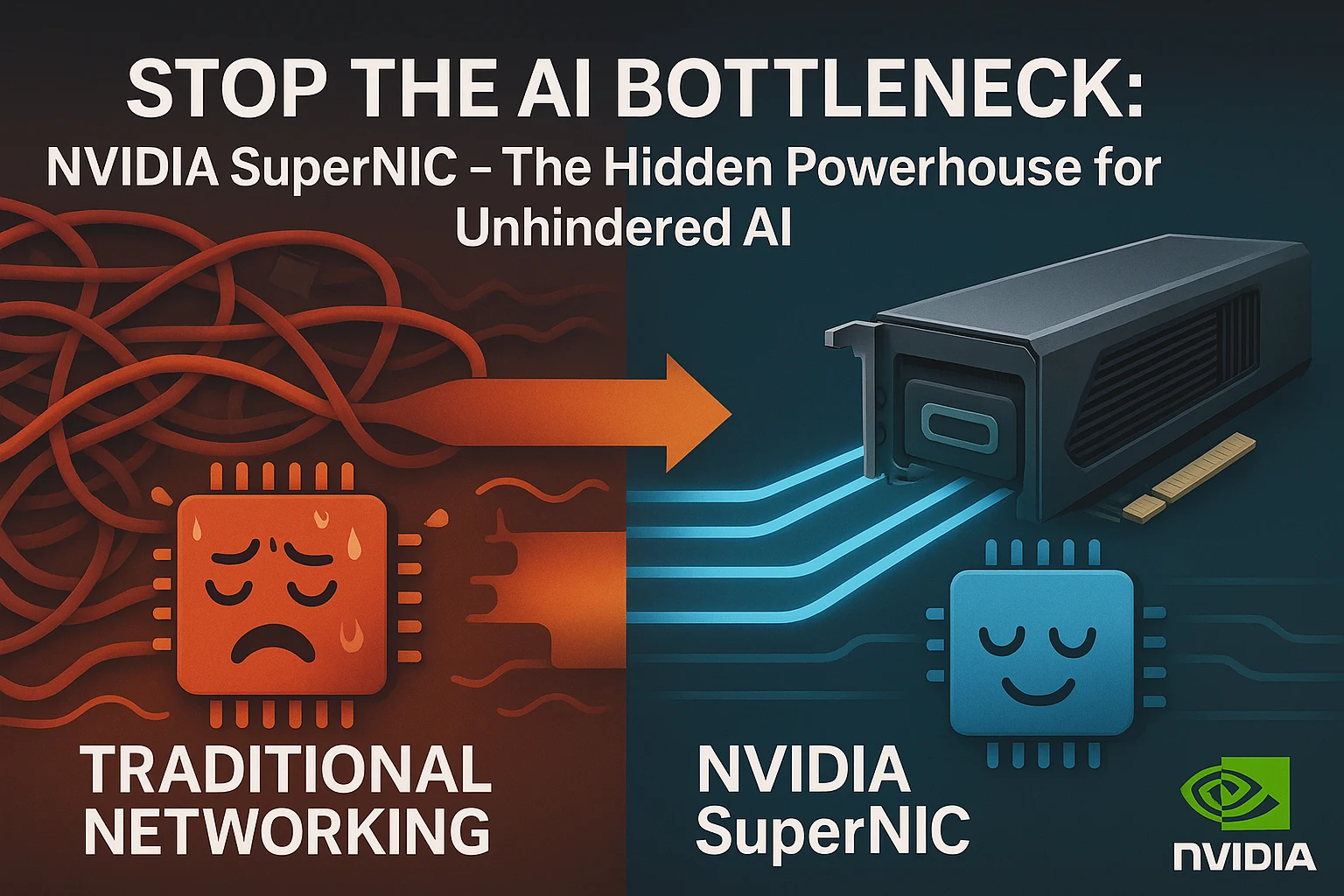
      When you think about AI cloud data centers, your focus naturally goes to GPUs—they’re the powerhouses of AI compute. But what if the real game-changer lies in how GPUs are connected, not just how many you deploy?


      That’s where NVIDIA SuperNIC steps in. It’s not a marketing gimmick—SuperNIC is the foundation for high-throughput, low-latency infrastructure required by ultra-scale AI workloads.
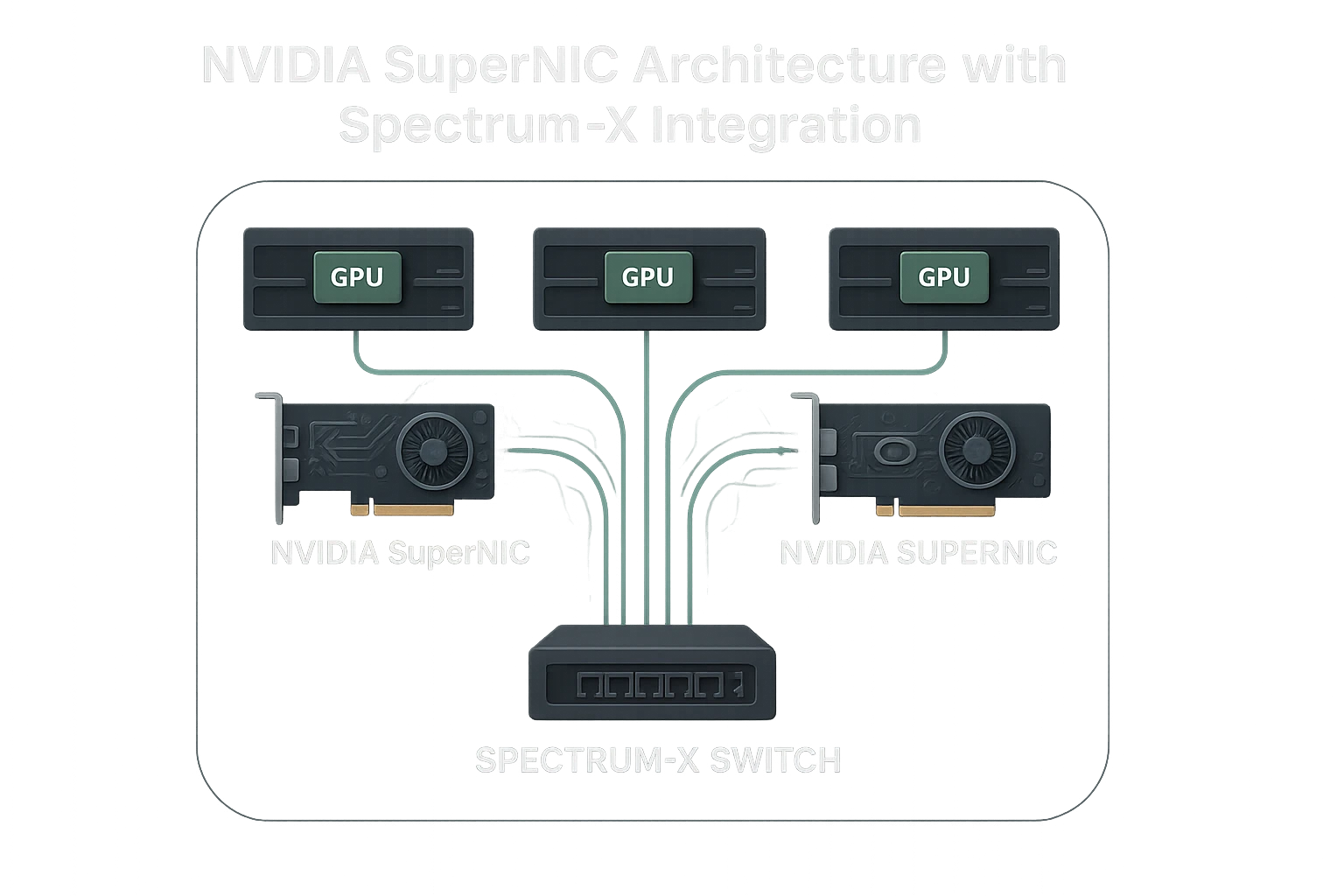
       

      Guide for an image illustrating NVIDIA SuperNIC architecture with Spectrum-X and GPU-server integration


      Addressing the Networking Bottleneck in AI Cloud Data Centers


      AI workloads—especially distributed model training and inference—place brutal demands on networking. Traditional Ethernet just wasn’t built for this:


      • It can’t guarantee microsecond-level latency.
      • Scaling bandwidth to match GPU demands is costly and complex.
      • It consumes CPU cycles during data movement, reducing AI efficiency.
      • Network jitter undermines synchronization in multi-node clusters.


      This isn’t just a networking challenge—it’s an AI infrastructure bottleneck. The NVIDIA SuperNIC is purpose-built to remove that bottleneck.


      What Makes NVIDIA SuperNIC Essential for AI Cloud Data Centers


      Per NVIDIA’s networking architecture, SuperNICs are a new breed of Ethernet accelerators engineered for massive-scale AI environments:


      • BlueField-3 SuperNIC — 400 Gb/s RDMA over Converged Ethernet (RoCE), delivering deterministic, isolated performance and secure multi-tenancy.
      • ConnectX-8 SuperNIC — Supports up to 800 Gb/s RDMA, accelerating generative AI workloads and enabling hyperscale fabric deployments.


      These aren’t incremental upgrades—they represent a shift in architecture, where GPUs and network are deeply integrated to power AI compute at scale.


      A key NVIDIA platform—the Spectrum-X Networking Fabric, which combines Spectrum switches with SuperNICs—boosts generative AI network performance by 1.6× compared to traditional Ethernet.


      SuperNIC vs Traditional NICs: Why the Difference Matter

      Feature Traditional NICs NVIDIA SuperNIC (BlueField/ConnectX)
      Max Throughput Up to 100 Gb/s Up to 800 Gb/s
      Protocol Standard TCP/IP RDMA (RoCE) with GPUDirect support
      CPU Involvement High (for packet processing) Offloaded (freeing CPU cycles for AI workloads)
      Latency Variable (unpredictable) Deterministic low-latency
      Multi-Tenant Isolation Limited Secure, hardware-enforced
      AI/ML Optimization Not AI-specific Designed for LLM training and inference
      Fabric Integration Manual setup Integrated with Spectrum-X Ethernet Fabric

      This leap isn’t just technical—it’s architectural. SuperNICs create predictability, scale, and security where traditional NICs introduce friction.
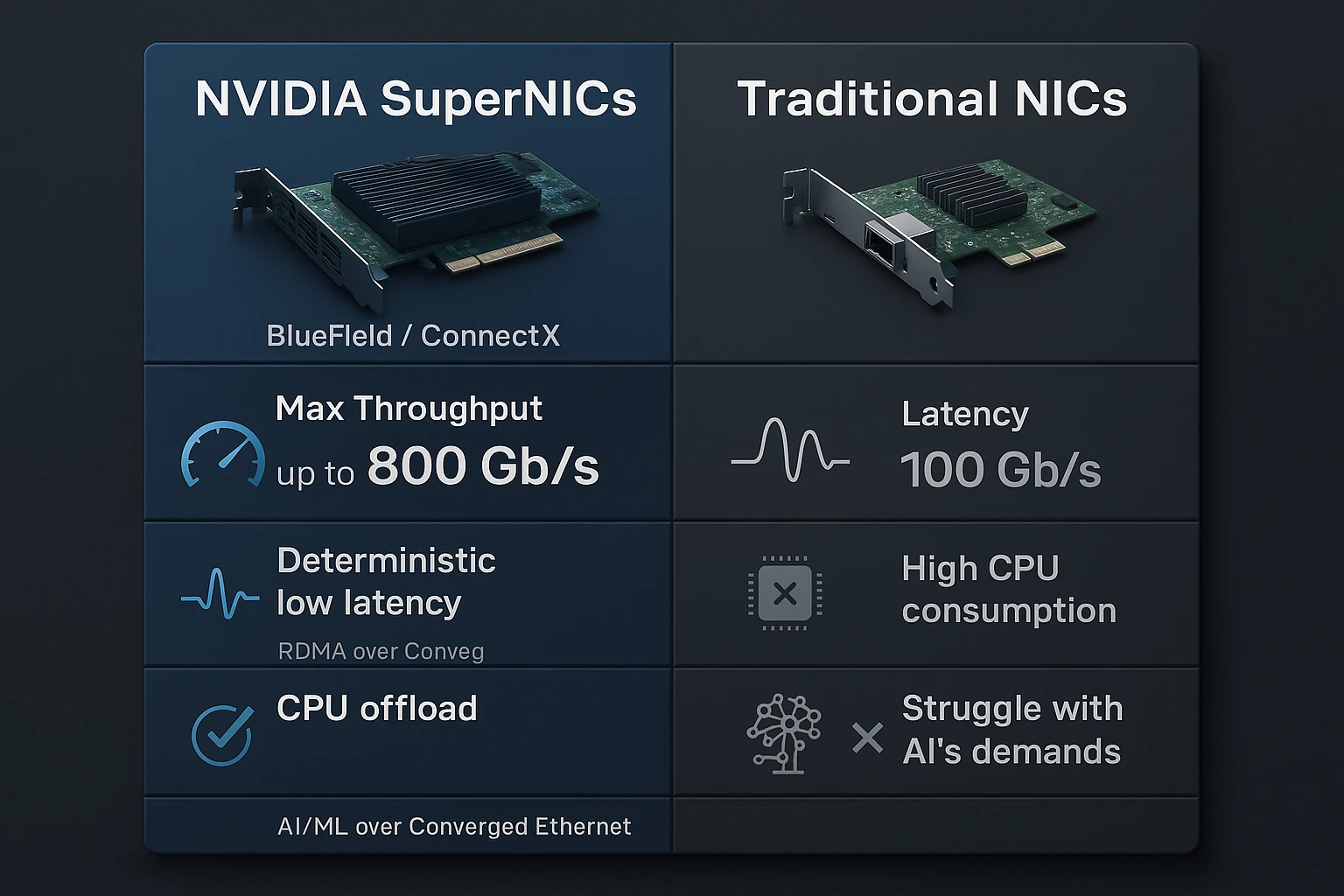
       

      Guide for an infographic comparing NVIDIA SuperNICs (800 Gb/s, CPU offload) against Traditional NICs (100 Gb/s, high CPU consumption) for AI


      SuperNIC in Supercharged AI Fabrics


      In an AI cloud data center—such as Semifly-powered deployments—the infrastructure fabric is not just connected, it’s cohesive:


      • GPU-server clusters linked via SuperNICs and Spectrum switches form unified compute domains.
      • RDMA (RoCE) bypasses CPU and system memory, accelerating inter-GPU communication.
      • Multi-tenant isolation ensures noiseless AI scaling across teams in shared environments.
      • Secure, deterministic performance keeps latency-sensitive inference accurate and efficient.


      In short, SuperNIC becomes the nervous system of your AI platform.
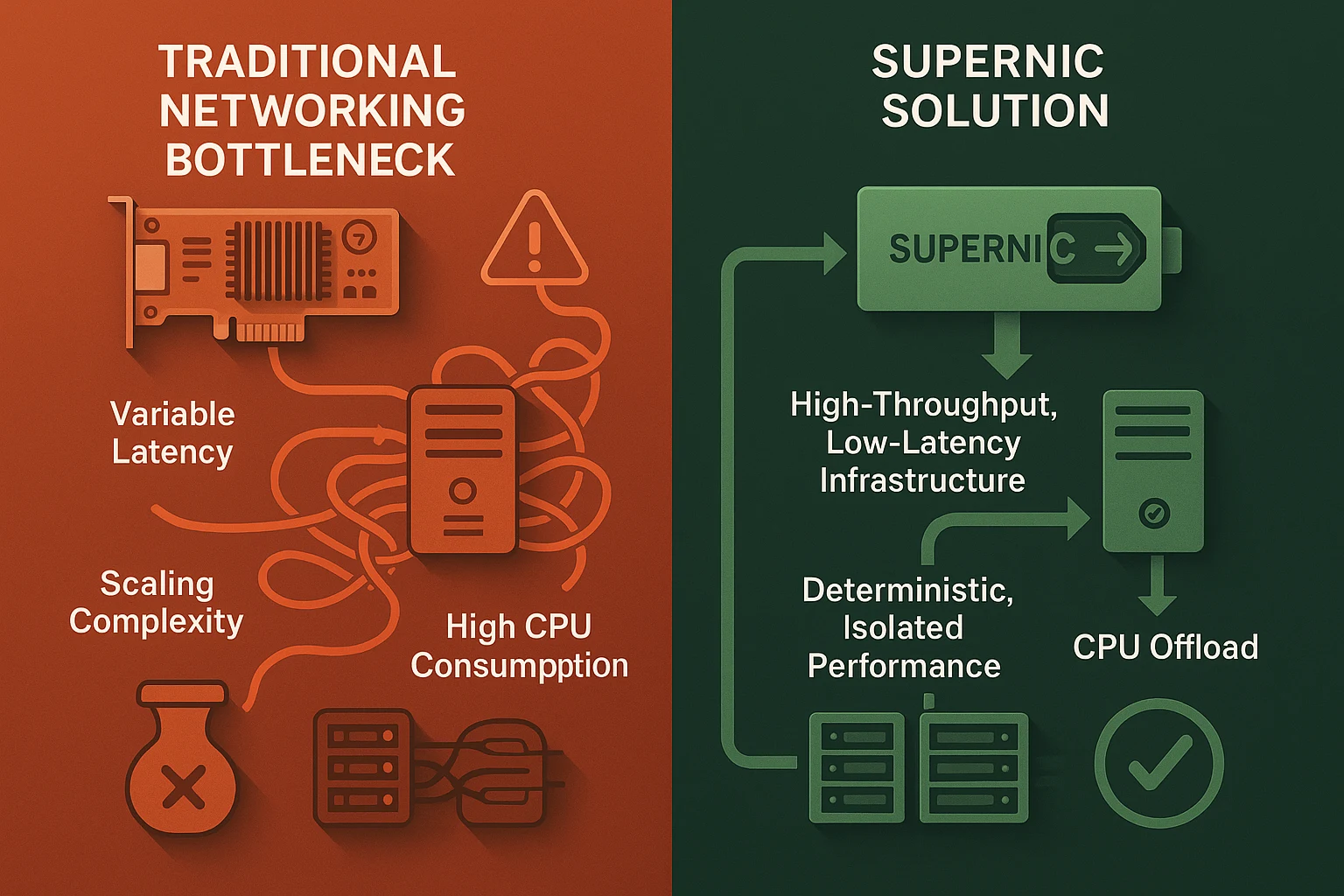
       

      Guide for a visual depicting AI networking bottleneck (traditional NICs) and its resolution by NVIDIA SuperNICs


      Semifly’s Advantage: Deploying SuperNIC-Optimized AI Infrastructure


      At Semifly, we specialize in end-to-end AI infrastructure deployment—selecting the right compute, networking fabric, and orchestration layer for your needs.


      By designing AI cloud environments with SuperNIC-enabled fabrics, Semifly helps organizations unlock:


      • Scalable GPUDirect RDMA networks for multi-rack training clusters.
      • Secure AI multi-tenancy, perfect for shared compute environments like universities or federated enterprises.
      • Consistent performance under varying AI workloads, from LLM fine-tuning to real-time inference.


      We connect NVIDIA-class hardware (SuperNICs, GPUs, Spectrum switches) with our deployment blueprints and automation stack—so AI cloud data centers hit performance goals from Day 1.


      Final Takeaway: SuperNICs Are the AI Edge You Didn’t Notice


      While GPUs get all the attention, it’s NVIDIA SuperNIC that delivers the connectivity foundation enabling real-time, scalable AI compute. In AI cloud data centers, network performance isn’t auxiliary—it’s central.


      If you’re architecting multi-node training clusters or private AI clouds, let’s incorporate SuperNICs into a deployment that’s efficient, secure, and predictive.


      → Talk to Semifly’s AI Infrastructure Team — we’ll help you map the right data fabric for your AI workloads.
       

      Bookmark me
      Share on
      Comments
      Add your Comment

      Writing About AI

      Semifly

      is an engineer and a technologist with a diverse background spanning software, hardware, aerospace, defense, and cybersecurity. As CTO at Semifly, he leverages his extensive experience to lead the company’s technological innovation and development.

      Explore Nvidia’s GPUs

      Find a perfect GPU for your company etc etc
      Go to Shop

      FAQs

      • NVIDIA SuperNIC primarily tackles the networking bottleneck that traditional Ethernet creates in AI cloud data centres. While GPUs are the computational powerhouses, their effectiveness is severely limited if the network connecting them cannot keep pace. Traditional networking struggles with AI workloads due to its inability to guarantee microsecond-level latency, its complexity and cost in scaling bandwidth to match GPU demands, its consumption of valuable CPU cycles during data movement, and network jitter that undermines synchronization in multi-node clusters. SuperNICs are purpose-built to eliminate these issues, ensuring that the network doesn’t hinder the massive-scale AI computations required for tasks like distributed model training and inference.

      • NVIDIA SuperNICs represent a significant architectural and functional shift from traditional NICs. Key differences include:


        Max Throughput: SuperNICs offer vastly higher throughput, reaching up to 800 Gb/s compared to the typical 100 Gb/s of traditional NICs.


        Protocol: They utilise RDMA (Remote Direct Memory Access) over Converged Ethernet (RoCE) with GPUDirect support, which allows data to bypass the CPU and system memory for direct communication between GPUs. Traditional NICs rely on standard TCP/IP, which involves higher CPU overhead.


        CPU Involvement: SuperNICs offload packet processing, freeing up CPU cycles to be dedicated to AI workloads, whereas traditional NICs demand significant CPU involvement for data movement.


        Latency: SuperNICs provide deterministic, low-latency performance, crucial for the synchronisation needed in multi-node AI clusters, unlike the variable and unpredictable latency of traditional NICs.


        Multi-Tenant Isolation: SuperNICs offer secure, hardware-enforced multi-tenant isolation, essential for shared AI environments, a feature largely absent or limited in traditional NICs.


        AI/ML Optimisation: They are specifically designed and optimised for Large Language Model (LLM) training and inference, unlike traditional NICs which are not AI-specific.


        Fabric Integration: SuperNICs are integrated with the Spectrum-X Ethernet Fabric for cohesive AI infrastructure, while traditional NICs require manual setup.

      • NVIDIA offers two primary SuperNIC models:


        BlueField-3 SuperNIC: This model delivers 400 Gb/s RDMA over Converged Ethernet (RoCE). It is engineered to provide deterministic, isolated performance and secure multi-tenancy, making it suitable for environments requiring consistent performance and secure sharing of resources.


        ConnectX-8 SuperNIC: This is the more advanced model, supporting up to 800 Gb/s RDMA. It is designed to accelerate generative AI workloads and enable hyperscale fabric deployments, catering to the most demanding and large-scale AI computational needs.


        Both models represent a deep integration of networking with GPUs, moving beyond incremental upgrades to a fundamentally new architecture for scaling AI compute.

      • The NVIDIA Spectrum-X Networking Fabric is a key platform that significantly boosts generative AI network performance. It combines Spectrum switches with SuperNICs to create a unified and highly optimised AI infrastructure. This combination can improve generative AI network performance by 1.6 times compared to traditional Ethernet setups. The fabric ensures that GPU-server clusters are not just connected but cohesively linked, allowing for:


        Accelerated inter-GPU communication through RDMA (RoCE) by bypassing the CPU and system memory.


        Multi-tenant isolation, ensuring consistent performance for various teams or workloads in shared environments.


        Secure, deterministic performance, which is vital for the accuracy and efficiency of latency-sensitive AI inference.


        Overall, it transforms the network into the “nervous system” of the AI platform, enabling unparalleled scale and efficiency.

      • RDMA (Remote Direct Memory Access) over Converged Ethernet (RoCE) is a networking technology that allows direct memory access from one computer to another without involving the operating system of either. When used with SuperNICs, RoCE bypasses the CPU and system memory for data transfers between GPUs. This significantly reduces latency and frees up CPU cycles that would otherwise be consumed in managing data movement.


        GPUDirect is an NVIDIA technology that enables direct data transfer between GPUs and other devices (like SuperNICs) without passing through the host CPU’s memory.


        Both technologies are crucial for AI workloads because:


        Reduced Latency: They dramatically lower the time it takes for data to move between GPUs, which is critical for the synchronisation and efficiency of distributed AI model training and inference.


        Increased Throughput: By offloading data transfer from the CPU, they allow for much higher data rates, matching the insatiable data demands of modern AI models.


        CPU Efficiency: They free up the CPU to focus on computational tasks rather than data handling, thereby boosting overall AI processing efficiency.

      • SuperNICs contribute to secure and scalable multi-tenancy through their inherent design features, particularly the BlueField-3 model. They offer:


        Hardware-Enforced Isolation: SuperNICs provide secure, hardware-enforced isolation between different tenants or workloads. This means that in a shared AI cloud environment, the network traffic and resources of one tenant are deterministically separated and protected from others.


        Deterministic Performance: This isolation ensures “noiseless AI scaling,” meaning that the performance of one tenant’s AI workload is not negatively impacted by the activities of other tenants. This predictability is vital for latency-sensitive applications like real-time inference and consistent LLM fine-tuning.


        Resource Allocation: By enabling isolated and secure channels, SuperNICs allow for efficient and fair allocation of network resources across multiple users or teams sharing the same underlying infrastructure, making them ideal for environments like universities or federated enterprises.

      • Semifly specialises in the end-to-end deployment of AI infrastructure, and its role in SuperNIC-optimised environments is critical. Semifly leverages SuperNICs to build high-performance, secure, and scalable AI cloud data centres. Their expertise allows organisations to:


        Unlock Scalable GPUDirect RDMA Networks: Semifly designs and implements multi-rack training clusters that fully exploit the benefits of GPUDirect RDMA networks powered by SuperNICs.


        Enable Secure AI Multi-Tenancy: They create shared compute environments where secure multi-tenancy is guaranteed, making them suitable for diverse users without compromising performance or security.


        Ensure Consistent Performance: Semifly’s deployment blueprints and automation stack integrate NVIDIA-class hardware (SuperNICs, GPUs, Spectrum switches) to ensure consistent performance for various AI workloads, from LLM fine-tuning to real-time inference, from day one.


        Essentially, Semifly bridges the gap between the advanced SuperNIC technology and its practical, high-performing application in real-world AI cloud data centres.

      • While GPUs typically garner the most attention as the primary drivers of AI compute, the network layer, particularly NVIDIA SuperNICs, is often the unsung hero—the “AI edge you didn’t notice.” It’s considered central, not auxiliary, because:


        Enabling Foundation: SuperNICs provide the critical connectivity foundation that enables real-time, scalable AI compute. Without an optimised network, even the most powerful GPUs cannot perform effectively in distributed AI workloads.


        Eliminating Bottlenecks: They remove the fundamental networking bottlenecks that traditional Ethernet creates, allowing AI workloads to scale efficiently and predictably.


        Integrated Performance: SuperNICs ensure that the network and GPUs are deeply integrated, creating a cohesive infrastructure where performance is not limited by communication inefficiencies.


        Overall System Performance: The network dictates the speed at which data can be moved to and from GPUs, and between GPUs themselves, directly impacting the overall speed, efficiency, and scalability of AI training and inference. In essence, the network dictates how well the entire AI platform can operate.

      More Similar Insights and Thought leadership

      No Similar Insights Found

      semifly