In today’s high-performance computing environments, InfiniBand data centers are under growing pressure from both cyber threats and operational challenges. Attackers may exploit network bottlenecks or launch unauthorized compute jobs like crypto-mining—disrupting services and raising operational costs. Traditional monitoring tools, however, often spot these issues only once damage has already occurred.
This is where the NVIDIA® UFM® Cyber-AI platform comes in. It’s an AI-powered extension of NVIDIA’s Unified Fabric Manager that adds intelligent network monitoring, real-time telemetry, and predictive maintenance capabilities. Operating on top of UFM Telemetry and UFM Enterprise, UFM® Cyber-AI provides a deeper layer of insight and automation to protect InfiniBand fabrics.
By continuously learning the “heartbeat” of your data center—normal usage, temperature, and traffic patterns—UFM® Cyber-AI identifies deviations early. It can detect performance degradation, unusual user activity, and even irregular application behavior. In some cases, it can alert admins to prevent downtime before it happens.
In this blog, we’ll explore how UFM® Cyber-AI fits into the UFM ecosystem, the technology behind its predictive intelligence, and how it helps secure, stabilize, and optimize InfiniBand-connected data centers.
1. What Is NVIDIA® UFM® Cyber-AI and How Does It Enhance Fabric Management?
The NVIDIA® UFM® Cyber-AI platform is the advanced tier of the Unified Fabric Manager family. It is designed specifically for InfiniBand data centers that demand high performance, reliability, and security. Built on top of UFM Telemetry and UFM Enterprise, it adds an AI-driven intelligence layer that transforms how operators monitor and secure their fabric infrastructure.
Unlike traditional monitoring, UFM® Cyber-AI doesn’t just react to issues—it learns from long-term data patterns to predict and prevent failures.
Capturing Long-Term Telemetry
UFM® Cyber-AI continuously collects detailed telemetry from the network. This includes traffic patterns, switch temperatures, and job behaviors across the entire data center. Over time, this creates a “digital fingerprint” of what normal operations look like. When deviations occur—such as abnormal spikes in bandwidth usage or unusual compute jobs—the system can flag them instantly. This proactive monitoring helps detect performance degradation, potential hardware failures, or even suspicious activity before they cause disruptions.
The Three-Layer Architecture of UFM® Cyber-AI
A. Input Telemetry
The first layer gathers real-time metrics from every part of the fabric—switches, adapters, cables, and workload usage. These metrics act as the “vital signs” of the network, similar to how a doctor tracks a patient’s pulse and temperature.
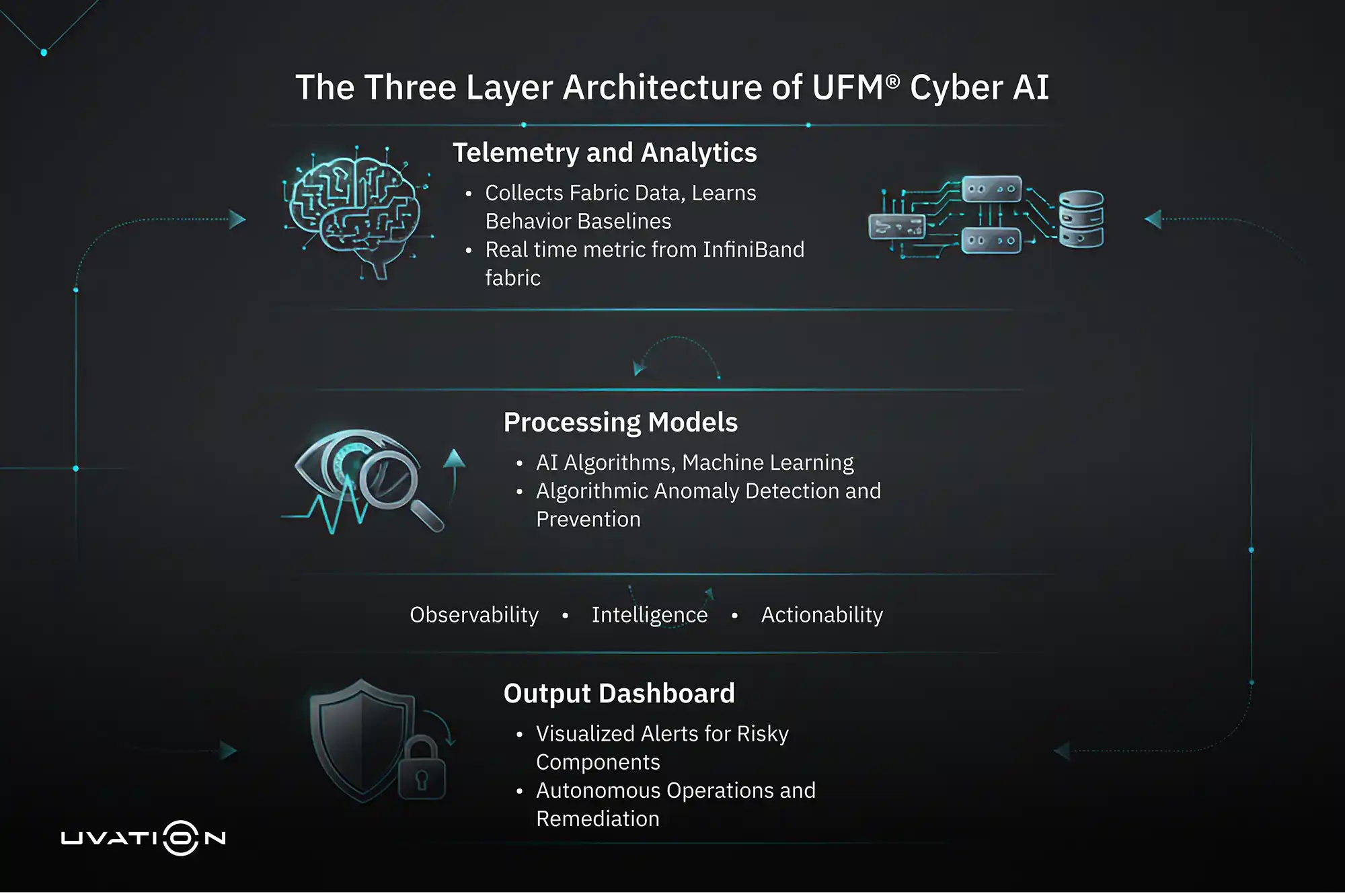
B. Processing Models
Next, AI and machine learning models analyze telemetry. These models learn from historical patterns to spot anomalies and predict possible failures. For example, they might identify that a cable is likely to fail based on temperature fluctuations or signal integrity issues.
C. Output Dashboard
Finally, UFM® Cyber-AI delivers its insights through a graphical user interface (GUI). The dashboard visualizes alerts, highlights risky components, and provides recommendations for corrective actions. This helps IT teams act quickly and confidently.
Summary Table: UFM® Cyber-AI Core Functions
| Component |
Function |
Benefit |
| Input Telemetry |
Gathers real-time infrastructure metrics |
Builds a baseline for normal operations |
| Processing Models |
Detects deviations and predicts faults |
Prevents downtime with early alerts |
| Output Dashboard |
Displays alerts and system insights |
Enables proactive network management |
The NVIDIA® UFM® Cyber-AI platform is part of a tiered ecosystem that has evolved to meet the growing complexity of InfiniBand data centers. Each level—UFM Telemetry, UFM Enterprise, and UFM® Cyber-AI—adds more intelligence and control. Together, they provide a full stack for monitoring, optimizing, and securing high-performance computing (HPC) fabrics.
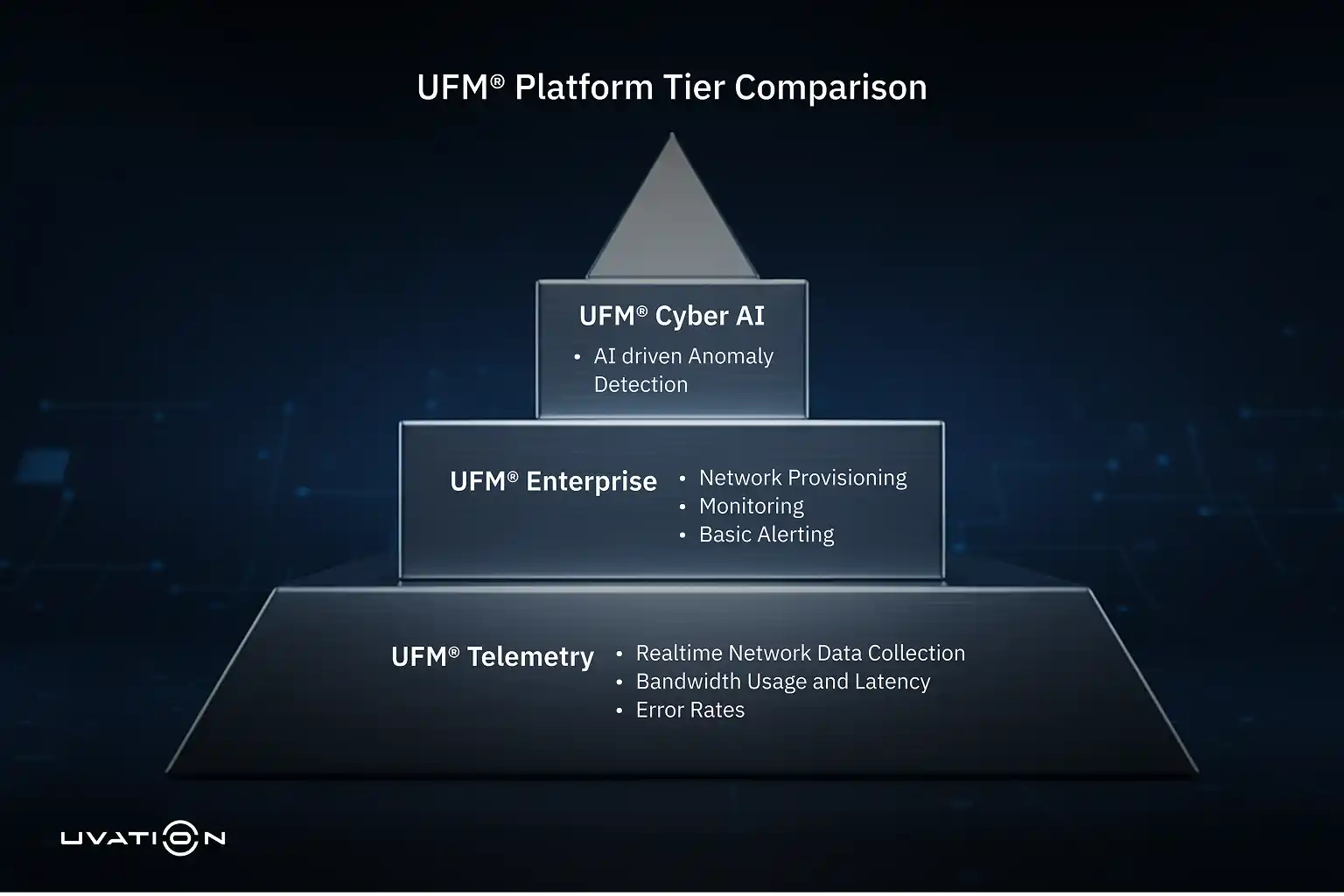
This evolution shows how fabric management has shifted from data collection to proactive, AI-driven security and performance assurance.
UFM Telemetry: The Foundation
UFM Telemetry is the entry-level platform. It focuses on capturing and streaming basic network data. This includes metrics such as bandwidth usage, latency, and error rates across switches, adapters, and links. Telemetry data is critical because it provides real-time visibility into the health of the network fabric. However, this tier mainly collects and displays information; it does not provide advanced analytics or automation.
UFM Enterprise: Adding Control and Analytics
UFM Enterprise builds on Telemetry by adding network validation, provisioning, and congestion analysis. It gives operators more than just data—they can now optimize and control the fabric.
One key feature is integration with job schedulers like Slurm and IBM LSF. This allows organizations to align their compute workloads with network performance in real time. For example, if a workload requires heavy data movement, the scheduler can adjust jobs to prevent congestion. This tier is ideal for HPC and AI clusters that need both scalability and operational efficiency.
UFM® Cyber-AI: Intelligence and Prevention
The UFM® Cyber-AI platform is the most advanced tier. It leverages machine learning and AI models to analyze long-term telemetry trends and detect early warning signs. Unlike the other tiers, it doesn’t just observe—it predicts.
With preventive maintenance alerts, it can flag issues such as a cable that is likely to fail or a switch running at abnormal temperatures. Its predictive analytics empower IT teams to act before downtime or data loss occurs. This is especially valuable for mission-critical industries like finance, research, and healthcare.
Summary Table: UFM Platform Tier Comparison
| Platform Tier |
Key Capabilities |
AI Integration |
| UFM Telemetry |
Real-time network data collection |
None |
| UFM Enterprise |
Network provisioning, monitoring, scheduler integrations |
Basic alerting |
| UFM® Cyber-AI |
AI-driven anomaly detection, predictive maintenance |
Full AI/ML-enabled insights |
3. What Benefits Does UFM® Cyber-AI Deliver to Data Center Operations?
The NVIDIA® UFM® Cyber-AI platform is not just about monitoring—it is about transforming how data center networks are managed. By combining AI-driven analytics with long-term telemetry, it brings proactive reliability, stronger security, and optimized operations to InfiniBand fabrics.
This makes UFM® Cyber-AI a critical layer for organizations that want to minimize downtime, prevent security breaches, and maximize infrastructure efficiency.
Proactive Network Reliability
One of the biggest advantages of the platform is its ability to identify root causes before failures occur. By analyzing telemetry trends, UFM® Cyber-AI can predict issues such as faulty cables, unstable switches, or performance degradation. This proactive detection reduces downtime and ensures that workloads keep running smoothly.
Stronger Security Posture
UFM® Cyber-AI is not limited to performance; it also enhances cybersecurity. The platform can detect abnormal usage patterns such as unauthorized access, crypto-mining activities, or suspicious traffic spikes. These real-time alerts allow administrators to stop threats before they spread across the network, protecting both infrastructure and sensitive workloads.
Operational Efficiency and Cost Savings
Downtime is expensive. By predicting failures and reducing outages, the platform helps lower operational expenditure. Optimized workload management also ensures better utilization of resources, which means higher performance at a lower cost. Over time, this creates a more resilient and cost-effective data center.
Integration with NVIDIA AI Ecosystem
Another advantage of UFM® Cyber-AI is its ability to integrate with broader NVIDIA solutions. For example, coupling it with NVIDIA Morpheus enables richer telemetry-driven insights combined with dynamic cyber protections. This creates an adaptive, AI-powered defense loop, where data center fabrics continuously learn and improve.
4. How Does UFM® Cyber-AI Integrate with NVIDIA H200 GPU Architecture?
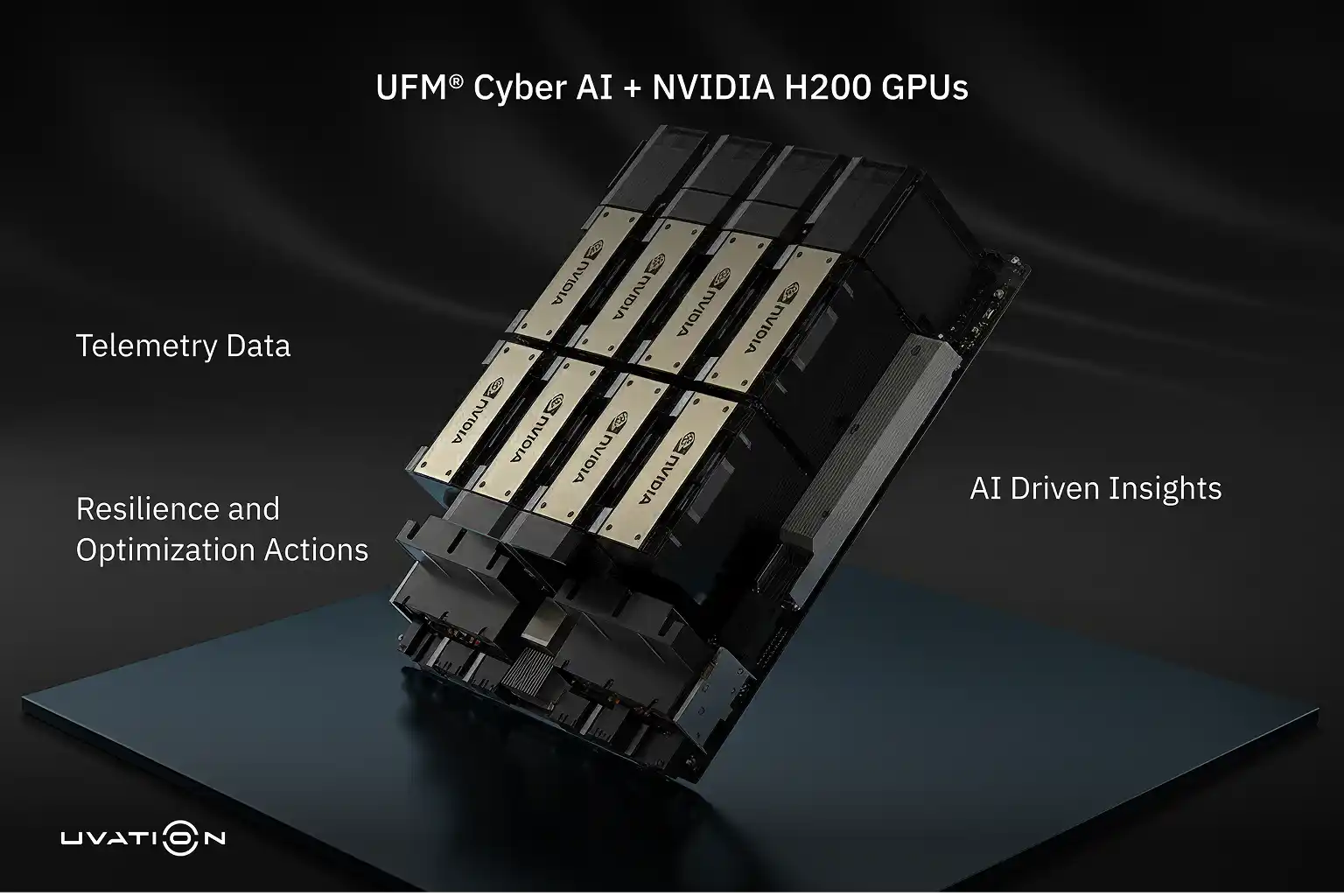
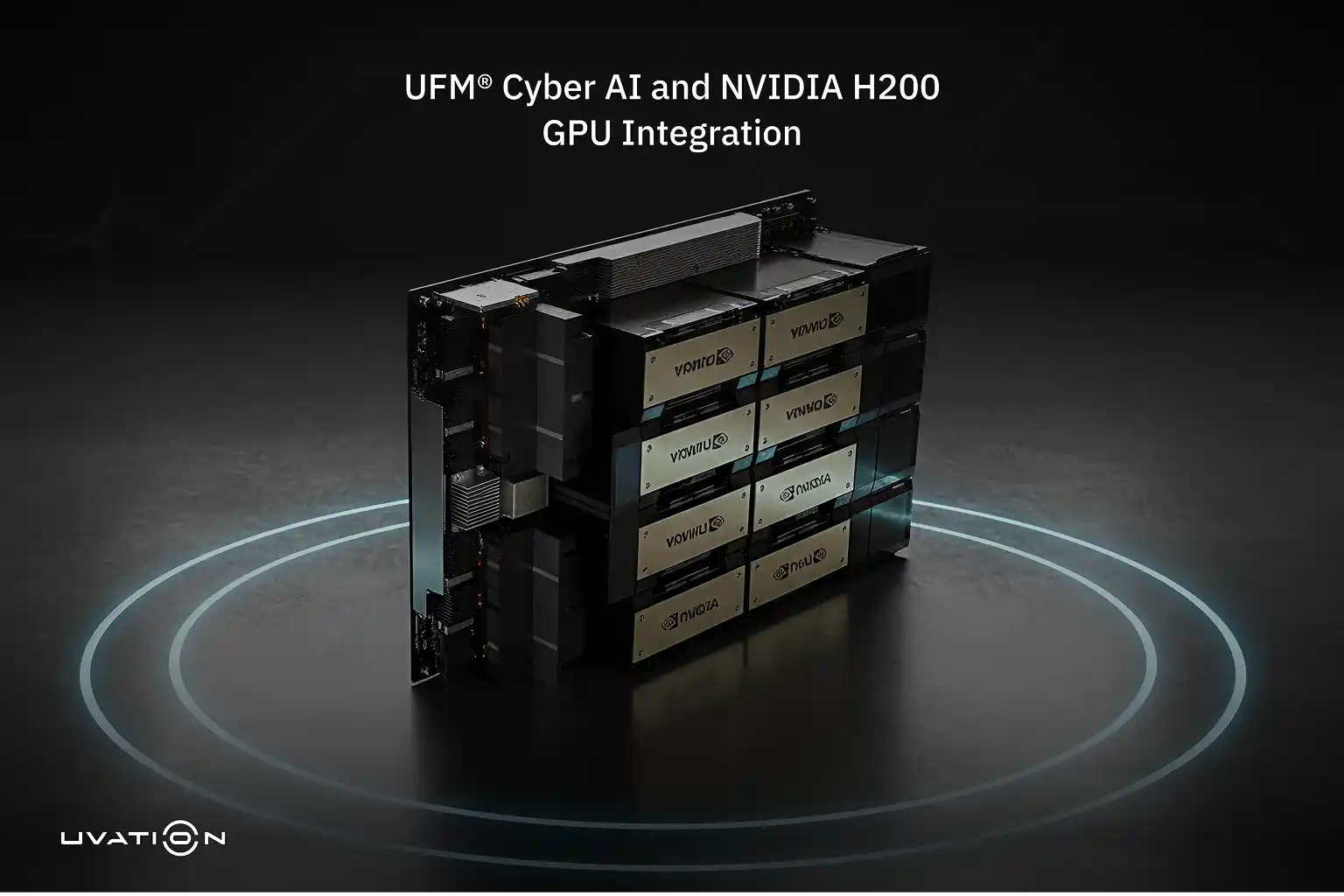
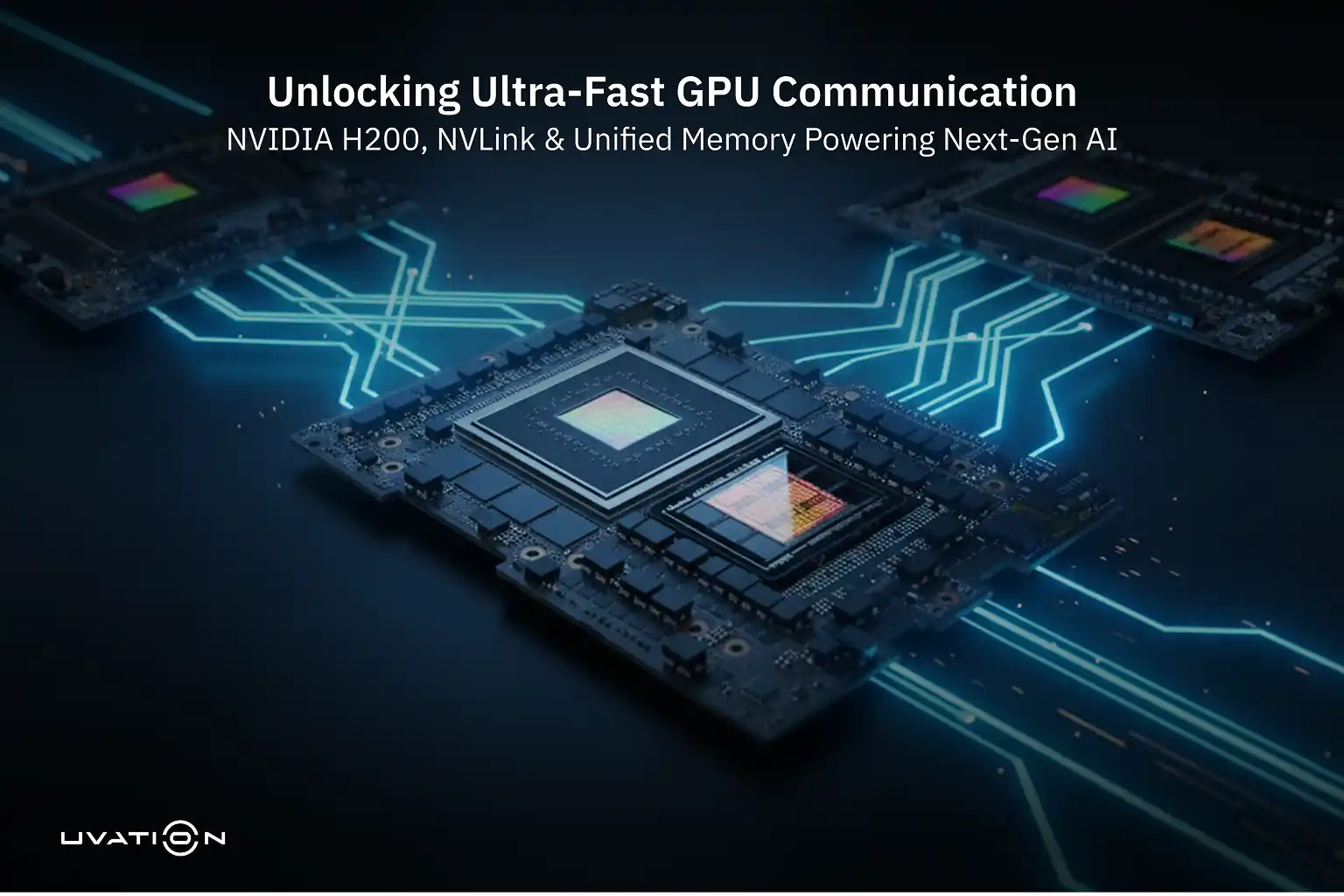
The NVIDIA® UFM® Cyber-AI platform is designed to manage InfiniBand networks, but its capabilities expand when combined with the NVIDIA H200 GPU. Together, they form a tightly connected ecosystem that brings both network intelligence and compute acceleration into a single framework.
By pairing telemetry-driven monitoring with GPU-powered analytics, organizations can scale real-time anomaly detection and predictive insights across even the largest data center fabrics.
The Role of NVIDIA H200 in AI and HPC Workloads
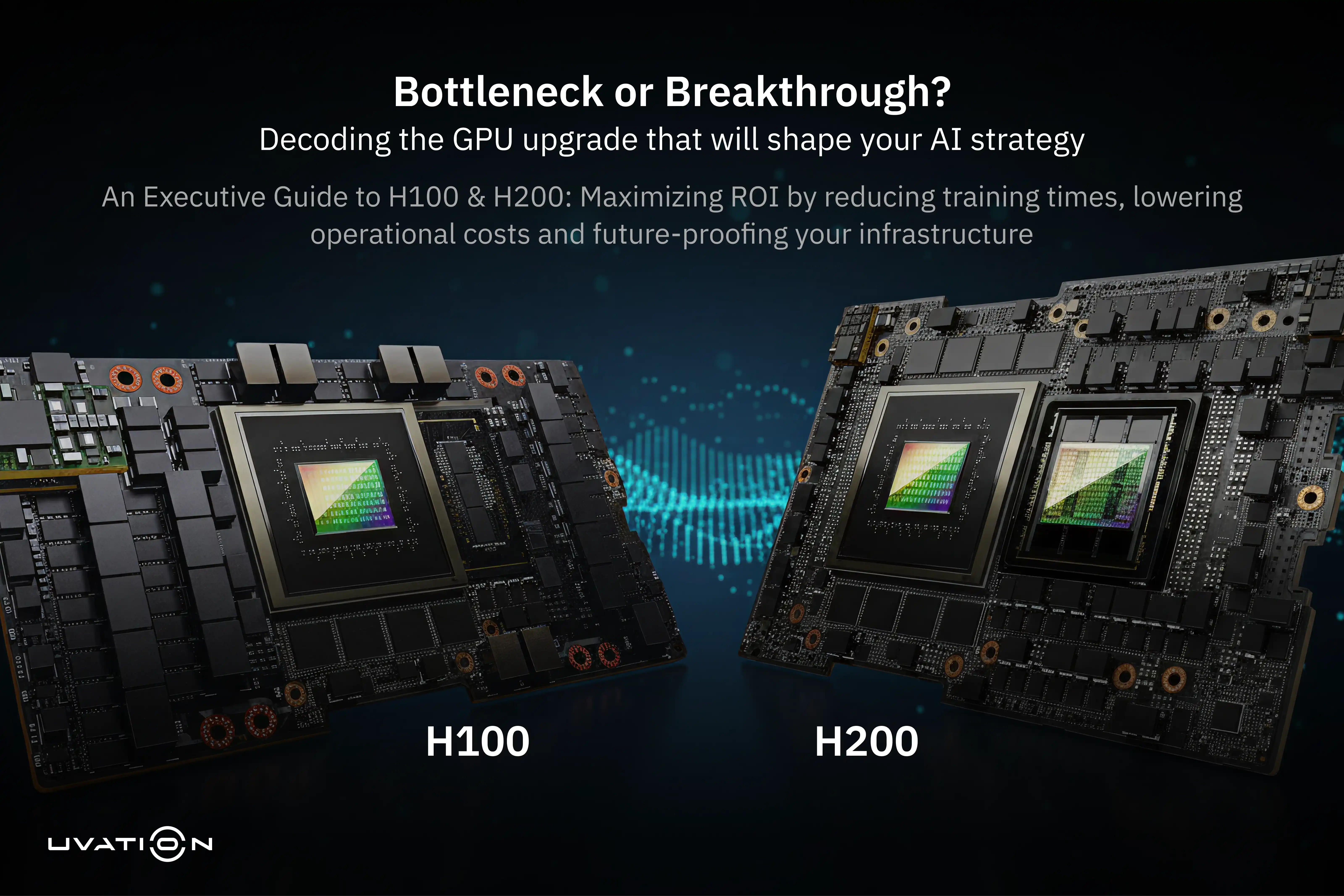
The NVIDIA H200 GPU is purpose-built for heavy AI and high-performance computing (HPC) workloads. It features 141 GB of HBM3e memory, which allows massive datasets to be processed quickly. Compared to the H100, it offers up to 2x faster inference performance, making it ideal for AI model training, large language models and simulation tasks.
UFM® Cyber-AI and GPU-Powered Telemetry Analysis
While UFM® Cyber-AI focuses on telemetry collection and anomaly detection, the H200 GPU provides the compute backbone needed for processing this data at scale. By running machine learning models directly on GPU clusters, organizations can analyze billions of telemetry signals in real time, covering traffic flows, job behavior, and hardware health.
Synergy in Fabric-Connected Environments
In environments where fabric-connected servers are powered by H200 compute nodes, the integration becomes even stronger. The GPU nodes deliver raw AI processing power, while UFM® Cyber-AI ensures the network fabric connecting them remains secure, stable, and optimized. This creates a feedback loop where GPUs accelerate AI-driven insights, and Cyber-AI ensures those insights are applied to keep the infrastructure resilient.
5. How Can Organizations Deploy and Access UFM® Cyber-AI?
Deploying NVIDIA® UFM® Cyber-AI is flexible and tailored to fit different data center setups. Organizations can choose between hardware-based or software-based options, depending on scale and existing infrastructure. The platform is purpose-built for InfiniBand-based HPC data centers where intelligent monitoring and predictive analytics are critical.
Deployment Options
UFM® Cyber-AI can be deployed in two main ways:
- Dedicated Cyber-AI Appliance: This is a standalone system preconfigured with the platform. It provides fast setup and reliable performance for enterprises that prefer a ready-to-use solution.
- Software Containers: For environments already running UFM Enterprise, administrators can deploy Cyber-AI as containerized software. Containers are lightweight, isolated environments that run on existing servers, making this option cost-effective and flexible.
Both approaches ensure that Cyber-AI integrates smoothly with UFM Enterprise, extending its monitoring and analysis capabilities.
Supported Environments
The platform is designed for InfiniBand-based high-performance computing (HPC) data centers. These environments handle large-scale workloads such as scientific research, AI training, and financial simulations. By embedding AI into the fabric layer, UFM® Cyber-AI delivers real-time insights into traffic, performance, and security without adding overhead to compute resources.
Access and Management Tools
Administrators can access UFM® Cyber-AI through:
- Dashboards: A graphical interface that visualizes anomalies, alerts, and recommendations. It allows quick identification of performance or security issues across the fabric.
- API Integrations: UFM® Cyber-AI provides APIs that can connect with external alerting tools and workflow systems. This makes it easy to automate responses, trigger tickets in IT systems, or integrate with enterprise security operations.
With these tools, administrators gain both real-time visibility and automation, improving operational efficiency and resilience of the entire data center fabric.
Conclusion
The NVIDIA® UFM® Cyber-AI platform represents a major leap forward in AI-driven fabric management. Unlike passive systems, this platform brings together real-time telemetry, predictive maintenance, and intelligent anomaly detection to boost the health of InfiniBand networks.
In today’s high-stakes digital environment, AI cybersecurity threats are growing smarter and more targeted. NVIDIA® UFM® Cyber-AI, especially when backed by the power of NVIDIA H200 GPUs, offers the intelligent, resilient infrastructure needed to stay ahead. It redefines what fabric management can be, making your data center not just reactive, but truly intelligent, secure, and future-ready.



Unregistered User
It seems you are not registered on this platform. Sign up in order to submit a comment.
Sign up now