• FEATURED STORY OF THE WEEK

      H200 vs H100 GPU Memory: Which One Is Better for AI Workloads?

      Written by :  
      semifly
      Team Semifly
      3 minute read
      July 16, 2025
      Category : Artificial Intelligence
      H200 vs H100 GPU Memory: Which One Is Better for AI Workloads?
      Why Is GPU Memory Now the Biggest Bottleneck in AI?
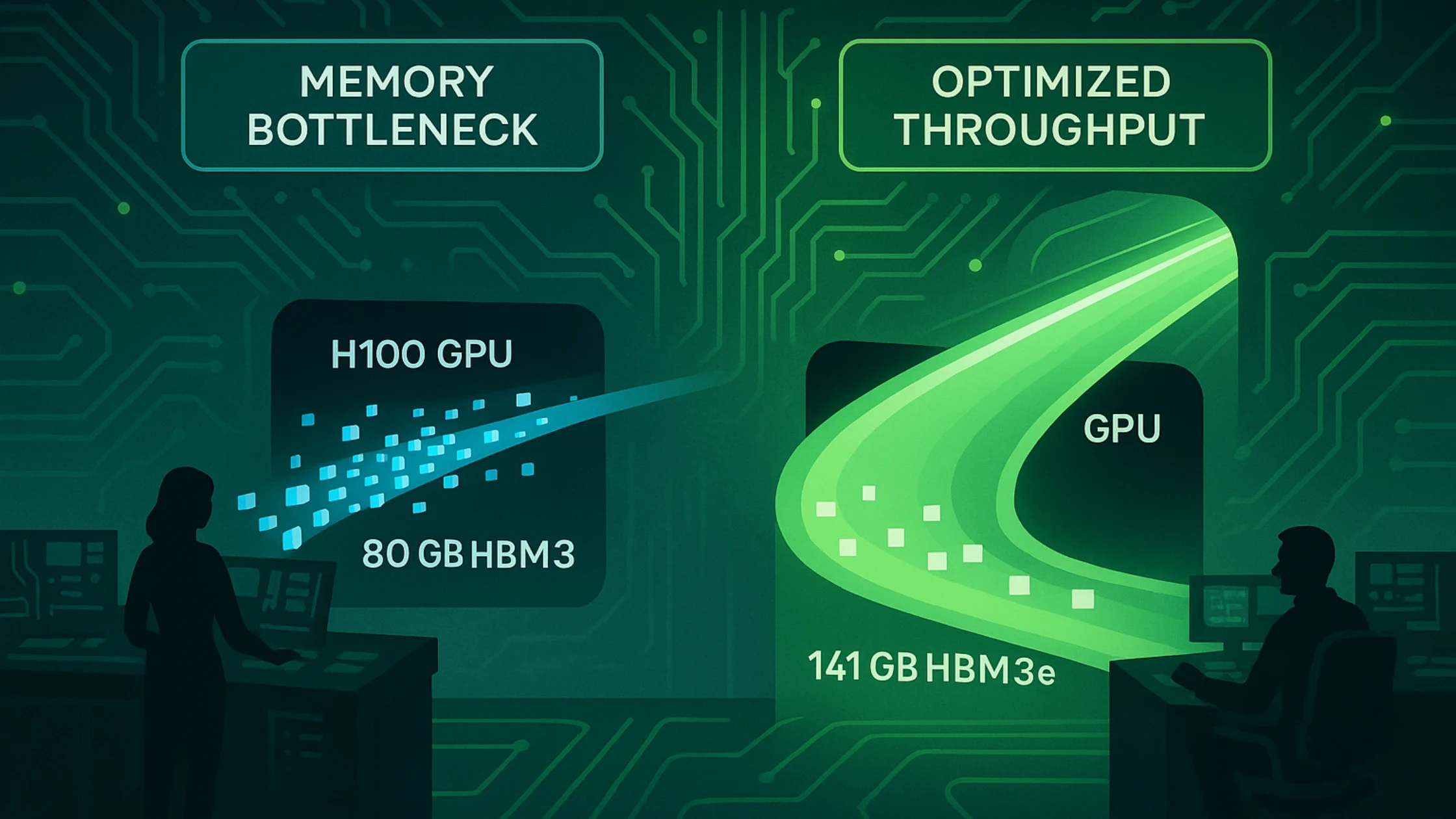
      Data streams showing H200’s wider memory channel versus H100’s congested bottleneck.


      A CIO recently hit a latency wall during a 128K-token LLM inference demo. Despite strong compute capacity, context window retention collapsed due to memory starvation.


      Modern AI workloads have evolved: It’s no longer about raw FLOPS. The real constraint is memory—how much you can hold in-cache, and how fast it can be accessed.


      Inference reliability, user concurrency, and GenAI UX now depend more on memory bandwidth and size than training power. This is where the NVIDIA H200 redefines limits.


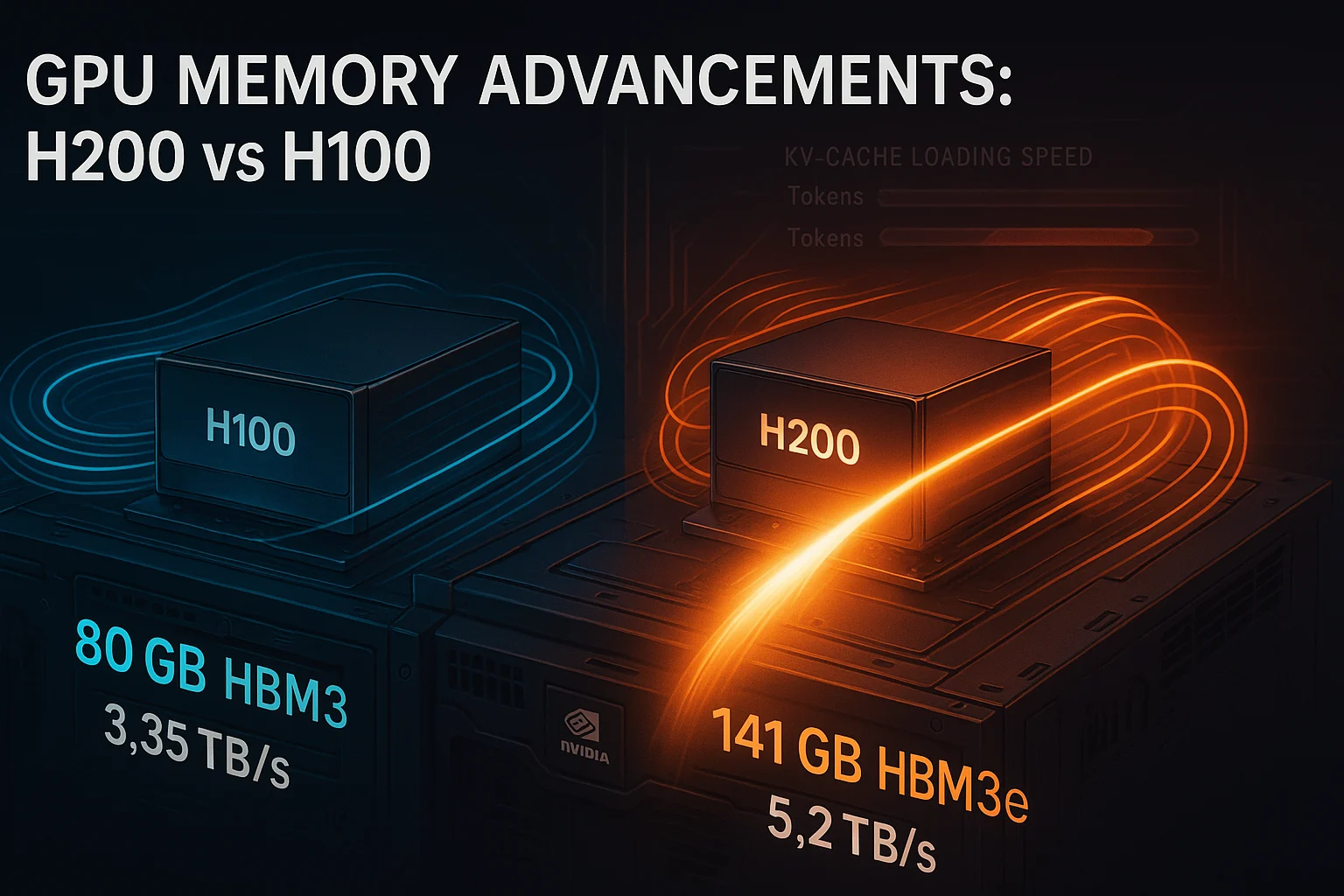
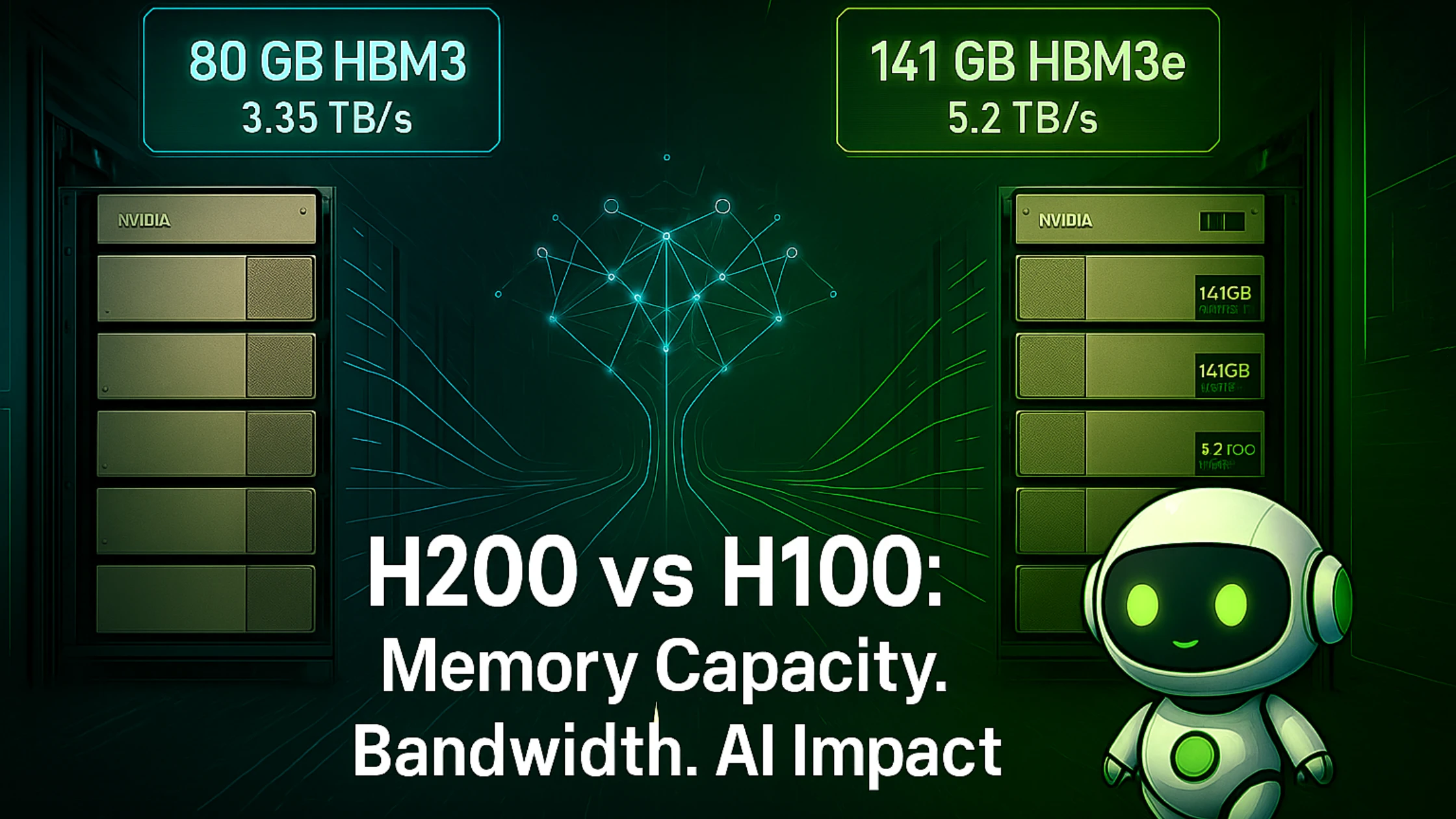
      What Are the Key Specs That Differentiate H200 and H100?


      GPU Memory Type Capacity Peak Bandwidth Transformer Engine Launch Year
      H100 HBM3 80 GB 3.35 TB/s Gen 1 2022
      H200 HBM3e 141 GB 5.2 TB/s Gen 2 2024


      The H200 adds 76% more memory and 1.5x bandwidth—giving LLMs breathing room.


      Does 141 GB HBM3e Outperform 80 GB HBM3 for Real LLMs?

      Let’s look at memory residency for real model pipelines:


      LLM Size KV-Cache per 1K Tokens Fits in H100? Fits in H200?
      13B 8 GB Yes Yes
      65B 38 GB Multi-GPU Yes
      70B + Embeddings 64–80 GB No Yes


      Real-world example: One Semifly client avoided a 2× GPU split in RAG + vision pipelines by upgrading to H200.
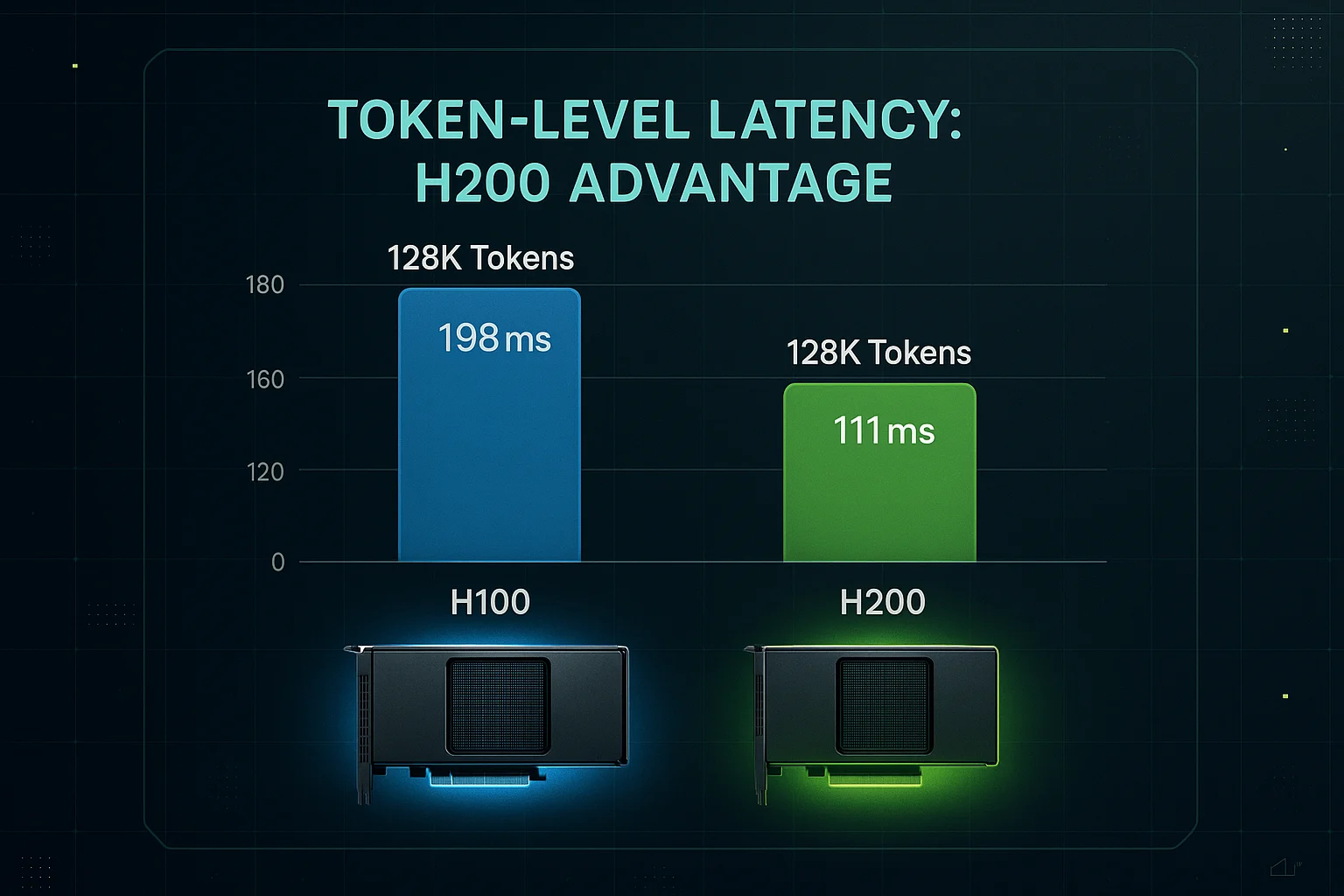
       

      Latency comparison bars showing H200’s faster token processing versus H100.

      How Does Memory Bandwidth Impact Token-Level Latency?


      Memory bandwidth affects how quickly GPUs can load KV-cache and retrieve context during attention operations. Token delays under load lead to jitter and inconsistency.


      Token Window H100 Latency (ms) H200 Latency (ms) Improvement
      64K 112 76 32% faster
      128K 198 111 44% faster


      H200’s 5.2 TB/s HBM3e enables smoother attention head traversal under scale.


      How Do H200 and H100 Perform in Enterprise GenAI Inference?


      Enterprise use cases—like multi-tenant chatbot farms and RAG pipelines—depend on:


      • Consistent latency
      • Higher session concurrency
      • Memory-persistent batching


      With NVLink 4.0 and 141 GB memory, the H200 reduces cold start penalties and model duplication. It supports:


      • 160+ concurrent users on Llama 2–13B
      • Persistent token context for multi-turn interactions


      Fewer model copies also mean:


      • Lower licensing risk
      • Tighter cost controls
      • Simpler observability dashboards


      Can HPC and FP8 Training Workloads Benefit from H200?


      Absolutely. CFD simulations, genomics pipelines, and hybrid FP8 workloads gain throughput benefits from higher memory bandwidth.


      Example: GPT-3 13B fine-tune


      • H100: 6,200 tokens/sec
      • H200: 9,400 tokens/sec (1.5x)


      More memory also improves:


      • Checkpoint management
      • Large-batch training
      • Memory-efficient precision stacking


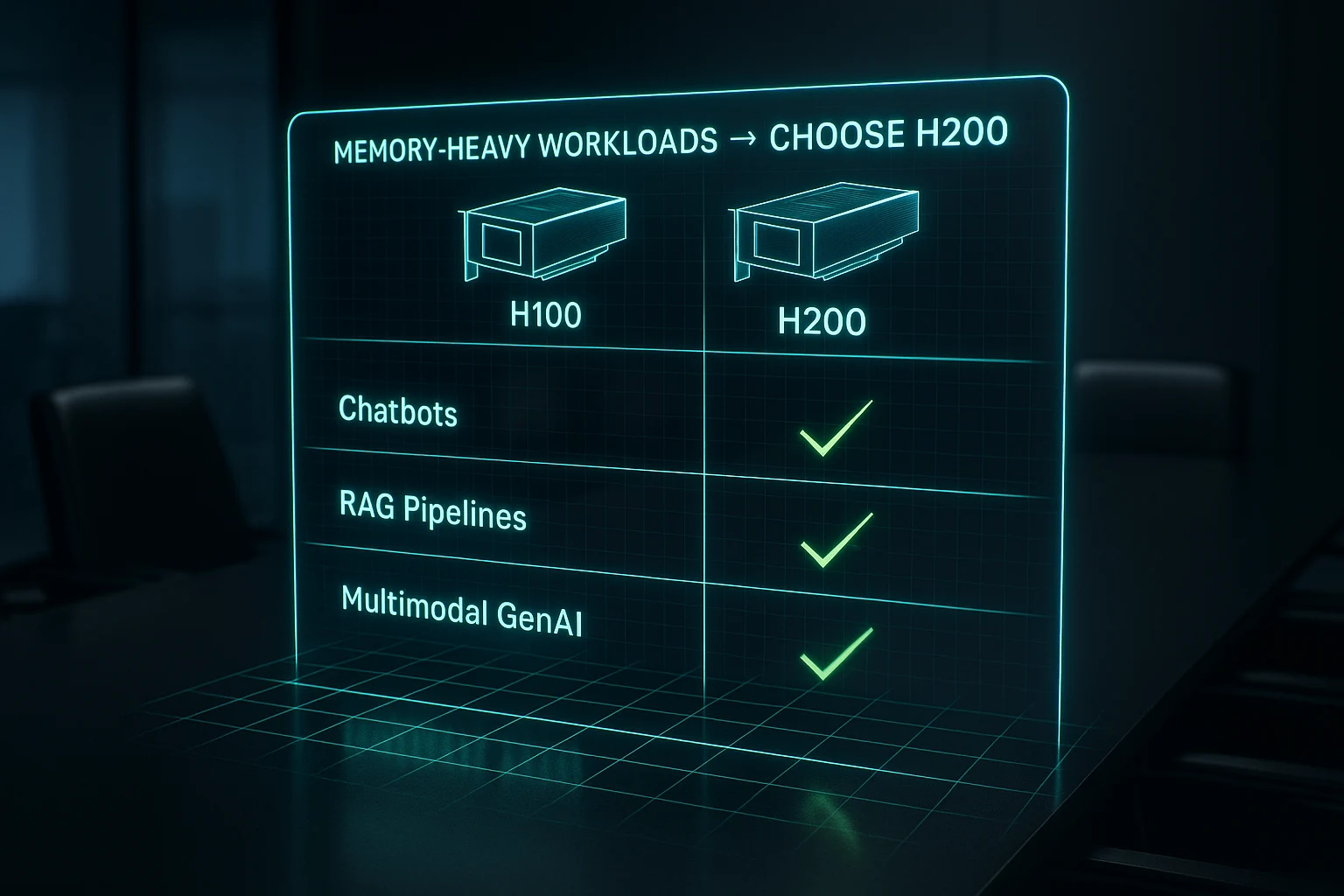
      GPU selection matrix showing H200 preferred for memory-heavy AI workloads.

      Which GPU Should You Choose for Your Workload?


      Workload Latency Target Dataset Size Best GPU Rationale
      Internal Chatbot (64K) < 120 ms Medium H100 Fits in 80 GB
      Public GenAI (128K) < 100 ms Large H200 Needs 141 GB + bandwidth
      Finetune 70B Model Throughput Large H100 Multi-GPU training centric
      RAG + Vision GenAI Consistency Extra Large H200 Multi-modal, memory heavy


      For real-time inference workloads, H200 saves cost by eliminating over-provisioning.


      How Does Semifly Help You Deploy Memory-Optimized H200 Clusters?


      Semifly helps enterprises turn memory-optimized GPUs into scalable, turnkey infrastructure. Our offering includes:


      Final Takeaway


      In 2025, memory is the new AI performance ceiling. The NVIDIA H200 offers:


      • 141 GB HBM3e memory
      • 5.2 TB/s bandwidth
      • Gen 2 transformer engine


      If you’re scaling chatbots, RAG, multimodal agents, or GenAI APIs, H200 gives you the memory headroom to stay fast, compliant, and cost-efficient.


      Book your H200 memory profiling session with Semifly and scale with confidence.
       

      Bookmark me
      Share on
      Comments
      Add your Comment

      Writing About AI

      Semifly

      is an engineer and a technologist with a diverse background spanning software, hardware, aerospace, defense, and cybersecurity. As CTO at Semifly, he leverages his extensive experience to lead the company’s technological innovation and development.

      Explore Nvidia’s GPUs

      Find a perfect GPU for your company etc etc
      Go to Shop

      FAQs

      • GPU memory has become the critical bottleneck in modern AI, particularly with the rise of large language models (LLMs) and generative AI (GenAI). While raw computational power (FLOPS) was once the main concern, the current limitation is how much data can be stored in-cache and how quickly it can be accessed. This shift is driven by the increasing complexity of AI tasks, such as handling large context windows (e.g., 128K tokens) in LLMs. When memory capacity or bandwidth is insufficient, it leads to “memory starvation,” causing latency spikes, reduced user concurrency, and a degradation of the user experience, making inference reliability and GenAI performance heavily dependent on memory capabilities.

      • The NVIDIA H200 significantly advances GPU memory capabilities compared to the H100. The H100 features HBM3 memory with 80 GB capacity and a peak bandwidth of 3.35 TB/s, utilising a Gen 1 Transformer Engine and launched in 2022. In contrast, the H200 incorporates HBM3e memory, boasting a substantially larger 141 GB capacity and a higher peak bandwidth of 5.2 TB/s. It also includes a Gen 2 Transformer Engine and was launched in 2024. This means the H200 offers 76% more memory and 1.5 times the bandwidth of the H100, providing crucial “breathing room” for demanding AI applications.

      • The increased memory (141 GB HBM3e) and bandwidth (5.2 TB/s) of the H200 significantly enhance LLM performance. The larger memory capacity allows much bigger models, such as 70B LLMs with embeddings, to reside entirely in a single GPU’s memory, avoiding the need for multi-GPU splitting or slower paging that would occur with an H100. The higher bandwidth directly translates to faster token processing by accelerating the loading of KV-cache and context retrieval during attention operations. For instance, the H200 can reduce token-level latency by 32% for 64K token windows and 44% for 128K token windows compared to the H100, leading to smoother and more consistent responses, especially under heavy load.

      • For enterprise generative AI inference, the H200 offers several crucial benefits, particularly for applications like multi-tenant chatbot farms and RAG (Retrieval Augmented Generation) pipelines. Its 141 GB memory and NVLink 4.0 support enable consistent latency, higher session concurrency, and memory-persistent batching. This means the H200 can support over 160 concurrent users on models like Llama 2–13B and maintain persistent token context for multi-turn interactions. By reducing the need for cold starts and model duplication, the H200 helps lower licensing risks, improve cost controls, and simplify observability dashboards, ultimately leading to more efficient and scalable enterprise GenAI deployments.

      • Yes, high-performance computing (HPC) and FP8 (8-bit floating-point) training workloads can significantly benefit from the H200’s enhanced memory bandwidth. Applications such as CFD (Computational Fluid Dynamics) simulations, genomics pipelines, and hybrid FP8 workloads experience increased throughput. For example, in fine-tuning a GPT-3 13B model, the H200 achieved 9,400 tokens/second, a 1.5x improvement over the H100’s 6,200 tokens/second. The larger memory also aids in more efficient checkpoint management, facilitates large-batch training, and enables memory-efficient precision stacking, all of which contribute to faster and more robust training processes

      • Memory residency, or the ability of a model’s data (especially KV-cache) to fit entirely within the GPU’s memory, is a critical factor in GPU selection for AI workloads. If a model’s memory requirements exceed the GPU’s capacity, it necessitates multi-GPU splitting or slower data paging, which introduces significant latency and overhead. For example, a Llama 2–70B model requires approximately 120 GB of GPU memory, making the H200 (with 141 GB) suitable for single-GPU deployment, whereas an H100 (80 GB) would require a less efficient multi-GPU setup. Matching the GPU’s memory capacity to the workload’s memory demands is essential for optimal performance, consistency, and cost-efficiency, especially for real-time inference.

      • The H200 is best suited for memory-intensive AI workloads that demand high consistency, low latency, and large context windows, especially those involving multi-modal data or extensive RAG pipelines. This includes public generative AI applications requiring large token windows (e.g., 128K tokens with <100ms latency) and RAG + Vision GenAI for consistency with extra-large datasets. The H100 remains suitable for internal chatbots with smaller context windows (e.g., 64K tokens with <120ms latency) and for throughput-centric fine-tuning of models like 70B, which can effectively leverage multi-GPU training. Essentially, if a workload is memory-bound or requires handling massive datasets and maintaining user concurrency, the H200 is the preferred choice to avoid over-provisioning and ensure optimal performance.

      • KV-Cache residency refers to how much of the Key-Value cache (a crucial component in transformer models for storing past computations) can be held directly in the GPU’s memory. Higher residency means less need to offload data, leading to faster inference. It can be measured programmatically on an H200 using a Python script with PyTorch and the Hugging Face Transformers library. By loading a model like Llama 2–70B and performing an inference operation, you can print the maximum GPU memory allocated. For example, a typical query on an H200 for a 70B model might show around 120 GB of GPU memory used, indicating that the model’s KV-cache largely resides within the H200’s 141 GB capacity. This direct measurement helps confirm whether a specific model workload fits efficiently on the H200.

      More Similar Insights and Thought leadership

      No Similar Insights Found

      semifly
      About Us