FEATURED STORY OF THE WEEK
NVIDIA H200 vs AMD MI300X: GPU Performance Comparison

If you’ve been tracking the AI hardware race lately, chances are you’ve seen countless debates around NVIDIA’s H200 and AMD’s MI300X. On one hand, NVIDIA continues to dominate the GPU market with its powerful CUDA ecosystem and proven performance benchmarks. On the other hand, AMD has been steadily closing the gap, promising higher memory capacity, energy efficiency, and a more open platform with the MI300X.
So, which one should you actually go for?
That’s the dilemma everyone from AI startups to enterprise data teams is trying to solve. In this blog, we will make the comparison between the two using a practical approach, breaking down the specifications, performance, pricing, power efficiency, and ecosystem factors so you can make a confident decision based on what matters most to your workload.
H200 and MI300X: What the Numbers Really Mean
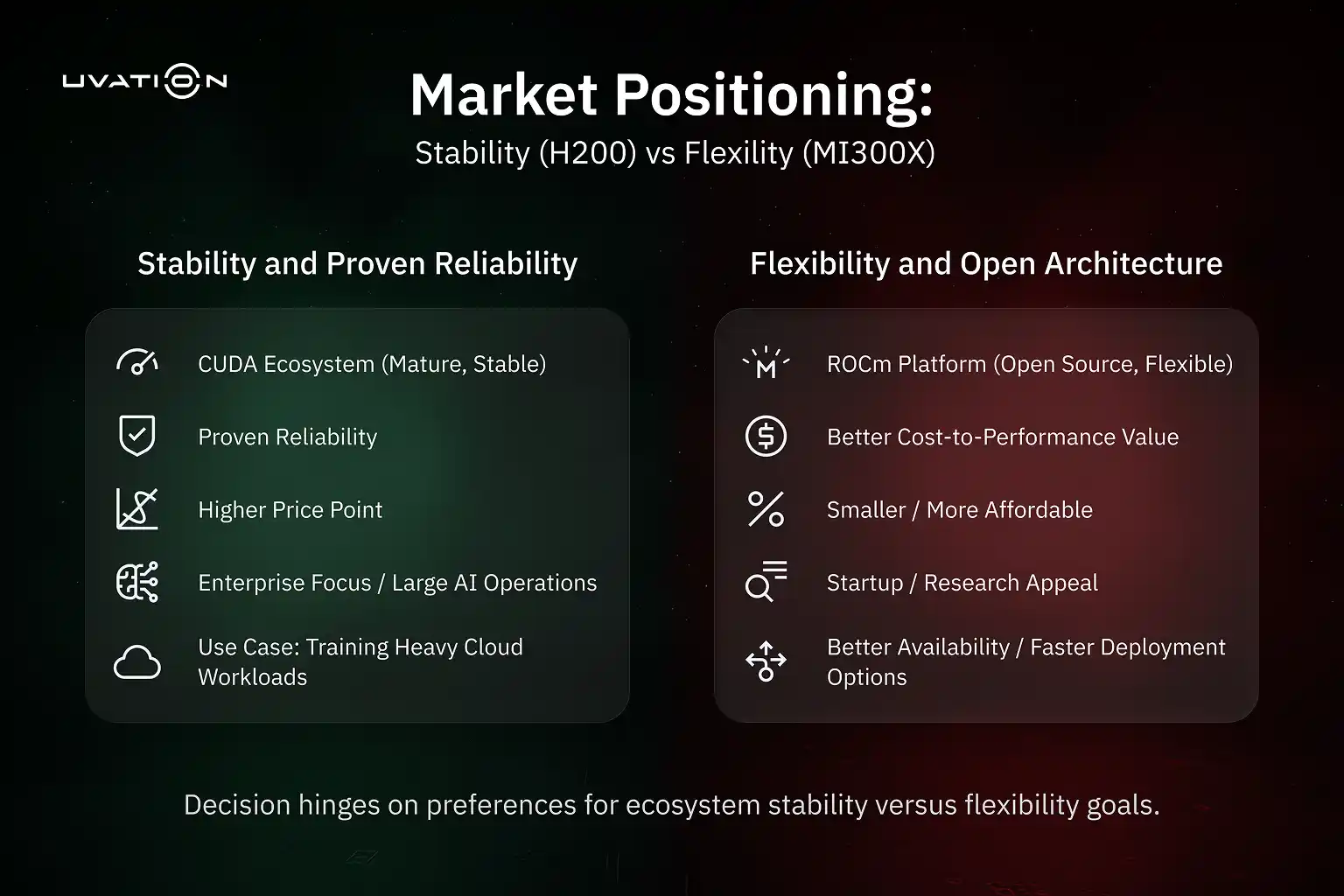
Choosing between the Nvidia H200 GPU and AMD MI300X starts with understanding their specifications; after all, raw numbers reveal capability, scalability, and theoretical performance. Here’s a look at how their technical foundations compare, making it clear what each delivers at the hardware level for your AI, HPC, or massive data workloads.
| Feature | NVIDIA H200 | AMD MI300X |
|---|---|---|
| Architecture | Hopper (H200 GPU) | CDNA 3 (MI300X APU) |
| Memory | 141 GB HBM3e | 192 GB HBM3 |
| Memory Bandwidth | 4.8 TB/s | 5.3 TB/s |
| Compute Performance (FP16) | ~989 TFLOPS | ~1300 TFLOPS |
| Interconnect | NVLink, PCIe 5.0 | Infinity Fabric, PCIe 5.0 |
| Power Consumption (TDP) | ~700W | ~750W |
| AI Framework Support | CUDA, TensorRT, cuDNN | ROCm, PyTorch, TensorFlow (open stack) |
While both GPUs deliver cutting-edge specs, their strengths lie in different areas. NVIDIA H200 is optimized for multi-GPU performance and low latency, while MI300X emphasizes memory capacity and bandwidth.
Putting H200 and MI300X to the Test: Which One Delivers More?
Benchmarks and architecture details are helpful, but what users really want to know is which one delivers more value when put to work across different AI and compute workloads. Let’s see how each performs in different scenarios:
AI Training and Large Models
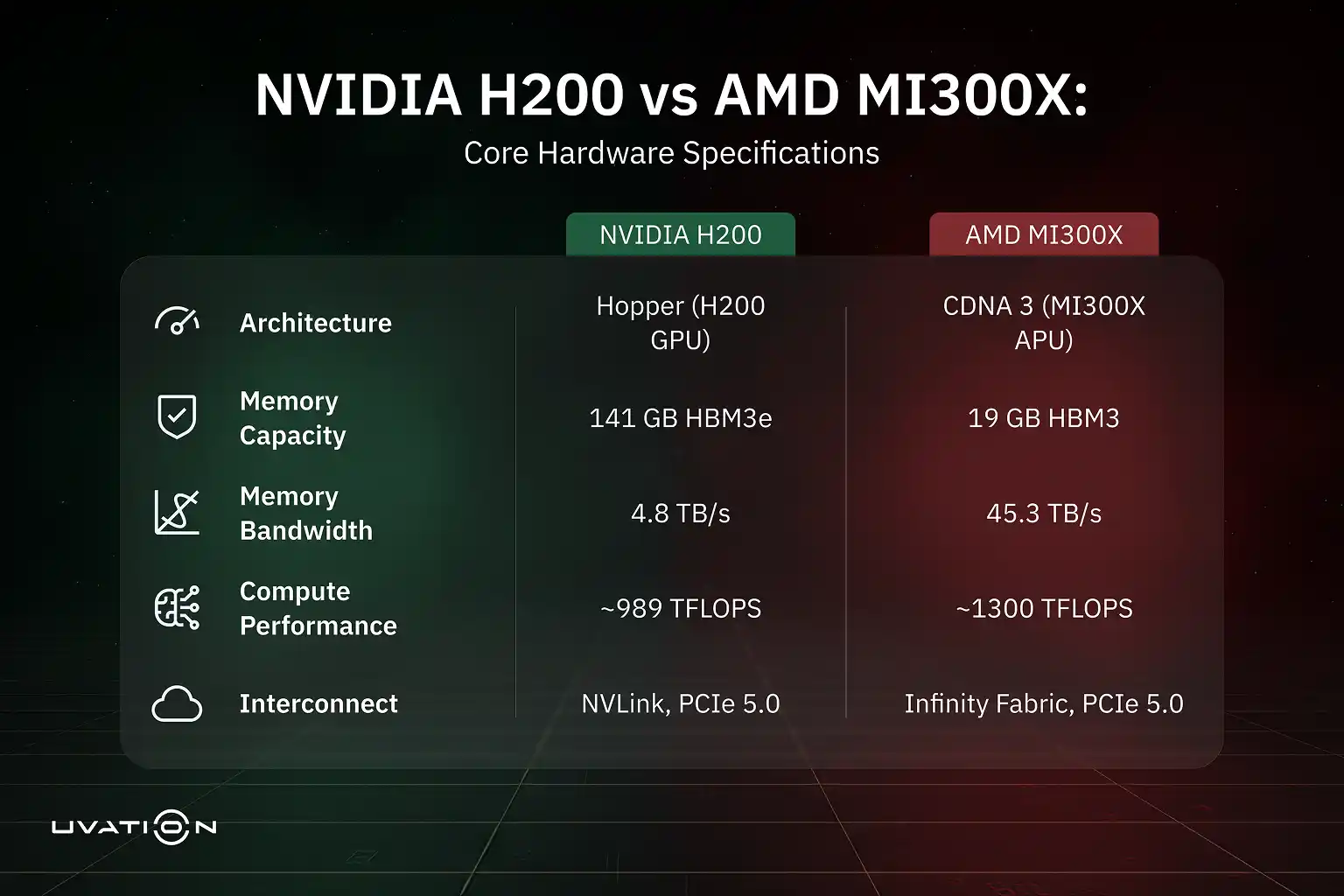
For large-scale AI training, the NVIDIA H200 shows more consistent performance. It builds on the strengths of the H100, with faster memory and improved interconnects that make data movement more efficient. The advantage, however, comes from software optimization, NVIDIA’s CUDA stack and libraries like TensorRT and cuDNN are deeply tuned for AI workloads. This gives H200 a noticeable lead in training speed and scaling efficiency, especially when models are distributed across multiple GPUs.
Inference and Deployment
The AMD MI300X performs strongly when it comes to inference and deployment, particularly for memory-intensive models. Its larger 192 GB HBM3 memory means it can host very large models on a single GPU, reducing the need for partitioning. This not only simplifies the setup but also helps improve latency and throughput for applications like generative AI and LLM inference.
High-Performance Computing and Mixed Workloads
In mixed workloads like data analytics, simulations, or hybrid HPC-AI tasks, AMD’s architecture design works in its favor. The MI300X’s APU (CPU+GPU) configuration helps with data locality and reduced transfer overhead, which can make a visible difference in compute-heavy environments. The H200, meanwhile, continues to dominate pure AI-driven parallel tasks due to its tensor core optimization and NVLink interconnects that enhance communication between multiple GPUs.
In short, the H200 is about refined performance; the MI300X is about flexible power. The best choice depends on what kind of workloads you’re running and how much optimization effort you’re willing to put in.
Pricing, Ecosystem, and Availability: The Deciding Factors
Once performance is clear, the next big question is what’s the real cost of ownership? Because in high-performance computing, pricing revolves around ecosystem fit, software costs, and long-term flexibility.
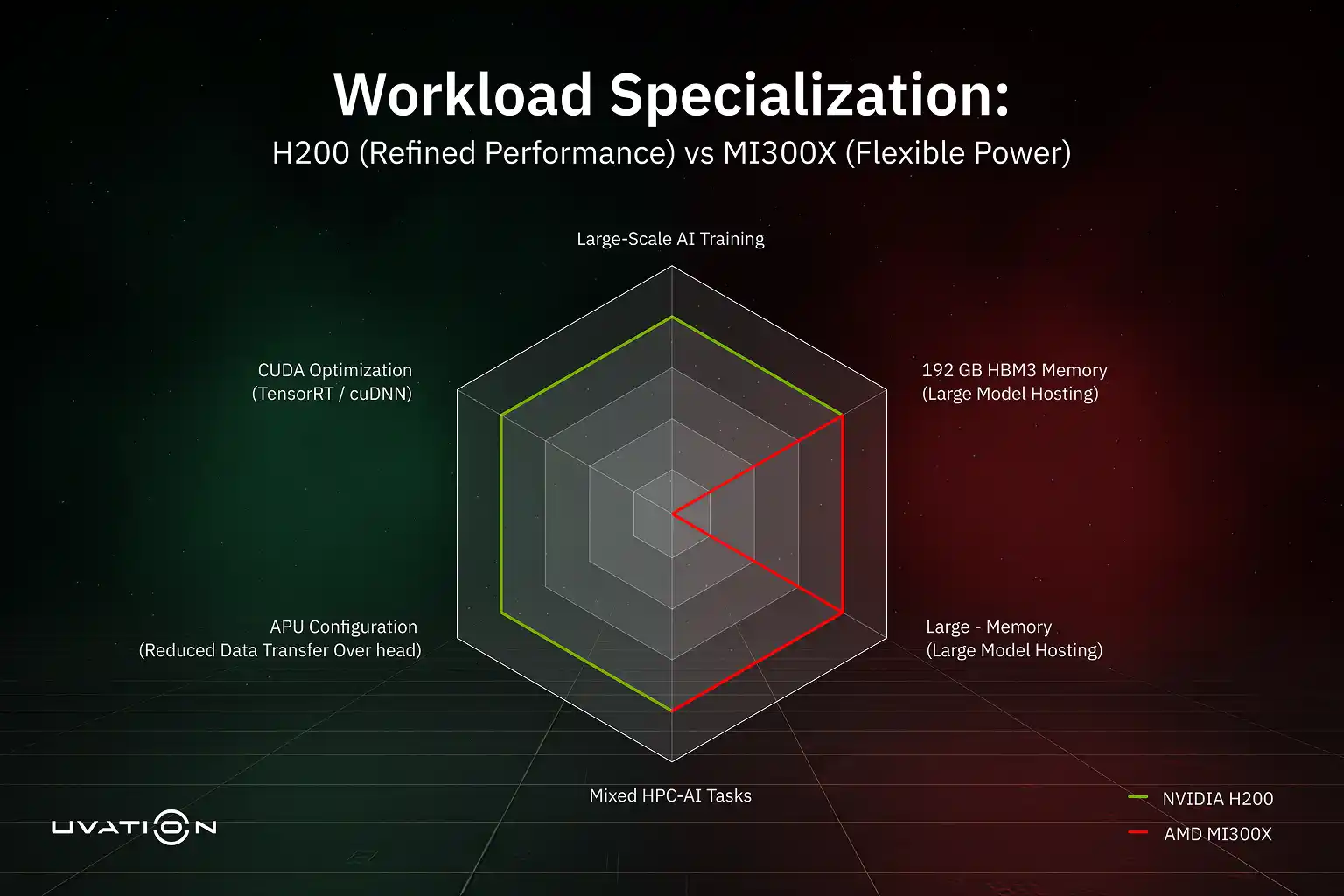
- Pricing: The NVIDIA H200 sits at a higher price point, driven by strong market demand and established dominance in AI infrastructure. The AMD MI300X, while newer, offers better cost-to-performance value, making it appealing for teams looking to scale efficiently without overextending budgets.
- Ecosystem: NVIDIA’s CUDA ecosystem remains its biggest advantage. It’s mature, widely supported, and seamlessly integrates with most AI frameworks, ideal for users who want stability and plug-and-play performance. AMD’s ROCm platform has evolved quickly, offering more open-source flexibility and broader framework compatibility, but it still has a smaller developer community compared to CUDA.
- Availability: Due to high demand, H200 units can be harder to source and may come with longer lead times. MI300X, being newer in the market and supported by multiple cloud providers, often offers better availability and faster deployment options.
H200 is the right choice if you want proven reliability and established ecosystem support. MI300X if you’re optimizing cost, scalability, and open architecture freedom.
The Right Choice Depends on You
Both GPUs are strong, but the right one depends on your needs. AMD MI300X works well for startups and research teams, offering more memory, open framework support, and flexibility without locking you into a specific ecosystem. NVIDIA H200 is better for enterprises and large AI operations, providing proven performance, seamless integration with existing NVIDIA setups, and reliable CUDA support.
For cloud or data center deployments, the H200 performs best in training-heavy workloads, while the MI300X is efficient for inference-driven or cost-sensitive setups. The choice isn’t about which GPU is better overall, it’s about which aligns with your workload, scalability goals, and preference for ecosystem stability versus flexibility.
How Semifly Marketplace Supports Your GPU Purchases
Choosing between NVIDIA and AMD becomes much easier when you can explore all the details in one place. At Semifly Marketplace, we help you simplify the process and help you compare, evaluate, and purchase GPUs that truly fit your needs.
- Side-by-side comparisons: Evaluate H200 and MI300X configurations, benchmark data, and technical specs without switching between sources.
- Transparent pricing and availability: Get real-time insights into cost differences and stock status so you can plan purchases effectively.
- Expert guidance: Semifly’s team helps match GPUs to your specific workloads, whether you’re scaling AI training, running inference, or building HPC clusters.
- Streamlined buying process: From product selection to deployment, everything happens in one place without vendor back-and-forth.
Want to know which GPU fits your setup best? Call our experts at Semifly and get personalized guidance before you make your next big infrastructure move.
Final Word
As the AI hardware race intensifies, the H200 and MI300X show just how far GPU innovation has come. Both bring serious capabilities to the table and whichever direction you lean, it’s clear that the next wave of AI computing will be faster, more efficient, and more accessible than ever before.
The real win lies in understanding your needs, staying informed, and choosing with clarity. And that’s exactly what this comparison and Semifly’s support is meant to help you do.
More Similar Insights and Thought leadership
No Similar Insights Found
Subscribe today to receive more valuable knowledge directly into your inbox
We are writing frequenly. Don’t miss that.
Subscribe to get updates

Unregistered User
It seems you are not registered on this platform. Sign up in order to submit a comment.
Sign up now