FEATURED STORY OF THE WEEK
H200 Compute Cores Benchmark: Measuring the Real-World Impact of NVIDIA’s Next-Gen GPU

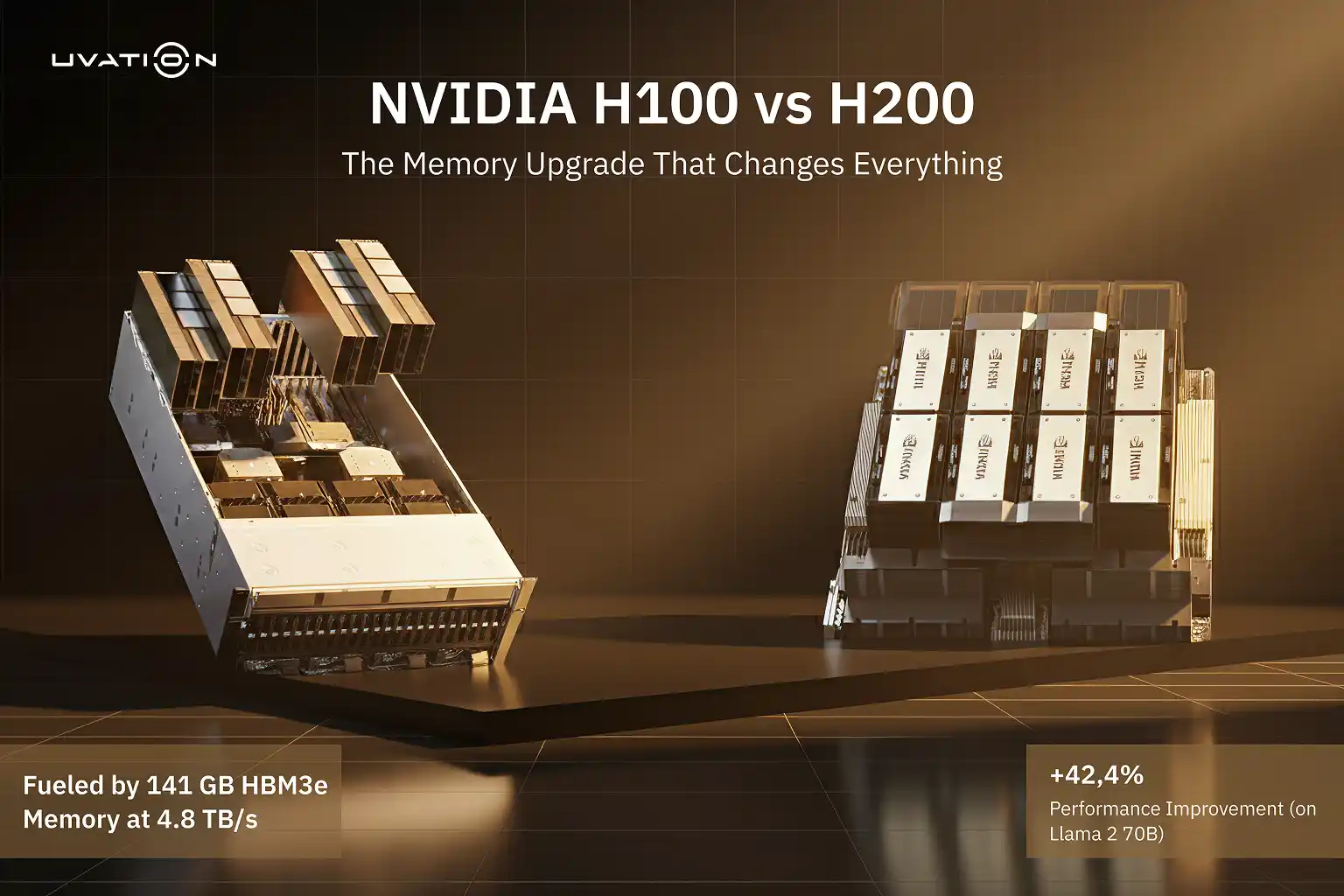
When NVIDIA introduced the Hopper H200, the question wasn’t just about raw specifications. It was about how its compute cores actually perform in real-world workloads. Could they handle massive AI models without slowing down? Could they keep up in applications that require fast responses, like live AI inference or large-scale scientific simulations?
Various benchmarks help us evaluate improvements like smarter tensor cores, faster memory, and better connections between GPUs that actually make a practical difference.
So, what happens when we put the H200’s compute cores to the test? Let’s explore the benchmarks, understand the architecture, and see how these improvements translate into faster, smoother, and more efficient performance for AI and scientific workloads.
The Big Picture: What Makes the H200 Different?
When you look at the H200, the differences aren’t always obvious on a spec sheet but they become clear the moment you start running demanding workloads. The design focuses on how compute cores, memory, and interconnects work together, which makes a real difference when you’re training large models or running multi-GPU simulations.
Here’s where the H200 really stands out:
- Enhanced Tensor Cores: They now support multiple precision modes FP8, FP16, BF16, TF32 which means the GPU can adjust on the fly, balancing speed and accuracy. For AI workloads, that’s a noticeable boost in training speed without compromising results.
- Next-Generation HBM3e Memory: With 4.8 TB/s of bandwidth, data flows to the cores smoothly. That keeps large models from hitting memory bottlenecks and avoids stalls that slow down training or inference.
- Smarter Task Scheduling: Workloads are distributed across cores more efficiently, so the GPU isn’t sitting idle when it could be crunching numbers. Multi-GPU setups also communicate more smoothly, reducing lag in complex training runs.
- Optimized Interconnects (NVLink 5.0): High-speed connections between GPUs allow them to act like a single, cohesive system. This makes a tangible difference in large-scale AI training or HPC simulations.
- Improved Energy Efficiency: Performance-per-watt has gone up significantly. For datacenters, that’s not just about saving power, it means running bigger workloads without hitting thermal limits.
Each of these improvements may seem small in isolation, but together they make a huge difference. You can train larger models on a single GPU, coordinate multiple GPUs more effectively, and maintain consistent performance across long, demanding workloads.
Benchmarking Compute Cores: What Are We Really Measuring?
When we benchmark compute cores, we’re really looking at how efficiently a GPU translates its architecture into performance you can rely on. For the H200, that means understanding how it handles parallel processing, keeps throughput steady, and adapts to different workloads without losing stability.
- Parallel Matrix Computation: This is the backbone of AI and scientific computing. We’re measuring how well the H200 handles large-scale matrix operations simultaneously.
- Throughput Consistency: Workloads vary like AI training, inference, data analytics and the H200 needs to maintain steady performance across all of them.
- Scalability Across Systems: In multi-GPU setups, how efficiently the GPUs communicate and scale together can make a big difference in overall performance.
Looking at these benchmarks gives a clear picture of how the H200 performs in realistic scenarios. It’s about seeing how it manages multiple tasks, distributes workloads, and keeps performance predictable even as demands increase.
The Numbers That Matter: Real-World Benchmark Results
Now let’s look at the results, this is where the design translates into real performance. The H200 delivers significant gains over the H100, setting a new standard for efficiency in AI and high-performance computing workloads. Its improvements become obvious when we examine how it handles actual tasks, from model training to inference and large-scale simulations.
- AI Training (MLPerf v3.1): On GPT-style transformer models, the H200 achieves 1.8x higher throughput compared to the H100. This improvement comes from a more efficient flow of data between memory and compute cores. In practice, that means large AI models train faster, letting teams iterate more quickly and experiment with bigger, more complex models without running into slowdowns.
- Inference (Stable Diffusion & Llama 3): For text and image generation, the H200 completes Llama 3 token generation up to 45% faster and reduces Stable Diffusion cycles by 35%. The benefit is immediate: AI-powered applications respond faster, making real-time services smoother and more reliable for users.
- HPC and Simulation Workloads: In tasks like weather modeling or molecular simulations, the H200 reduces runtime by around 30%, even without modifying existing software. This backward compatibility is important as organizations can run their current workloads more efficiently without rewriting code.
Energy efficiency also improves substantially. The H200 delivers nearly 60% better performance-per-watt, meaning it achieves higher throughput while consuming less power. For datacenters, this translates to lower energy costs, reduced heat generation, and the ability to handle larger workloads sustainably.
H200 creates a smoother, more reliable, and cost-effective workflow across AI training, inference, and simulation tasks. Teams can iterate faster, models can scale bigger, and operations can remain efficient all without the frustration of bottlenecks or unpredictable performance.
What Drives the H200’s Performance Leap
NVIDIA redesigned key parts of the H200’s architecture to make every cycle productive, keep all cores active, and ensure large workloads run smoothly. These improvements directly affect how AI models train, how inference performs, and how high-performance computing tasks scale:
- Memory–Compute Synergy: HBM3e memory keeps data flowing to the compute cores without interruptions. This means large AI models can train steadily, reducing pauses and allowing faster iteration.
- Dynamic Precision Modes: FP8 support lets the GPU adjust precision on the fly. For deep learning, this allows more data to be processed at higher speed while maintaining accuracy, enabling larger models and quicker experimentation.
- Improved GPU Interconnects: NVLink 5.0 connects multiple GPUs with 1.8 TB/s of bidirectional bandwidth. Multi-GPU setups operate seamlessly, scaling efficiently with minimal delays, which keeps large simulations and model training predictable and fast.
These improvements make the H200 feel efficient and reliable in practice. By smoothing out common bottlenecks, NVIDIA ensures workloads run consistently, letting teams focus on building and deploying models rather than troubleshooting performance issues
In Practice: What It Means for Enterprises and Researchers
The H200’s compute performance has tangible implications for how organizations train models, run workloads, and manage infrastructure costs.
Here’s what different users stand to gain:
AI Startups & Model Labs:
Faster training loops mean more iteration cycles per day. That’s crucial for refining models quickly, testing hypotheses, and shipping updates faster.
Cloud Service Providers:
Better performance-per-watt translates to serving more inference requests per GPU-hour, directly improving profitability and energy efficiency.
Research Institutions:
From genomics to climatology, faster compute cycles mean months saved in simulation and data analysis timelines.
Enterprise IT Teams:
The improved efficiency reduces thermal loads and energy requirements, aligning perfectly with sustainability targets and cost optimization.
Ultimately, every benchmark improvement ripples across the ecosystem, shaping how fast innovation can happen.
How Semifly Helps You Leverage H200 Performance
Deploying H200 GPUs effectively requires careful planning, configuration, and validation. At Semifly, we guide enterprises through every step to ensure your H200 deployments deliver consistent, predictable performance:
- Pre-validated H200 configurations for AI training, inference, and HPC workloads.
- Monitoring integration using NVSM and DCGM for visibility over GPU health and utilization.
- Topology optimization for NVLink and multi-GPU setups to maximize communication efficiency.
- Benchmarking and performance validation to confirm your environment delivers the expected gains.
- Operational handover and training for in-house teams to confidently manage clusters.
Free Consultation: If you’re planning an H200 rollout or optimizing an existing setup, Semifly offers a complimentary infrastructure review to assess readiness, identify bottlenecks, and recommend tailored solutions.
Final Word
The H200’s compute core benchmarks mark a solid step forward in how GPU performance translates to real-world value. For organizations running large-scale AI or HPC workloads, that means better output for every watt and every dollar spent. The H200 is a generational upgrade and more like a system that’s built to keep up with the pace of modern computing.
More Similar Insights and Thought leadership
No Similar Insights Found
Subscribe today to receive more valuable knowledge directly into your inbox
We are writing frequenly. Don’t miss that.
Subscribe to get updates

Unregistered User
It seems you are not registered on this platform. Sign up in order to submit a comment.
Sign up now