• FEATURED STORY OF THE WEEK

      NVIDIA H200 vs H100: What CIOs Must Know Before Signing the Next GPU Contract

      Written by :  
      semifly
      Team Semifly
      8 minute read
      May 14, 2025
      Category : Artificial Intelligence
      NVIDIA H200 vs H100: What CIOs Must Know Before Signing the Next GPU Contract
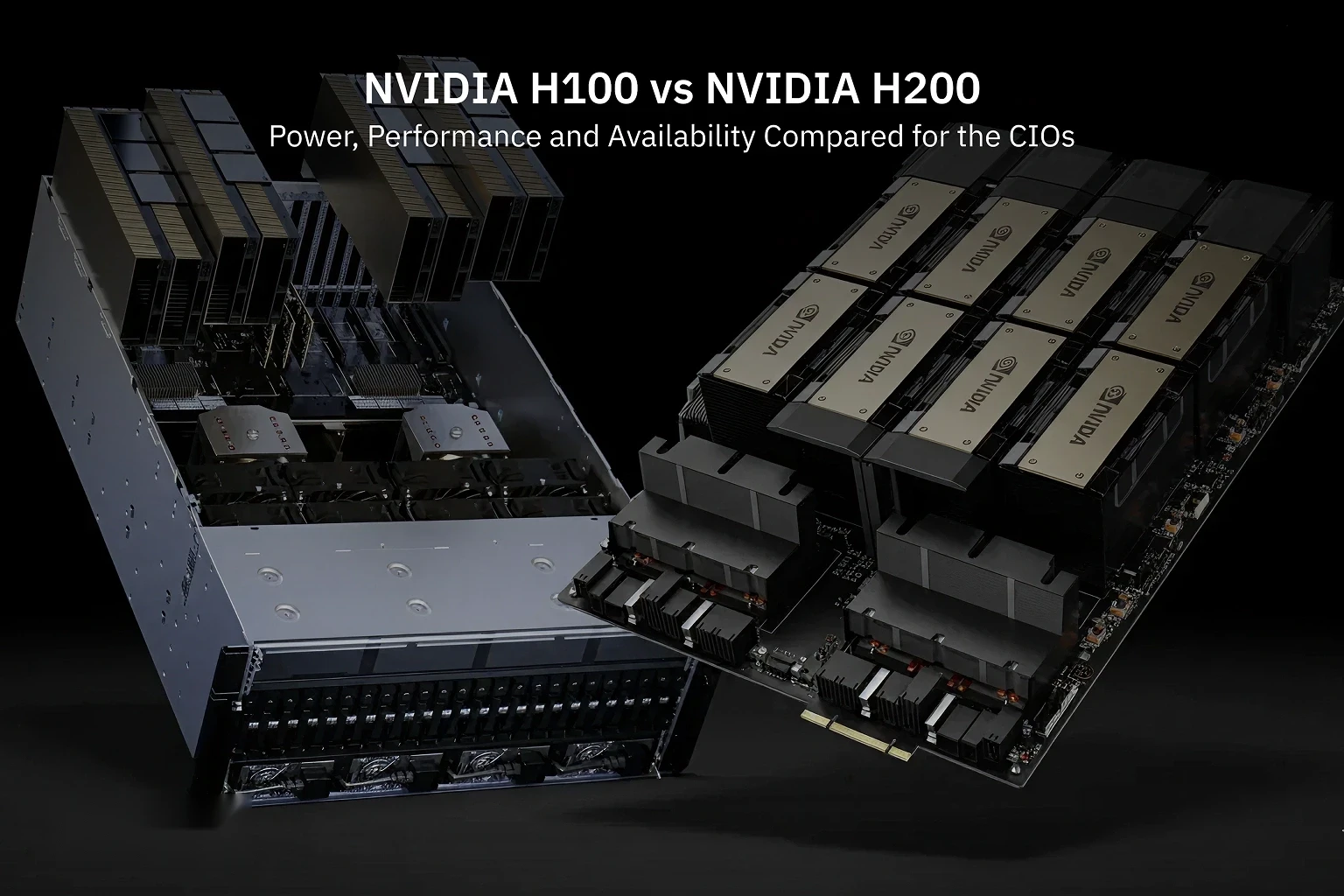
      GPUs are no longer just infrastructure—they’re strategic assets. As enterprises rush to scale AI, the choice between NVIDIA’s H100 and its new successor, the H200, is shaping up to be a defining one.


      The H100 has proven its worth since 2022, powering everything from LLMs to HPC. But the H200 raises the bar with faster memory and better efficiency. It’s designed for scale—but at a higher price point.


      This blog breaks down the trade-offs: performance, availability, energy savings, and long-term value. For CIOs, choosing the right GPU isn’t just a technical decision—it’s a competitive one.
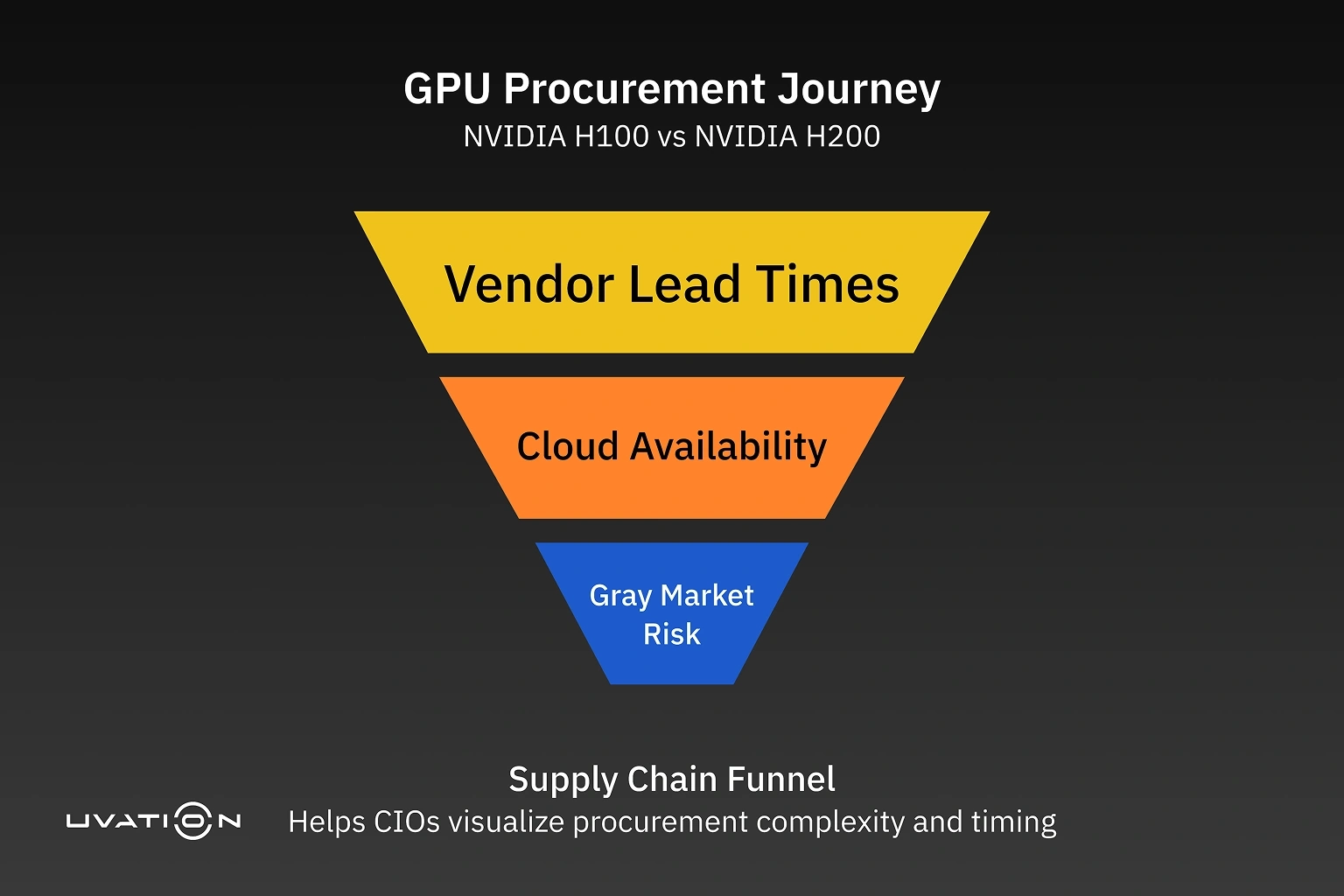
       

      GPU procurement journey funnel comparing NVIDIA H100 and H200 vendor lead times, cloud availability, and gray market risk


      1. Head-to-Head Specifications


      Architecture
      Both the H100 and H200 are built on NVIDIA’s Hopper architecture—tailored for AI workloads. But the H200 brings a crucial edge: HBM3e memory. It’s faster, more efficient, and removes bottlenecks the H100 still contends with.


      Power Consumption
      On paper, both GPUs run at ~700W TDP. In practice, the H200 squeezes more value out of every watt, thanks to architectural tweaks and its upgraded memory stack.


      Why It Matters
      HBM3e doesn’t just move data faster—it uses less energy to do it. That means more throughput with no added power draw. It’s an invisible gain, but one that shows up on your power bill.


      Cooling + Cost Implications
      Both cards demand robust cooling. But with the H200’s efficiency, there’s slightly less waste heat to manage. In dense deployments, that could mean 5% lower cooling costs—a small number with big scale impact.


      For enterprises running racks of GPUs 24/7, efficiency isn’t just a bonus. It’s a budget line.


      2. Performance Metrics


      Memory: Speed and Scale
      The H200 ships with 141GB of HBM3e memory—nearly double the H100’s 80GB. But it’s not just about size. With 4.8 TB/s bandwidth, the H200 moves data 43% faster. That matters when you’re training models north of 100 billion parameters. What struggles to fit on the H100 runs natively on the H200—no sharding, no hacks.


      Inference and Training Gains
      In practical terms, the H200 delivers up to 2x faster inference. That means real-time responses, lower latency, and smoother user experiences. Training sees a ~20% speed boost—cutting cloud hours and speeding time-to-market.


      FP8 / FP16 Efficiency
      Lower-precision math is common in vision, voice, and inferencing tasks. The H200 is optimized here, running FP8 and FP16 workloads faster and with lower power draw. Processing 10,000 images? The H200 will likely do it in half the time, using less energy.


      Bottom Line
      The H200 isn’t just faster. It changes the economics of AI. Quicker inference means happier users. Bigger memory means fewer compromises. Smarter precision math means lower bills.


      Software Compatibility
      Both GPUs run on CUDA 12+, so existing stacks (PyTorch, TensorFlow) work out of the box. No major refactoring needed. But to unlock full H200 gains—especially memory speed—you’ll want to update libraries and tweak configs. Think of it like swapping in a new engine but tuning it for track performance.


      3. Availability and Supply Chain Considerations


      H100: Still in High Demand
      Launched in 2022, the H100 remains the gold standard—but getting one isn’t easy. Lead times stretch 3–6 months, and volume buyers like AWS and Google dominate supply.


      If you’re a startup or mid-market enterprise, prepare for delays—or higher prices on secondary markets. Renting cloud instances helps, but costs add up fast.


      Supply Chain Pressures
      Hopper-based chips are built on 4nm wafers from TSMC, and capacity is tight. Automotive, cloud, and AI workloads are all in line. Add export controls and geopolitical friction, and the result is a fragmented, unpredictable market.


      H200: Promising, But Not Plug-and-Play
      NVIDIA is prioritizing hyperscalers and top OEMs for early H200 shipments. That means longer wait times for most buyers—just like the H100 rollout.


      And there’s a bottleneck: HBM3e. SK Hynix is scaling up, but demand is rising faster than supply. For now, expect limited availability and allocation-based purchasing.
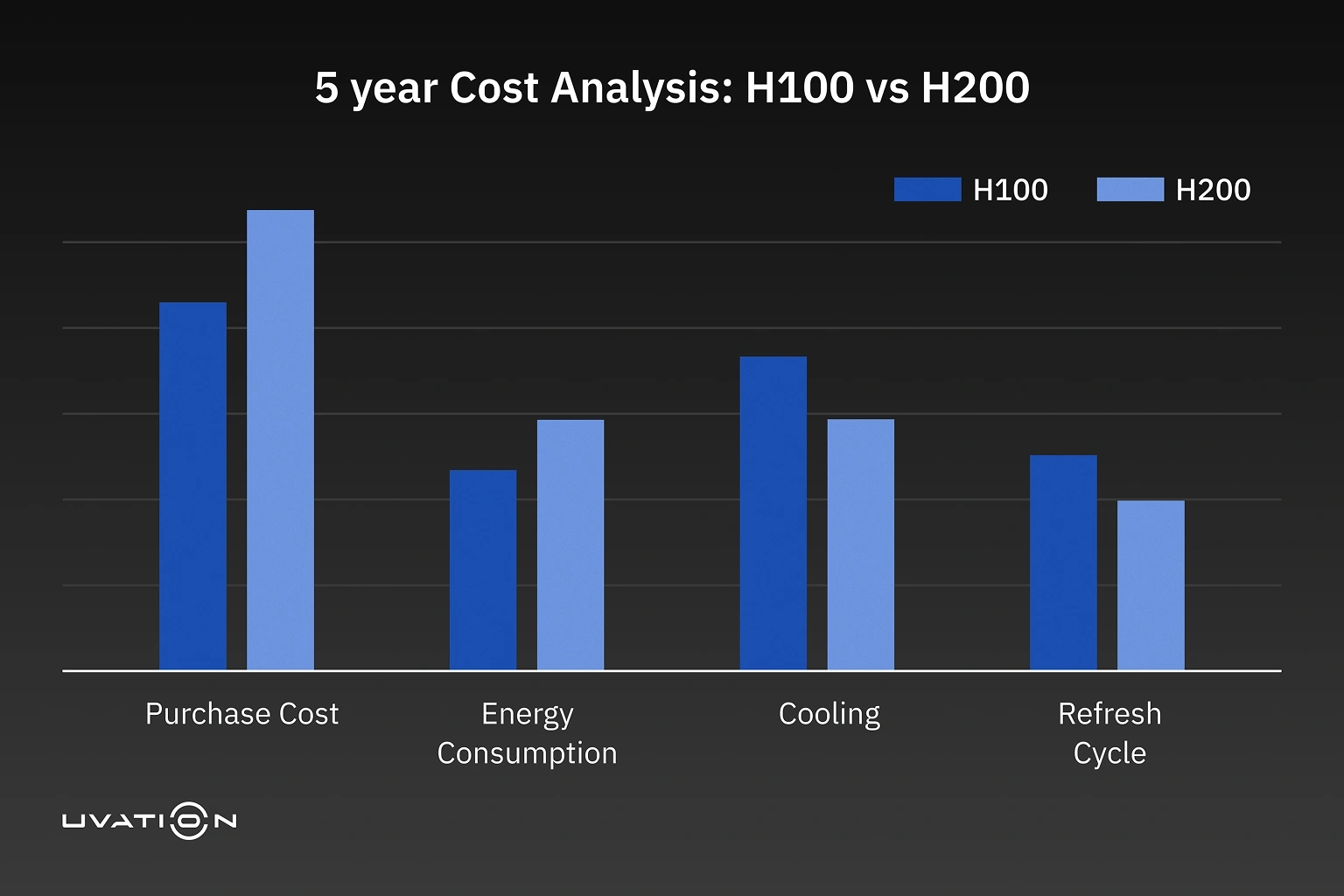
       

      Five year cost analysis chart comparing NVIDIA H100 and H200 across purchase cost, energy consumption, cooling, and refresh cycle


      What This Means for CIOs

      If you need GPUs in the next 3–6 months, the H100 is your realistic option. For 2025 deployments and beyond, pre-book H200s early. The sooner you’re in the queue, the better your odds.


      4. Strategic Procurement Tips for CIOs


      1. Match Lead Times to Roadmaps
      If your AI rollout is slated for 2025, the H100 is the safer bet—it’s available (with some patience) and battle-tested. Waiting on the H200 could mean project delays and missed milestones.


      But if you’re planning for 2026 and beyond, lock in H200 orders now. Early commitments to vendors like Semifly can get you priority access.


      2. Strengthen Vendor Relationships
      Partner closely with OEMs like Dell, HPE, or Lenovo. Those relationships open doors—whether to reserved GPU inventory or preferred pricing. The same goes for cloud partners offering GPU-backed reserved instances.


      3. Diversify Deployment
      Blend on-prem H100 clusters with cloud-based H200 instances. That hybrid model gives you control today and flexibility tomorrow—without overcommitting on a single architecture.


      4. Negotiate with Leverage
      Use multi-year GPU contracts to secure pricing and delivery windows. NVIDIA’s Enterprise License Agreements offer volume discounts—but you’ll need to stay flexible on timelines.


      5. Watch the Gray Market (With Caution)
      Third-party sellers can bridge short-term gaps, but the risks are real: no warranty, firmware tampering, and compliance headaches. If you go this route, stick to verified partners in NVIDIA’s official network.
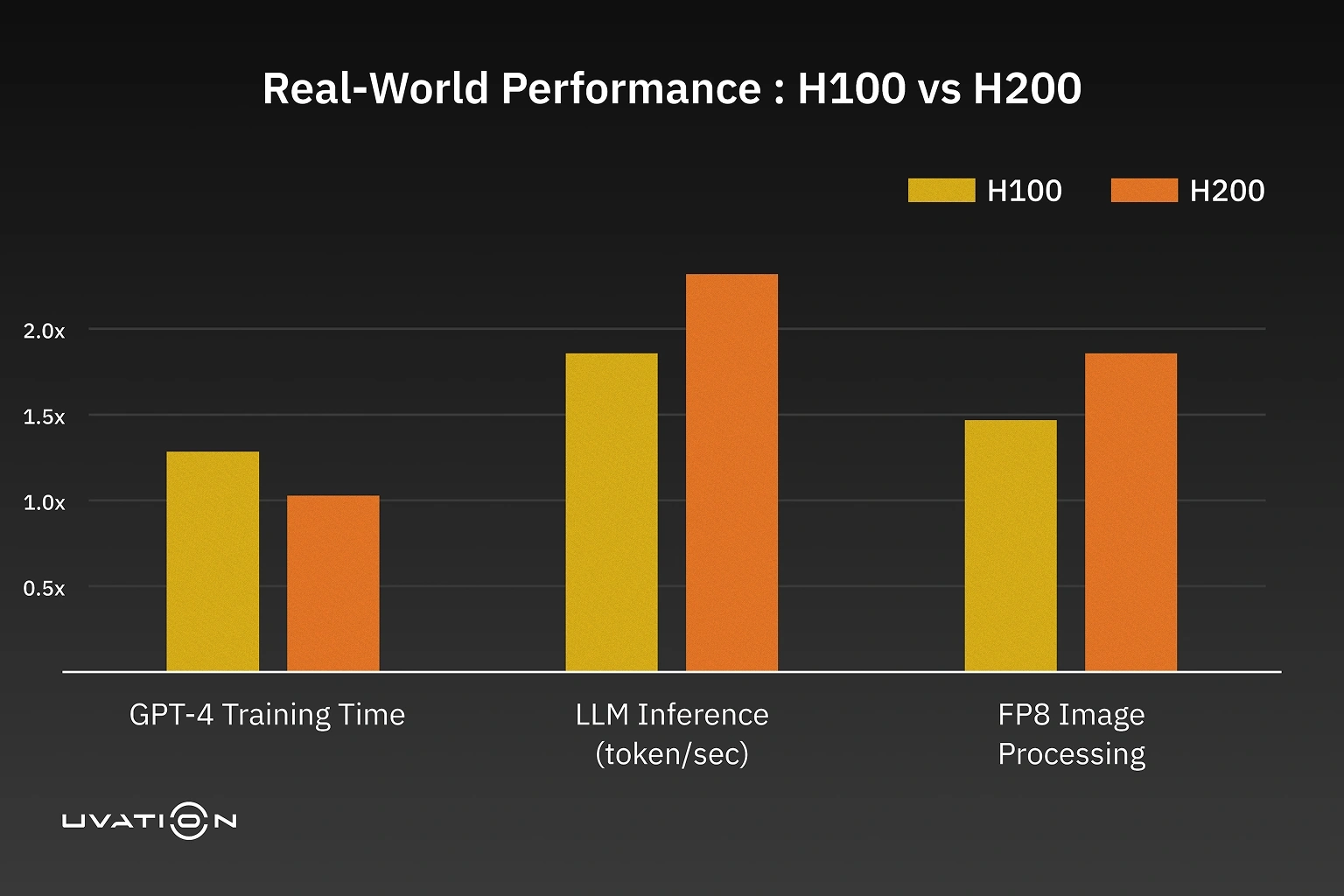
       

      Real world performance comparison of NVIDIA H100 vs H200 showing GPT-4 training time, LLM inference throughput, and FP8 image processing performance


      5. Cost Analysis: H200 Price vs H100 Value


      Upfront Costs
      The H100 currently ranges from $30K to $40K per unit, depending on vendor and configuration. The H200? It’s expected to land 15–25% higher—likely between $34K and $50K.


      That’s a steep delta. For clusters with 100+ GPUs, the difference adds up fast—$1M to $5M more in capex.


      TCO: Where the H200 Pulls Ahead
      Despite the shared 700W TDP, the H200 delivers 15–20% better performance per watt. Run it 24/7, and you’re saving $500–$1000 in energy costs per GPU annually.


      Cooling sees similar gains. H200s generate slightly less heat, which can shave 5–10% off rack-level cooling expenses—worth $10K–$20K per rack over five years in large facilities.


      Future-Proofing Value
      The H200’s 141GB of HBM3e memory gives it headroom for tomorrow’s models. A 100GB VRAM workload today might need 150GB in 18 months. H100 users would need to upgrade. H200 buyers won’t.


      ROI Math
      In training, the H200 is ~20% faster. Inference? Twice as fast. That means faster time-to-market and double the throughput with the same hardware.


      Better yet, the extra memory allows larger models to fit on fewer GPUs. A 175B parameter model that needs 8 H100s might run on 5 H200s. That’s a 37% cut in hardware—and fewer interconnect issues.


      Delaying the Refresh Cycle
      Buying H200s today could defer your next major upgrade by 2–3 years. For a 500-GPU fleet, that’s $15M–$25M in avoided spend when H300-class GPUs arrive.


      6. The Verdict: When Does the H200’s Premium Pay Off?


      For Immediate Needs
      If your priority is speed-to-deployment and cost control, the H100 is still the GPU to beat. It’s proven, available (with some planning), and delivers strong ROI for most current workloads.


      For Scaled, Future-Ready AI
      The H200 justifies its premium for enterprises planning to scale aggressively—especially those leaning into cloud AI, vision models, or LLMs.


      • Cloud Workloads benefit from shorter training and inference cycles, cutting pay-as-you-go costs.
      • On-Prem Deployments get energy and cooling savings that compound over time.
      • AI Innovators gain the memory and compute headroom to handle next-gen models without a refresh.


      Bottom Line
      The H200 isn’t just a spec bump. It’s a hedge against obsolescence and an investment in AI velocity. For CIOs with long-term ambitions, it can pay for itself in fewer nodes, faster throughput, and deferred upgrades.


      But for others, the H100 delivers what matters now—reliably, and at a lower cost.


      Conclusion


      Choosing between NVIDIA’s H200 and H100 isn’t just about tech specs—it’s about aligning GPU strategy with enterprise timelines and risk tolerance.


      Yes, the H200 brings 141GB of HBM3e, 2x inference gains, and future-proof architecture—but it comes with longer lead times and a 15–25% premium. The H100, while less scalable, remains a smart pick for teams with active workloads and tight procurement windows.


      What CIOs Should Do Now:


      • Audit Your AI Pipeline
        Reserve the H200 for LLMs, multi-modal, and memory-bound use cases. Deploy H100s for general AI and mixed HPC workloads.
      • Compare Long-Term TCO, Not Just Sticker Price
        Factor in energy, cooling, model fit, and upgrade cycles.
      • Secure Supply Chains Early
        Partner with vendors like Semifly to run real-world pilots and lock in allocations before shortages hit.


      Because in this market, your GPU isn’t just infrastructure. It’s your AI advantage.
       

      Bookmark me
      Share on
      Comments
      Add your Comment

      Writing About AI

      Semifly

      is an engineer and a technologist with a diverse background spanning software, hardware, aerospace, defense, and cybersecurity. As CTO at Semifly, he leverages his extensive experience to lead the company’s technological innovation and development.

      Explore Nvidia’s GPUs

      Find a perfect GPU for your company etc etc
      Go to Shop

      FAQs

      • The primary difference is the memory technology. While both GPUs are built on the powerful Hopper architecture, the H200 incorporates next-generation HBM3e memory. This upgrade is the H200’s critical edge, as this memory is significantly faster and more efficient, removing key data transfer bottlenecks that can limit the performance of the H100 in demanding, large-scale AI workloads.

      • Although the official Thermal Design Power (TDP) is similar at approximately 700W, the H200 achieves substantially more throughput per watt. This is due to its architectural tweaks and, most importantly, its upgraded HBM3e memory stack. HBM3e uses less energy to move data, meaning the H200 can process more information without an increase in power draw. This creates an “invisible gain” in efficiency that translates directly to lower operational expenses on your power bill.

      • The H200’s superior efficiency means it generates slightly less waste heat than the H100 for a given workload. While this may seem minor, in dense, large-scale deployments, that could mean 5% lower cooling costs. At the scale of an enterprise data center, this small percentage has a significant and positive impact on the operational budget over the hardware’s lifecycle.
        These foundational hardware differences are the direct cause of the significant performance advantages the H200 offers.

        • The H200 offers substantial upgrades over the H100 in memory capacity, bandwidth, and processing speed for both training and inference tasks.
        • Memory Size: The H200 is equipped with 141GB of HBM3e, which is nearly double the H100’s 80GB.
        • Memory Bandwidth: The H200 features a memory bandwidth of 4.8 TB/s, making it 43% faster than the H100.
        • Inference Speed: For real-world applications, the H200 delivers up to 2x faster inference.
        • Training Speed: For model development, the H200 provides a ~20% speed boost in training performance.
        • FP8 / FP16 Efficiency: The H200 is highly optimized for lower-precision math common in vision and voice tasks, enabling faster processing with lower energy consumption for these specific workloads.
      • The H200’s superior memory architecture changes the economics and feasibility of working with large-scale AI. Models that struggle to fit onto a single H100 can run natively on an H200—no sharding, no hacks. This dramatically reduces engineering complexity. In production, the 2x inference speed gain translates directly into business value through lower latency for end-users and smoother, more responsive AI-powered experiences. For model training, the 20% speed boost means reduced cloud hours, lower development costs, and a faster path from concept to deployment.

      • No, migration is generally straightforward. Both the H100 and H200 run on CUDA 12+, ensuring that existing software stacks built on frameworks like PyTorch and TensorFlow will work out of the box without requiring major refactoring. However, unlocking the H200’s full potential requires deliberate effort. Think of it like swapping in a new engine but tuning it for track performance; updating libraries and tweaking configurations is necessary to fully leverage its enhanced memory speed.
        The H200’s clear performance advantages naturally lead to an analysis of its cost and long-term financial value.

      • The H100 GPU currently ranges from $30,000 to $40,000 per unit. The H200 is expected to carry a premium, with an anticipated price point that is 15–25% higher, likely landing between $34,000 and $50,000 per unit.

        • The H200’s superior TCO is driven by its operational efficiency and its capacity to handle future workloads, which offset its higher upfront cost over time.
        • Energy Savings: With 15–20% better performance per watt, each H200 can save an estimated $500–$1000 in energy costs annually compared to an H100 running 24/7.
        • Cooling Savings: The reduction in waste heat can cut rack-level cooling expenses by 5–10%, which is worth $10,000–$20,000 per rack over five years in large facilities.
        • Future-Proofing: Its 141GB of memory provides critical headroom for the larger, more complex AI models of tomorrow. This capability can defer the next major and costly hardware upgrade cycle by an estimated 2–3 years.
        • Yes, absolutely. The H200’s larger memory capacity allows it to run models that would require multiple H100s. For example, a 175B parameter model that needs 8 H100s for training or inference might run effectively on just 5 H200s. This represents a significant reduction in the required hardware, which in turn simplifies interconnect complexity and lowers the overall capital expenditure for the project.
        • While the financial case is compelling, the practical realities of acquiring these high-demand components must be a central part of any strategic plan.
        • 4.0 Procurement and Availability
        • In the current AI landscape, a brilliant hardware strategy is rendered ineffective without a realistic and proactive procurement plan. Supply chain management has become a critical strategic function. For any CIO, understanding lead times, navigating supply bottlenecks, and cultivating strong vendor relationships are essential for successful execution.
      • Both GPUs face significant supply constraints due to overwhelming demand.
        For the H100, it remains the market’s gold standard and is in extremely high demand. This results in typical lead times of 3–6 months, with much of the available supply being allocated to large-volume buyers like hyperscale cloud providers.
        For the H200, NVIDIA is prioritizing its initial shipments for hyperscalers and top-tier OEMs. This means most other buyers will face longer wait times. The supply is further constrained by a bottleneck in the production of HBM3e memory.

      • Given the challenging supply environment, a multi-faceted procurement strategy is essential.
        Match Lead Times to Roadmaps: For AI rollouts planned for 2025, the H100 is the more realistic and safer bet due to its relative availability. For strategic initiatives planned for 2026 and beyond, pre-booking H200 orders now is critical.
        Strengthen Vendor Relationships: Partner closely with established OEMs and cloud service providers. These relationships can provide priority access to reserved inventory and preferential pricing.
        Diversify Deployment: Implement a hybrid model that blends on-premise H100 clusters for current needs with cloud-based H200 instances for flexibility and future-scaling.
        Negotiate with Leverage: Utilize multi-year contracts and NVIDIA Enterprise License Agreements to secure more favorable pricing and predictable delivery windows.
        Use Caution with the Gray Market: While third-party sellers can fill short-term gaps, they come with significant risks, including a lack of warranty, potential for firmware tampering, and compliance issues.
        With a procurement plan in place, the final step is to make the strategic choice of which GPU best aligns with your enterprise goals.
        Strategic Decision-Making: Choosing the Right GPU
        Ultimately, the choice between the H100 and H200 is not a simple technical decision. It is a strategic one that must be carefully aligned with your enterprise’s specific AI ambitions, project timelines, budget realities, and overall risk tolerance. The right GPU is the one that best positions your organization for a competitive advantage.

      • The H100 remains the GPU to beat when the primary organizational priorities are speed-to-deployment and cost control. It is the smart and pragmatic choice for teams with active workloads, tight procurement windows, and a focus on general AI or mixed High-Performance Computing (HPC) tasks where its proven performance is more than sufficient.

      • The H200’s premium is justified for enterprises that are planning to scale their AI initiatives aggressively. It is the ideal choice for organizations focused on training and deploying large-scale LLMs, multi-modal models, and other memory-bound use cases. For cloud-based workloads, it cuts operational costs, and for on-premise deployments, its superior energy and cooling efficiency savings compound over time, delivering a strong return on the initial investment.

      • The H200 should not be viewed as a simple specification bump. It is a strategic hedge against obsolescence and an investment in AI velocity. The core advice for CIOs is to audit the organization’s AI pipeline, compare the long-term TCO of both platforms rather than just the sticker price, and work to secure supply chains as early as possible. In today’s competitive market, the choice of GPU is no longer just an infrastructure decision—it is a foundational source of your enterprise’s AI advantage.

      More Similar Insights and Thought leadership

      No Similar Insights Found

      semifly
      About Us