• FEATURED STORY OF THE WEEK

      H200 PCIe Datasheet: NVIDIA’s Most Versatile AI GPU Form Factor for Enterprise AI

      Written by :  
      semifly
      Team Semifly
      4 minute read
      July 30, 2025
      Category : Datacenter
      H200 PCIe Datasheet: NVIDIA’s Most Versatile AI GPU Form Factor for Enterprise AI
      Looking for a deploy-anywhere AI GPU that doesn’t compromise on power?
      The NVIDIA H200 PCIe version offers just that, massive performance, memory, and compatibility packed into a widely adopted form factor.


      Whether you’re upgrading legacy servers, building edge inferencing clusters, or deploying mixed AI workloads in the cloud, the H200 PCIe is a game-changing option. This blog unpacks the H200 PCIe datasheet, showing how it enables flexible, high-performance AI deployments, without needing a DGX-class system.
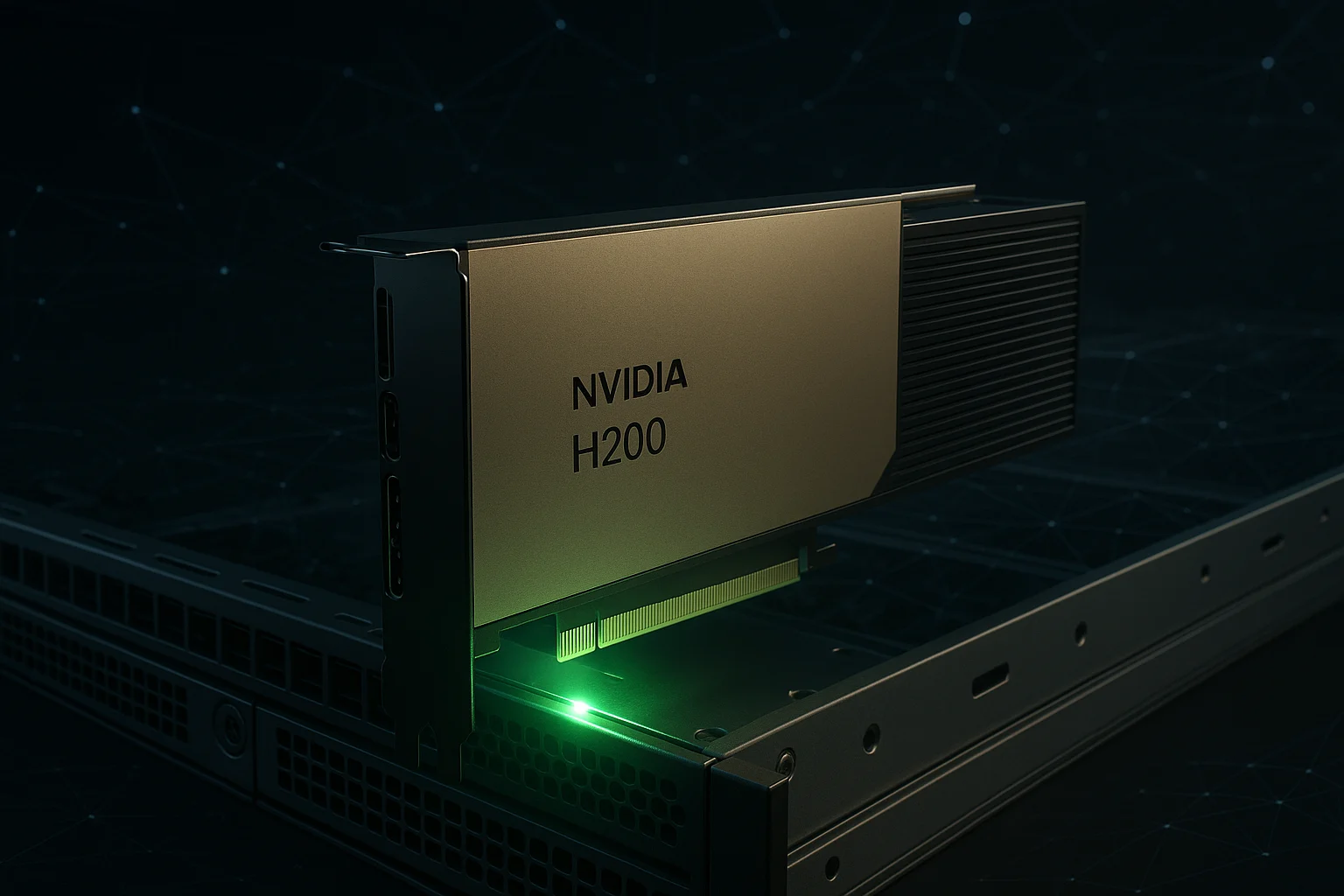
       

      A close-up, dynamic shot of the NVIDIA H200 PCIe GPU card, sleek and powerful, positioned within a standard server rack with a subtle green glow, symbolising its "deploy-anywhere AI GPU" capability. The image highlights its form factor as "NVIDIA’s Most Versatile AI GPU Form Factor for Enterprise AI" and its "broad compatibility with existing x86 servers


      What Is the NVIDIA H200 PCIe?


      The NVIDIA H200 is built on the Hopper architecture and designed for AI/ML, LLM inference, and HPC workloads. While the SXM version is optimized for max throughput in DGX systems, the PCIe variant gives enterprises broader compatibility with existing x86 servers, without losing access to key features like:


      • 141 GB of HBM3e memory
      • Up to 4.8 TB/s memory bandwidth
      • FP8 support for LLMs
      • MIG (Multi-Instance GPU) partitioning
      • NVLink and PCIe Gen5 interface


      H200 PCIe Datasheet: Key Specifications

      Here’s a quick glance at the technical specifications for the PCIe form factor, optimized for plug-and-play deployment:

      Feature H200 PCIe Specification
      Architecture NVIDIA Hopper
      Memory 141 GB HBM3e
      Memory Bandwidth Up to 4.8 TB/s
      PCIe Interface Gen5 x16
      NVLink Support No (NVLink available only in SXM)
      TDP 600W
      MIG Support 7 instances @ 16.5 GB
      Tensor Cores FP8, FP16, BF16, TF32, INT8, FP64
      Confidential Computing Supported via TEEs

      Ideal for inference-heavy workloads and retrofitting existing servers
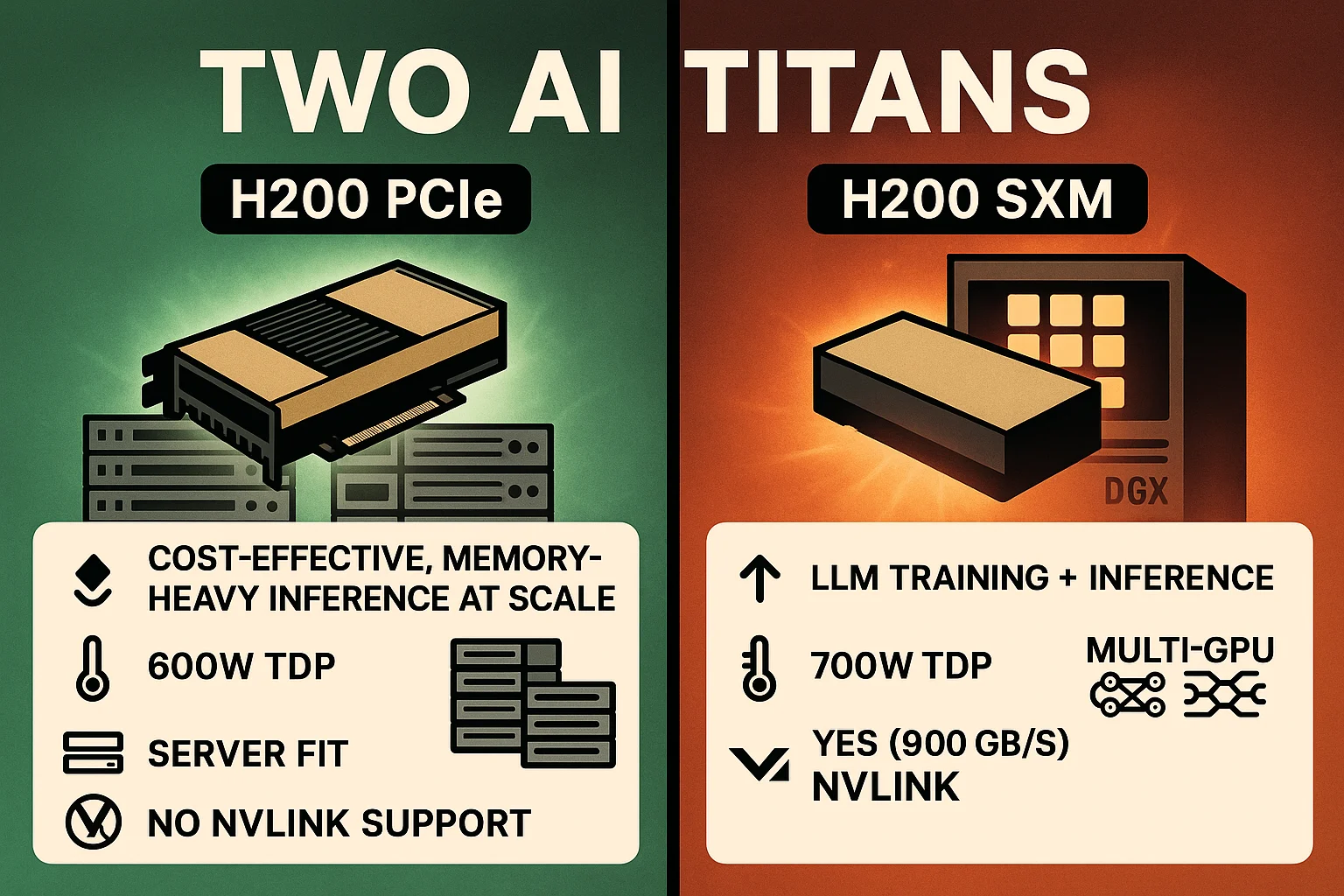
       

      A comparative infographic displaying the NVIDIA H200 PCIe on the left and the NVIDIA H200 SXM on the right, contrasting their key features and use cases. The H200 PCIe side highlights its 600W TDP and "No NVLink Support", suitable for "x86 servers, rackmount" and "cost-effective, memory-heavy inference at scale". The H200 SXM side features its 700W TDP and "Yes (900 GB/s) NVLink", ideal for "DGX systems" and "LLM training + inference


      How Is H200 PCIe Different from SXM?


      Feature H200 SXM H200 PCIe
      TDP 700W 600W
      NVLink Yes (900 GB/s) No
      Server Fit DGX systems x86 servers, rackmount
      Deployment Use LLM training + inference Inference, hybrid AI workloads
      Interconnect NVLink + PCIe PCIe only


      If you need multi-GPU training clusters, SXM is your best bet. But if you’re focused on cost-effective, memory-heavy inference at scale, the H200 PCIe is a smarter fit.


      Real-World Use Cases: Where Does H200 PCIe Shine?
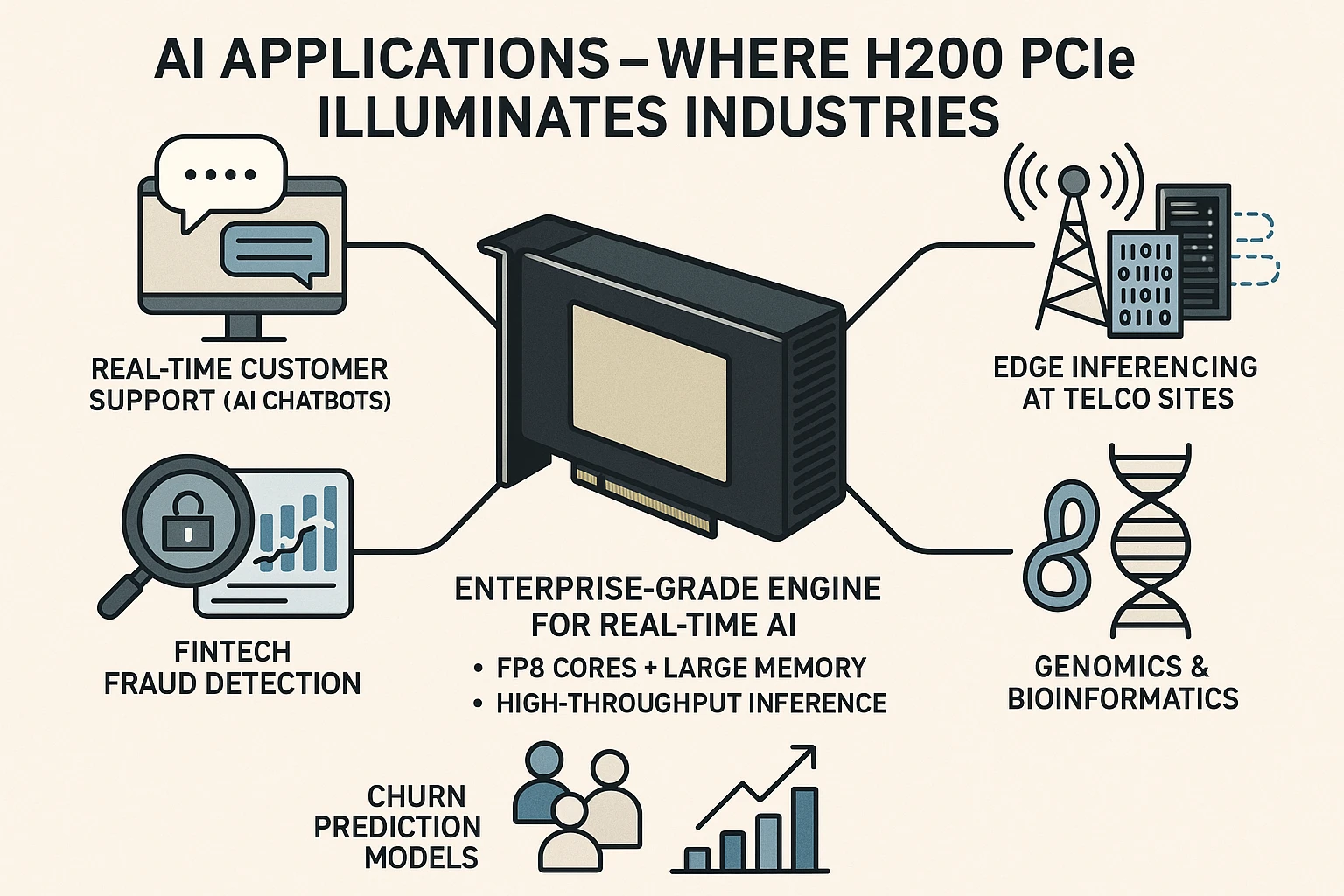
      An infographic showcasing diverse real-world applications of the NVIDIA H200 PCIe GPU, with a central stylised H200 PCIe branching out to various industry icons

      Use Case Why H200 PCIe Works
      Real-time Customer Support (AI chatbots) FP8 cores + large memory support multi-lingual LLMs
      Edge inferencing at Telco Sites Runs INT8/FP8 models efficiently on standard racks
      Fintech fraud detection Fast token inference on encrypted, live traffic
      Genomics & bioinformatics Handles large datasets without memory overflows
      Churn Prediction Models Inference + retraining possible in one stack


      Can I Use H200 PCIe for Training?


      Yes, with some limits. While the H200 PCIe can support model training using FP8, TF32, and FP16, the lack of NVLink means multi-GPU parallelism is limited. For full-scale LLM training, SXM remains ideal. But for fine-tuning, instruction tuning, or embedding generation, PCIe is more than capable.


      Sample Code: FP8 Inference with Hugging Face on H200 PCIe


      import torch
      from transformers import AutoTokenizer, AutoModelForCausalLM

      tokenizer = AutoTokenizer.from_pretrained(“mistralai/Mistral-7B-Instruct-v0.1”)
      model = AutoModelForCausalLM.from_pretrained(“mistralai/Mistral-7B-Instruct-v0.1”).half().cuda()

      inputs = tokenizer(“Why is PCIe important for enterprise AI?”, return_tensors=”pt”).to(“cuda”)

      with torch.autocast(“cuda”, dtype=torch.float8): # Exclusive to Hopper GPUs
      outputs = model.generate(**inputs, max_new_tokens=50)

      print(tokenizer.decode(outputs[0]))


      This code runs completely in-GPU without memory paging, even with 7B models.


      Why Choose H200 PCIe for Your AI Stack?


      • No specialized infrastructure needed, runs on standard servers
      • Future-proof your inference stack with FP8 and MIG support
      • Save power and cost over DGX setups
      • Deploy faster with pre-built compatibility templates


      How Semifly Helps You Deploy H200 PCIe at Scale


      At Semifly, we offer turnkey deployment and AI infrastructure design for H200 PCIe-based stacks:


      • DGX alternatives: Pre-tuned PCIe clusters for real-time workloads
      • MIG slicing: Optimize multi-tenant clusters for edge or call center models
      • Confidential AI: Enable isolated LLM deployments in regulated industries
      • Custom dashboards: Monitor cost per token, memory usage, and throughput
      • Infrastructure-as-Code: Deploy across hybrid environments using Terraform/Ansible


      Ready to test your workload on H200 PCIe?
      Book a simulation with our AI Infrastructure team →


      Final Thoughts: Is H200 PCIe Right for You?


      If your AI roadmap involves high-throughput inference, regulated deployment, or scalable GPU memory without rebuilding infra, then yes, the H200 PCIe is your best choice.


      It’s not just a GPU. It’s a flexible, future-ready, enterprise-grade engine for real-time AI.

       

      Bookmark me
      Share on
      Comments
      Add your Comment

      Writing About AI

      Semifly

      is an engineer and a technologist with a diverse background spanning software, hardware, aerospace, defense, and cybersecurity. As CTO at Semifly, he leverages his extensive experience to lead the company’s technological innovation and development.

      Explore Nvidia’s GPUs

      Find a perfect GPU for your company etc etc
      Go to Shop

      FAQs

      • The NVIDIA H200 PCIe is a versatile graphics processing unit (GPU) built on the Hopper architecture, specifically designed for enterprise-level Artificial Intelligence (AI), Machine Learning (ML), Large Language Model (LLM) inference, and High-Performance Computing (HPC) workloads. It offers a balance of significant performance, memory, and broad compatibility, making it suitable for deployment in existing x86 servers without requiring specialised infrastructure like DGX systems.

      • The H200 PCIe boasts impressive specifications, including 141 GB of HBM3e memory with up to 4.8 TB/s memory bandwidth, enabling efficient handling of large datasets. It supports a PCIe Gen5 x16 interface and features FP8 support, which is crucial for LLMs, along with support for FP16, BF16, TF32, INT8, and FP64 Tensor Cores. It also incorporates MIG (Multi-Instance GPU) partitioning, allowing for up to 7 instances, and supports Confidential Computing via TEEs. Its Thermal Design Power (TDP) is 600W.

      • The H200 PCIe is distinct from the H200 SXM primarily in its form factor, power consumption, and interconnectivity. The PCIe version has a TDP of 600W and lacks NVLink support, making it ideal for integration into standard x86 servers and focused on inference and hybrid AI workloads. In contrast, the H200 SXM has a higher TDP of 700W, features NVLink (900 GB/s) for multi-GPU communication, and is optimised for DGX systems, making it better suited for full-scale LLM training and maximising throughput. While SXM excels in multi-GPU training clusters, the PCIe offers a more cost-effective and memory-heavy solution for inference at scale.

      • The H200 PCIe shines in a variety of real-world scenarios due to its large memory and efficient processing capabilities. It is particularly well-suited for real-time customer support AI chatbots, leveraging FP8 cores and ample memory for multi-lingual LLMs. It’s also effective for edge inferencing at Telco Sites, running INT8/FP8 models on standard racks, and for Fintech fraud detection, enabling fast token inference on encrypted, live traffic. Additionally, it can handle large datasets without memory overflows in genomics and bioinformatics, and supports both inference and retraining for churn prediction models.

      • Yes, the H200 PCIe can be used for AI model training, though with some limitations. It supports model training using FP8, TF32, and FP16. However, due to the absence of NVLink, its capacity for multi-GPU parallelism is restricted, making the SXM version more ideal for full-scale LLM training. Nevertheless, the PCIe variant is more than capable for specific training tasks such as fine-tuning, instruction tuning, or embedding generation.

      • Enterprises should consider the H200 PCIe for their AI stack because it offers significant advantages. It doesn’t require specialised infrastructure, running seamlessly on standard servers. It helps future-proof inference stacks with its FP8 and MIG support. Furthermore, it contributes to power and cost savings compared to DGX setups and facilitates faster deployment through pre-built compatibility templates. This makes it a flexible, future-ready, and enterprise-grade engine for real-time AI.
      • Semifly provides comprehensive services for deploying H200 PCIe-based stacks at scale. This includes offering DGX alternatives with pre-tuned PCIe clusters for real-time workloads and optimising multi-tenant clusters for edge or call centre models through MIG slicing. Semifly also enables confidential AI for isolated LLM deployments in regulated industries, provides custom dashboards for monitoring cost per token, memory usage, and throughput, and facilitates deployment across hybrid environments using Infrastructure-as-Code tools like Terraform and Ansible.

      • While the H200 PCIe is a powerful and versatile GPU, it’s not universally the optimal choice for every AI application. It is best suited for AI roadmaps involving high-throughput inference, regulated deployments, or scalable GPU memory without the need for infrastructure rebuilding. For scenarios demanding multi-GPU training clusters and maximum throughput for full-scale LLM training, the H200 SXM, with its NVLink support, remains the superior option. The decision depends on whether the primary focus is on cost-effective, memory-heavy inference at scale and compatibility with existing server infrastructure, or on high-performance, multi-GPU training.

      More Similar Insights and Thought leadership

      No Similar Insights Found

      semifly
      About Us