NVIDIA DGX H200 vs. DGX B200: Choosing the Right AI Powerhouse
Artificial intelligence is transforming industries, but its complex models demand specialized computing power. Standard servers often struggle. That’s where NVIDIA DGX systems come in – they are pre-built, supercomputing platforms designed from the ground up specifically for the intense demands of enterprise AI. Think of them as factory-tuned engines built solely for accelerating AI development and deployment.
Today, we’re comparing two cutting-edge DGX servers: the NVIDIA DGX H200 and the NVIDIA DGX B200. Both pack tremendous AI performance into a single server unit, but they represent different generations of NVIDIA technology and excel in distinct ways. The NVIDIA DGX H200 features eight H200 Tensor Core GPUs based on the proven Hopper architecture. The NVIDIA DGX B200 steps forward with the revolutionary Blackwell architecture, offering groundbreaking compute performance.
Choosing between these AI powerhouses depends heavily on your specific technical needs and infrastructure capabilities. This comparison will break down their architectures, performance, and ideal workloads. Our goal is simple: to provide clear, factual insights that help you decide whether the NVIDIA H200 or the NVIDIA B200 server is the right engine for your AI ambitions.
1. How Do the Core Architectures of DGX H200 and B200 Differ?
Both NVIDIA DGX H200 and DGX B200 are AI supercomputers designed for enterprise-scale workloads. They feature some of the most powerful GPUs available today and are built on different GPU architectures. While they may appear similar in form factor, the underlying GPU technologies are quite different and impact performance, memory capacity, and use cases.
NVIDIA DGX H200: Powered by Hopper Architecture
The NVIDIA H200 GPU, used in the DGX H200 system, is based on the Hopper architecture. This is a second-generation design tailored for AI and HPC (high-performance computing). Hopper GPUs introduce support for FP8 precision, which enables faster AI model training and inference with less memory usage.
Each DGX H200 system comes with eight H200 GPUs. Together, they offer a total of approximately 1,128 GB of GPU memory, using HBM3e (High Bandwidth Memory). HBM3e allows the GPUs to access data at very high speeds—up to 4.8 terabytes per second (TB/s) per GPU. This makes the DGX H200 ideal for large-scale AI inference and HPC workloads.
NVIDIA DGX B200: Built on the Next-Gen Blackwell Platform
The NVIDIA B200 GPU is part of the newer Blackwell architecture, introduced in 2024. The DGX B200 system also comes with eight GPUs, but each is a B200, offering higher memory capacity and more compute throughput than Hopper-based GPUs.
The total GPU memory in a DGX B200 system is around 1,440 GB, thanks to next-generation HBM3e memory. This allows for even faster data access and supports large generative AI models with greater efficiency. The system’s interconnect bandwidth is extremely high—up to 64 TB/s, enabling faster communication between GPUs for better performance.
Table: GPU Architecture and Memory Comparison
| Feature |
NVIDIA DGX H200 |
NVIDIA DGX B200 |
| GPU Model |
8 × H200 (Hopper architecture) |
8 × B200 (Blackwell architecture) |
| Total GPU Memory |
~1,128 GB |
~1,440 GB |
| GPU Memory Technology |
HBM3e (~4.8 TB/s per GPU) |
HBM3e (up to 64 TB/s across GPUs) |
| Release Generation |
Hopper-based system |
Blackwell-based next generation |
In summary, the NVIDIA H200 offers outstanding performance for AI inference and simulation workloads. However, the NVIDIA B200 takes performance and memory even further, positioning DGX B200 as a better choice for large-scale model training and generative AI applications.

Performance is one of the biggest differences between NVIDIA DGX H200 and DGX B200. While both are high-end AI computing systems, they are built for slightly different use cases and power levels. DGX B200 is the more advanced system in terms of raw AI performance, while DGX H200 is optimized for scalable and efficient AI workloads.
DGX H200: High Throughput for Enterprise AI Inference
The NVIDIA H200 GPU in the DGX H200 system supports FP8 (floating point 8-bit) precision, a newer number format that enables faster AI inference with lower memory use. The DGX H200 delivers up to 32 petaFLOPS of FP8 AI performance across its eight GPUs. This level of performance is excellent for running large language models (LLMs), high-performance computing (HPC), and AI factories at enterprise scale.
Compared to earlier generations like the DGX H100, DGX H200 offers approximately 2 times the performance. It also includes faster networking and memory bandwidth, which help reduce bottlenecks during large-scale AI inference tasks.
DGX B200: Designed for Generative AI and Model Training at Scale
The DGX B200 features the latest Blackwell architecture and delivers exceptional performance in both training and inference. It provides up to 72 petaFLOPS for AI training and up to 144 petaFLOPS for AI inference using FP8 precision. This makes it ideal for handling massive generative AI models, real-time inference, and end-to-end model pipelines.
NVIDIA claims that DGX B200 offers up to 3 times faster training and 15 times faster inference compared to the previous DGX H100 system. These improvements come from a combination of more GPU memory, higher compute power, and faster internal communication.
Table: Performance Comparison
| Metric |
DGX H200 |
DGX B200 |
| AI Performance (FP8) |
~32 petaFLOPS |
~72 petaFLOPS training, ~144 petaFLOPS inference |
| Relative to Predecessor |
~2× faster than DGX H100 |
~3× training, ~15× inference vs DGX H100 |
| Use Case Focus |
Scalable enterprise LLMs and HPC workloads |
Generative AI, LLM training, real-time inference |
3. What Are the System Configurations and Hardware Specs for Each Server?
System hardware plays a critical role in how well an AI server performs. Both DGX H200 and DGX B200 are designed with top-tier components for enterprise-level AI workloads. While their form factors and layouts are similar, several internal specifications make the DGX B200 more powerful and future-ready.
DGX H200: Balanced Configuration for AI Inference and HPC
The NVIDIA H200-powered DGX H200 comes with two Intel Xeon Platinum 8480C CPUs, offering a total of 112 CPU cores. These processors can run at speeds up to 3.8 GHz, making them suitable for managing large data pipelines and coordinating GPU tasks.
The system is equipped with 2 terabytes (TB) of DDR system memory, which helps with large-scale model inference and high-speed data access. It uses a 4th-generation NVSwitch, connecting eight GPUs through NVLink. This allows for faster GPU-to-GPU communication without data bottlenecks.
For networking, DGX H200 includes eight ConnectX-7 OSFP ports, each supporting up to 400 gigabits per second (Gb/s). It also integrates BlueField-3 DPUs (Data Processing Units) for better networking, security, and workload offloading.
Storage includes two 1.9 TB NVMe drives for the operating system and eight 3.84 TB NVMe U.2 drives for data caching, set up in a RAID configuration for speed and redundancy.
DGX B200: Higher Capacity and Bandwidth for Model Training
The NVIDIA B200-based DGX B200 also includes dual Intel Xeon Platinum 8570 CPUs, again with 112 total cores, but these processors can reach up to 4.0 GHz, giving a performance edge in compute-intensive environments.
DGX B200 supports up to 4 terabytes of DDR memory, doubling the capacity of the H200. This is useful for training massive AI models that need larger memory buffers. It also introduces 5th-generation NVSwitch, delivering a total bandwidth of 14.4 terabytes per second (TB/s) between GPUs. This upgrade helps reduce communication delays during model training.
Like the H200, DGX B200 includes eight ConnectX-7 ports and BlueField-3 DPUs for high-speed networking. The storage layout is also the same, with RAID-configured NVMe drives for OS and data. However, it requires more power, with a total consumption of around 14.3 kilowatts (kW), compared to the H200’s 10.2 kW.
Table: System Hardware Comparison
| Specification |
DGX H200 |
DGX B200 |
| CPUs |
2 × Intel Xeon Platinum 8480C (112 cores) |
2 × Intel Xeon Platinum 8570 (112 cores) |
| System Memory |
2 TB DDR |
Up to 4 TB DDR |
| NVLink / NVSwitch |
4 × 4th-gen NVLink |
2 × 5th-gen NVSwitch (~14.4 TB/s aggregate) |
| Storage |
2 × 1.9 TB (OS), 8 × 3.84 TB (data cache) |
Same layout, RAID-configured |
| Network / InfiniBand |
8 × ConnectX-7 OSFP (400 Gb/s) |
Same |
| Power Consumption |
~10.2 kW max |
~14.3 kW max |

4. Which AI Workloads and Use Cases Does Each Serve Best?
Both DGX H200 and DGX B200 are powerful AI systems, but they are designed for different kinds of workloads. Choosing the right one depends on your organization’s priorities, such as training versus inference, real-time performance, or system scalability.
DGX H200: Ideal for Inference, HPC, and Enterprise AI Scaling
The NVIDIA H200, used in DGX H200, is especially good for inference workloads, where trained AI models are used to make predictions. Its support for FP8 precision allows models to run faster and more efficiently, using less memory. This is helpful when deploying large language models (LLMs) across many users or applications.
The DGX H200 is also a strong choice for high-performance computing (HPC) tasks. HPC workloads often involve simulations or complex data analysis that require high bandwidth and memory performance. Thanks to its HBM3e memory and fast NVLink connections, the DGX H200 can handle these jobs with ease.
It fits well in enterprise settings where AI factories are built to support many AI models at once. Organizations running large AI inference pipelines across multiple teams can benefit from its balance of compute, networking, and efficiency.
DGX B200: Built for Large-Scale Training and Generative AI
The NVIDIA B200, featured in DGX B200, is designed for training large-scale models. Training refers to the process of teaching AI models using large datasets. This process is very resource-intensive and benefits from high GPU memory, fast interconnects, and strong CPU-GPU coordination.
The DGX B200 is also optimized for generative AI applications, such as creating images, code, or natural language responses. It performs well in real-time inference, where speed is critical. With up to 1,440 GB of GPU memory, it can run larger models in production without needing to split them across multiple servers.
Other key use cases include advanced LLM training, recommender systems, and end-to-end AI pipelines that involve both training and inference. The DGX B200 delivers high performance at each stage of the AI development cycle.
5. What Software Stack and Ecosystem Support the H200 And B200 Systems Offer?
Powerful hardware needs equally strong software to operate at full potential. Both DGX H200 and DGX B200 come with an integrated software stack built by NVIDIA. This stack helps organizations deploy, monitor, and manage AI workloads more efficiently across their infrastructure.
Unified Software Stack: AI Enterprise and Base Command
Both the NVIDIA H200 and NVIDIA B200 systems are bundled with NVIDIA AI Enterprise, a full suite of software tools and libraries designed for end-to-end AI development. It includes frameworks for model training, inference, security, and performance optimization. This package ensures that teams can develop and deploy AI applications with enterprise-grade reliability.
Each system also includes NVIDIA Base Command, which is used for orchestration and job scheduling. Base Command helps manage multiple AI workloads running across GPUs, making it easier to track training jobs, usage metrics, and system health. This is especially useful in teams or organizations working on multiple models in parallel.
DGX OS and Operating System Flexibility
Both systems run on DGX OS, which is NVIDIA’s optimized operating system for AI systems. It supports both Ubuntu Linux and Red Hat Enterprise Linux (RHEL), giving users flexibility based on their IT standards. This OS is tuned specifically for AI performance and integrates seamlessly with GPU drivers and system monitoring tools.
DGX OS also includes optimized containers, libraries like cuDNN and TensorRT, and direct access to NVIDIA NGC (NVIDIA GPU Cloud) for pre-trained models and scripts. These tools help reduce setup time and simplify deployment for AI developers.
Integration with DGX SuperPOD and BasePOD
The NVIDIA H200 and NVIDIA B200 are designed to scale in large AI data center environments. Both systems can be deployed as part of DGX SuperPOD™ or NVIDIA BasePOD™. These are reference architectures for building massive AI clusters that connect multiple DGX nodes with high-speed networking.
DGX SuperPOD is used by organizations building AI factories, while BasePOD is a more flexible option for midsize enterprise deployments. In both cases, users benefit from pre-validated configurations, easier setup, and full NVIDIA support services.

6. How Do Energy Consumption, Rack Size and Physical Requirements Compare?
Understanding the physical and power demands of AI servers is important, especially for data center planning. While DGX H200 and DGX B200 are similar in design, there are some differences in size, weight, and energy consumption that can impact deployment choices.
DGX H200: Compact Form Factor with Moderate Power Draw
The NVIDIA H200-based DGX H200 comes in a standard rackmount chassis that measures around 14 inches (356 mm) high and 19 inches wide, which is roughly equivalent to 8U rack space. This makes it relatively compact for a system with eight high-performance GPUs.
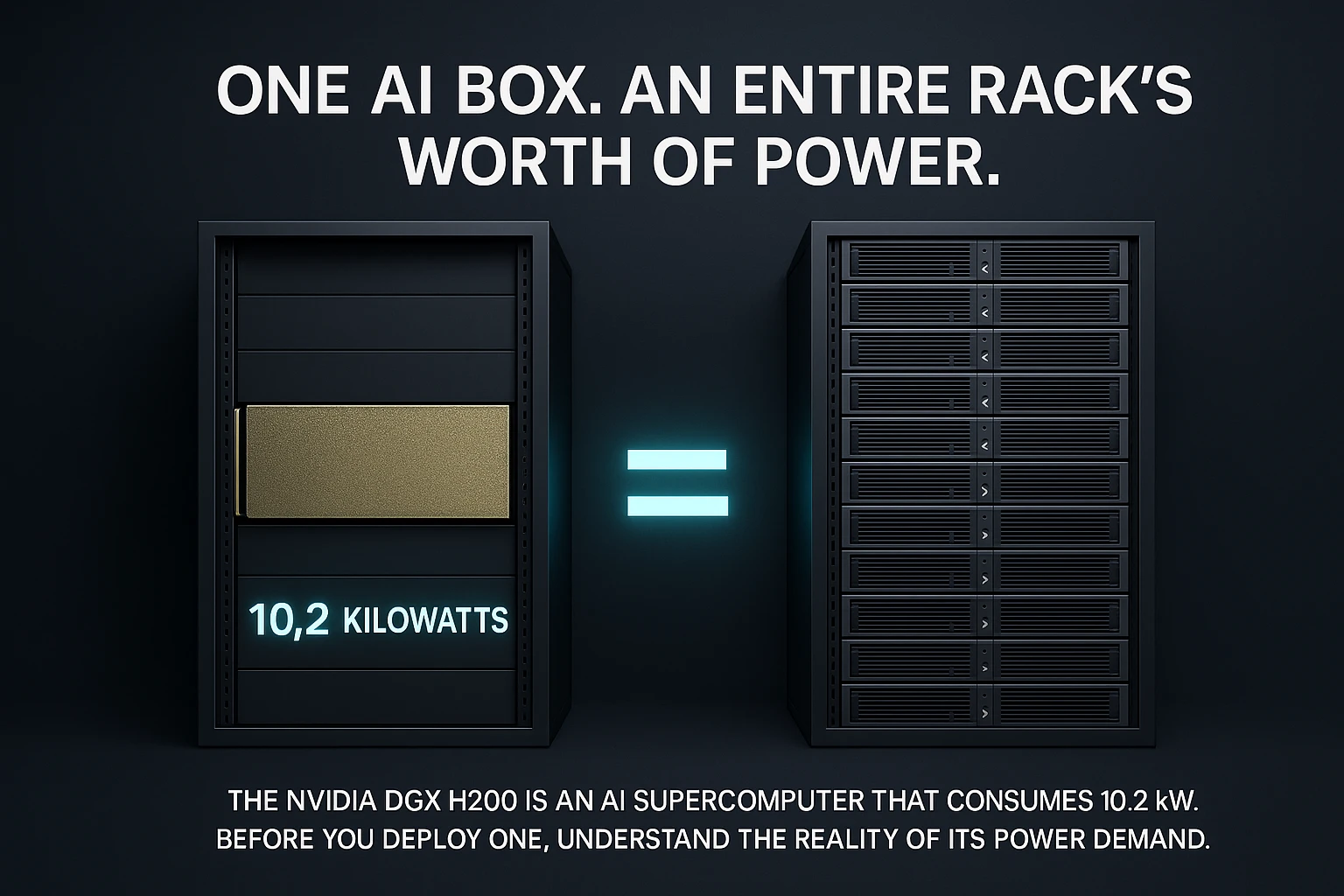
The system weighs around 130 kilograms, which is manageable in most enterprise data centers. Its power consumption is approximately 10.2 kilowatts (kW) during full operation. While this is substantial, it is still efficient for the kind of performance it delivers.
DGX B200: Larger Footprint with Higher Energy Demand
The NVIDIA B200-powered DGX B200 has a slightly larger physical footprint. It is a 10U rackmount system, which makes it about 444 millimeters in height. This allows more internal space for additional power delivery and thermal management, especially for the higher-performance B200 GPUs.
The system weighs about 142 kilograms, making it slightly heavier than the DGX H200. Its peak power consumption is around 14.3 kW, which reflects the increased GPU memory, CPU power, and faster interconnects that drive the system’s performance. This higher power draw requires careful planning in environments with limited electrical or cooling capacity.
7. Which Should You Choose: DGX H200 or DGX B200?
Choosing between NVIDIA H200 and NVIDIA B200 servers depends on your workload requirements, infrastructure readiness, and performance priorities. Both are powerful systems, but each is built to solve different AI challenges at scale.
Choose DGX H200 for Scalable Inference and HPC Workflows
The DGX H200 is a strong choice if your focus is on large-scale inference, scientific computing, or enterprise HPC (high-performance computing). It is powered by eight H200 GPUs and optimized for FP8 precision, which improves speed for AI inference tasks.
This system is also better suited if you are already running DGX-based infrastructure like SuperPOD environments. Its lower power usage (around 10.2 kW) and smaller footprint make it easier to deploy in existing data centers.
Choose DGX B200 for Generative AI and LLM Training at Scale
The DGX B200 is built for next-generation workloads like training large language models (LLMs), generative AI, and real-time inference. It includes eight B200 GPUs, which are based on the new Blackwell architecture and offer more memory (up to 1,440 GB total) and faster interconnect bandwidth.
With up to 144 petaFLOPS FP8 inference performance, this system is ideal for enterprises developing foundation models or AI services at scale. However, it requires more power (up to 14.3 kW), more rack space, and stronger cooling infrastructure.
If your goal is efficient inference and seamless integration into an existing NVIDIA stack, go with the DGX H200. If you need maximum AI training throughput and want to future-proof for the Blackwell generation, the DGX B200 is the way to go.
8. What Is the Future Outlook and Upgrade Path Beyond H200 And B200?
The NVIDIA H200 and NVIDIA B200 represent current high-performance standards in AI infrastructure. However, NVIDIA’s roadmap shows clear momentum toward even more advanced systems. These future platforms promise greater scalability, memory bandwidth, and computing power for next-generation AI workloads.
NVIDIA’s Architectural Roadmap: Blackwell and Beyond
The DGX B200 is already built on the Blackwell architecture, a major leap over Hopper. But NVIDIA is not stopping there. Systems like the GB200 Grace Blackwell Superchip combine Blackwell GPUs with Grace CPUs to deliver higher performance and memory throughput. Another upcoming system, the DGX GH200, is expected to offer over 16 TB of unified memory using NVLink, tailored for the largest models and data-intensive tasks.
Scalable Integration with DGX SuperPOD and BasePOD
Both NVIDIA H200 and NVIDIA B200 servers are designed as modular units that can scale into larger DGX SuperPOD or BasePOD environments. This means businesses can start with a few systems and expand as needs grow, maintaining compatibility with new GPU generations. It also ensures long-term value through an upgradeable architecture that keeps pace with AI innovation.
A Foundation for Tomorrow’s AI Factories
These servers are not just standalone machines. They are foundational blocks for building modern AI factories—large-scale data centers focused entirely on training and deploying AI models. With continued NVIDIA support and evolving software stacks like NVIDIA AI Enterprise, enterprises using H200 or B200 systems can confidently plan their upgrade paths into the future.
Conclusion
The NVIDIA H200 and NVIDIA B200 represent two of the most advanced AI servers available today. Both are purpose-built to support demanding workloads in modern data centers, but they serve slightly different needs depending on scale and performance goals.
The NVIDIA H200 is ideal for organizations focused on high-throughput inference, enterprise large language model (LLM) deployment, and high-performance computing (HPC) workloads. Powered by H200 GPUs with HBM3e memory and support for FP8 precision, it delivers excellent performance for AI inference at scale, while maintaining balanced power and physical requirements. It integrates well with DGX SuperPOD setups for scalable AI infrastructure.
In contrast, the NVIDIA B200, built on the next-generation Blackwell architecture, takes performance even further. It excels in training large AI models, real-time inference for generative AI, and handling complex AI pipelines. With up to 144 petaFLOPS of inference capability and 4 TB of system memory, it is optimized for the most demanding enterprise workloads.
In summary, choose the NVIDIA H200 if your focus is scalable, efficient inference, and HPC workflows. Choose the NVIDIA B200 if your business needs high-throughput AI training and full power from the latest GPU architecture. Both options are future-ready and designed to expand with evolving AI demands.




Unregistered User
It seems you are not registered on this platform. Sign up in order to submit a comment.
Sign up now